
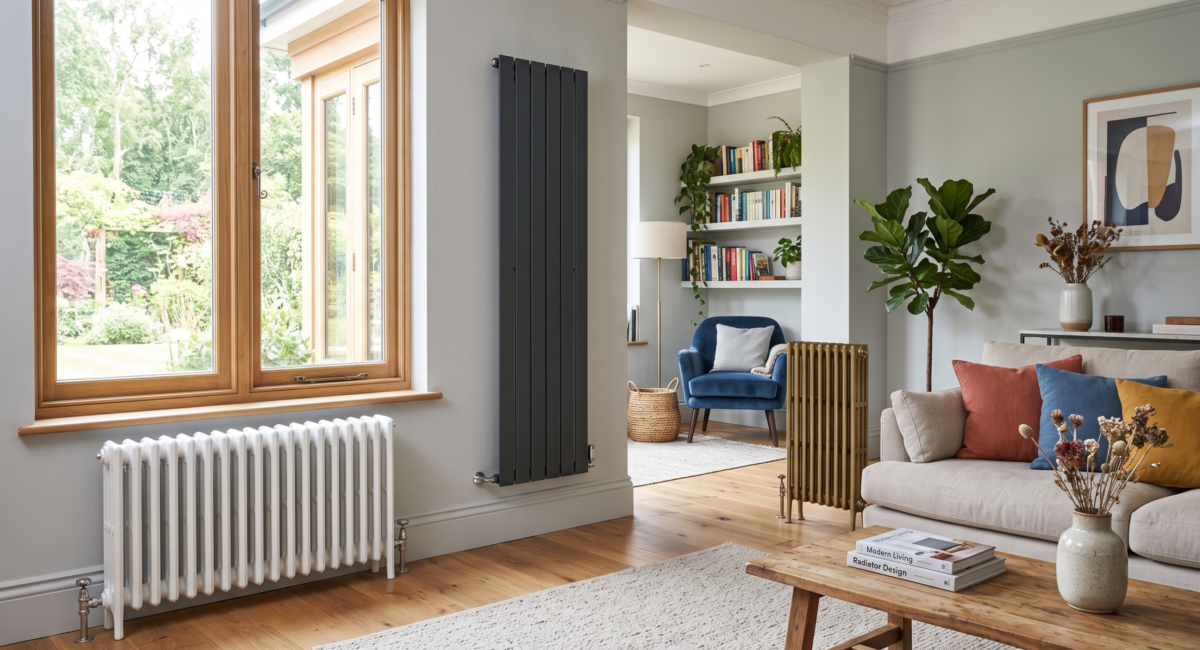
Radiators are the part of your heating system you see every day, but they’re often the last thing homeowners think about until a room won’t heat up properly or a renovation calls for a style refresh.
Whether you’re replacing a tired panel radiator or planning a full reheat of your home around a new boiler or heat pump, understanding how radiators work, what they’re made from, and how to size them correctly will save you money and cold rooms.
This guide covers the fundamentals: how radiators actually heat a room, the material options available, the designer styles worth considering, and, most importantly, how to size a radiator properly using BTU calculations.
How Radiators Actually Work
Despite the name, radiators heat a room mostly through convection, not radiation. Hot water from your boiler or heat pump flows through the radiator, warming the metal casing. Air in contact with the radiator’s surface heats up, rises, and circulates around the room, pulling cooler air in behind it to be warmed in turn. Only around 20–30% of the heat output is true radiant heat, the warmth you feel directly from the radiator’s surface, particularly if you stand close to it.
This is why radiator placement matters. A position under a window is traditional because it counters the cold air falling off the glass, creating a convective loop around the room rather than a cold spot. It’s also why radiators with more surface area – through fins, columns, or convector panels at the back – move more air and heat a room faster than a flat, single panel of the same physical size.
The water itself is heated centrally (by a boiler, heat pump, or other heat source) and pumped around a closed loop of pipework to each radiator, then returns to be reheated. The temperature this water runs at (the flow temperature) has a big impact on how radiators need to be sized, which matters a great deal if you’re switching from a gas boiler to an air-source heat pump.
Radiator Materials: Steel, Cast Iron, and Aluminium
Steel (Pressed Steel Panel Radiators)
By far the most common type in UK homes. Made from pressed steel sheets welded together, usually with one, two, or three panels and optional convector fins behind them.
Pros:
- Lowest cost by a wide margin
- Widely available in every size and configuration
- Heats up reasonably quickly due to relatively low water content
- Simple to install and replace like-for-like
Cons:
- Prone to internal corrosion if system water isn’t properly treated with inhibitor
- Shorter lifespan than cast iron (typically 10–15 years, though well-maintained systems can exceed this)
- Cools down fairly quickly once the heat source switches off
- The standard finish is a basic white enamel — limited style options at the budget end
Cast Iron
The traditional Victorian-style radiator is still manufactured new as well as reclaimed and restored from period properties.
Pros:
- Very high thermal mass — stays warm long after the heating switches off, giving a steadier, more even heat
- Extremely durable; original Victorian radiators are still in service well over a century later
- Aesthetic appeal for period properties and traditional interiors
- Resistant to the pinhole corrosion that affects pressed steel
Cons:
- Heavy — floor loading and lifting during installation are real considerations
- Slow to heat up, which can feel unresponsive if you like quick temperature changes
- Considerably more expensive than steel
- Less efficient to run with modern low-flow-temperature heat pumps unless sized generously, owing to the higher thermal mass needing more energy to get up to temperature
Aluminium
A less common but growing choice, particularly for heat pump retrofits and designer radiators.
Pros:
- Excellent thermal conductivity — heats up and responds to temperature changes faster than steel or cast iron
- Lightweight, easing installation
- Low water content, which suits systems where quick response is wanted
- Good compatibility with heat pumps due to efficient heat transfer at lower flow temperatures
Cons:
- More expensive than standard steel panels
- Cools down quickly once the heat source stops, a similar drawback to steel but more pronounced
- Fewer traditional style options compared with steel or cast iron
- Some models are less robust to knocks and impacts than steel
Designer Radiators: Styles and Trade-offs
Beyond the standard white steel panel, “designer” radiators cover a wide range of shapes built primarily around aesthetics, though the shape does affect performance too.
Horizontal Panel Radiators
The modern default replacement for a standard panel radiator — wider than tall, mounted under windows or along a wall.
Pros:
- Familiar heat distribution pattern, effective under windows
- Widest range of sizes and price points
- Easiest to size using standard BTU charts and manufacturer data
Cons:
- Requires sufficient wall width, which can be limited in smaller rooms
- Less visually distinctive than vertical or column styles
Vertical Radiators
Tall, narrow radiators that can run floor-to-near-ceiling height, popular in hallways, bathrooms, and rooms with limited wall width.
Pros:
- Makes efficient use of narrow wall spaces where a horizontal radiator wouldn’t fit
- Often available as a strong visual feature, not just a functional item
- Can output high heat for a small footprint, useful in tight spaces
Cons:
- Heat distribution is less even across a room compared with horizontal — heat rises up the vertical run rather than spreading widely
- Fewer suitable placement spots outside hallways, stairwells, and bathrooms
- Tend to cost more per BTU output than an equivalent horizontal panel
Flat Panel Modern Radiators
Slim, minimalist steel or aluminium panels, often in anthracite, matt black, or other contemporary finishes rather than gloss white.
Pros:
- Clean, unobtrusive look that fits modern interiors
- Widely available with the same performance characteristics as standard steel panels
- Reasonably priced compared with column or designer vertical options
Cons:
- Coloured finishes carry a price premium over standard white
- Slimline single-panel versions have lower output per unit of wall space than double- or triple-panel equivalents, so sizing needs care
Column Radiators (Modern and Traditional Style)
Vertical tubes or columns, either genuinely traditional cast iron or modern steel/aluminium versions styled to look similar.
Pros:
- High surface area relative to footprint, giving strong heat output
- Traditional cast iron column styles suit period properties well
- Modern column radiators offer the traditional look with lighter weight and faster response than genuine cast iron
Cons:
- Traditional cast iron versions are heavy, slow to heat, and among the most expensive options
- More surfaces and gaps between columns can gather dust, requiring more frequent cleaning
- Modern lightweight versions sacrifice some of the thermal mass benefit that makes genuine cast iron desirable in the first place
Sizing a Radiator: BTU and Room Heat Loss
A radiator that’s too small will never get a room to temperature on the coldest day of the year, no matter how high you turn the thermostat. Oversizing wastes money and can make a room uncomfortably hot before the thermostat catches up.
Getting the size right starts with calculating the room’s heat loss in BTUs (British Thermal Units per hour) — or in watts, if you’re working from more modern documentation, since 1 watt ≈ 3.412 BTU/hr.
Factors That Affect Required BTU Output
- Room dimensions. Length × width × height determines room volume, the starting point for any calculation.
- Room type. Living rooms and bedrooms are typically calculated at a lower watts-per-cubic-metre figure than kitchens or bathrooms, which need more headroom for heat loss through extractor use and higher ventilation rates.
- External walls and windows. Rooms with more external wall area, especially with large or single-glazed windows, lose heat faster and need a higher BTU allowance.
- Insulation levels. Well-insulated walls, lofts, and floors reduce heat loss significantly — an insulated Victorian terrace and an uninsulated one of the same dimensions can have very different requirements.
- Number of external doors. External doors lose more heat than a solid wall of the same area and are usually added as a flat allowance per door.
- Corner vs. mid-terrace positions. End-of-terrace and detached rooms have more exposed external walls than mid-terrace equivalents, increasing heat loss.
- Flow temperature of the system. This is the big one for heat pump retrofits. A radiator sized for a 70–80°C gas boiler flow temperature will underperform on a heat pump running at 45–55°C and typically needs to be roughly 1.5–2x larger in output to compensate; this is why heat pump installations often involve radiator upgrades as part of the job.
Basic BTU Sizing Method
A commonly used rule-of-thumb formula for a room with average insulation is:
Room volume (m³) × BTU factor = Required BTU/hr
Where the BTU factor varies by room type and insulation quality. This is a simplified approach. A full room-by-room heat loss survey (as installers use for MCS-compliant heat pump design) accounts for individual walls, windows, and doors separately and is considerably more accurate, especially where a heat pump is involved. For a straightforward like-for-like radiator replacement on an existing gas system, the rule-of-thumb approach is generally sufficient.
Radiator Sizing Chart (Approximate Guide)
The table below gives rough BTU/hr requirements by room type and size, assuming reasonable modern insulation and a standard gas boiler flow temperature. Poorly insulated or heat-pump-fed rooms should be sized toward the higher end, or ideally via a proper heat loss calculation.
Radiator sizing chart
Approximate BTU/hr requirements by room type and size
| Room type | Small ~10 m² |
Medium ~15 m² |
Large ~20 m² |
Extra large ~25 m²+ |
|---|---|---|---|---|
| Living room | 3,000–4,000 | 4,500–6,000 | 6,000–7,500 | 7,500–9,500 |
| Bedroom | 2,500–3,500 | 3,500–5,000 | 5,000–6,500 | 6,500–8,000 |
| Kitchen | 3,500–4,500 | 5,000–6,500 | 6,500–8,000 | 8,000–10,000 |
| Bathroom | 2,500–3,000 | 3,500–4,500 | 4,500–5,500 | 5,500–7,000 |
| Hallway / landing | 1,500–2,500 | 2,500–3,500 | 3,500–4,500 | — |
Figures shown in BTU/hr. Assumes reasonable modern insulation and a standard gas boiler flow temperature — poorly insulated rooms or heat pump systems should be sized toward the higher end, or ideally via a full heat loss calculation.
These figures are a starting guide, not a substitute for a proper heat loss calculation — particularly if you’re planning a heat pump installation, where accurate sizing at the correct flow temperature matters far more than with a gas boiler running at a higher temperature with more headroom to compensate for undersizing.
Radiator Cost and Size Guide
Prices vary considerably by brand, finish, and retailer, but the table below gives a realistic sense of where different radiator types sit in the market, from budget steel panels through to premium designer and cast iron options.
Radiator cost guide by type
Typical UK price ranges — unit cost only, excludes valves and installation
| Radiator type | Lower range | Mid range | Upper range |
|---|---|---|---|
| Steel panel single, white | £40–£70 | £70–£120 | £120–£180 |
| Steel panel double, white | £60–£100 | £100–£170 | £170–£250 |
| Flat panel modern coloured finish | £90–£140 | £140–£220 | £220–£350 |
| Horizontal designer panel | £90–£160 | £160–£280 | £280–£450 |
| Vertical designer radiator | £100–£180 | £180–£320 | £320–£550+ |
| Aluminium radiator | £120–£200 | £200–£350 | £350–£600+ |
| Modern column-style steel / aluminium | £150–£250 | £250–£400 | £400–£650+ |
| Traditional cast iron column | £250–£400 | £400–£700 | £700–£1,500+ |
Prices are for the radiator unit only. Larger sizes, taller vertical runs, and premium finishes will push any category toward the top of its range or beyond it.
Getting the Choice Right
For most homes, a straightforward steel panel radiator remains the sensible default: cheap, reliable, and easy to size using standard charts. Where a room is visually prominent or wall space is at a premium, a designer vertical or column radiator can solve a practical problem while improving the look of a room.
If you’re planning a heat pump installation, radiator sizing deserves particular attention: what worked comfortably on a hot gas boiler flow temperature may need upsizing to perform properly at the lower flow temperatures a heat pump runs at. A proper room-by-room heat loss calculation, rather than a rule-of-thumb chart, is the safest way to get this right before committing to new radiators.