

Ground source heat pumps (GSHPs) are one of the most efficient ways to heat a home, but they’re also one of the least understood. This guide breaks down how they work, what they cost, and whether one might suit your property — in plain language, without the sales pitch.
Table of Contents
- What Is a Ground-Source Heat Pump?
- How do they work?
- Types of Ground Loop: Horizontal vs Vertical
- Efficiency and SCOP
- GSHP Costs in the UK
- GSHP Pros and Cons
- Ground Source Heat Pump vs Air Source Heat Pump
- Are They Right for Your Home?
- Final Thoughts
What Is a Ground-Source Heat Pump?
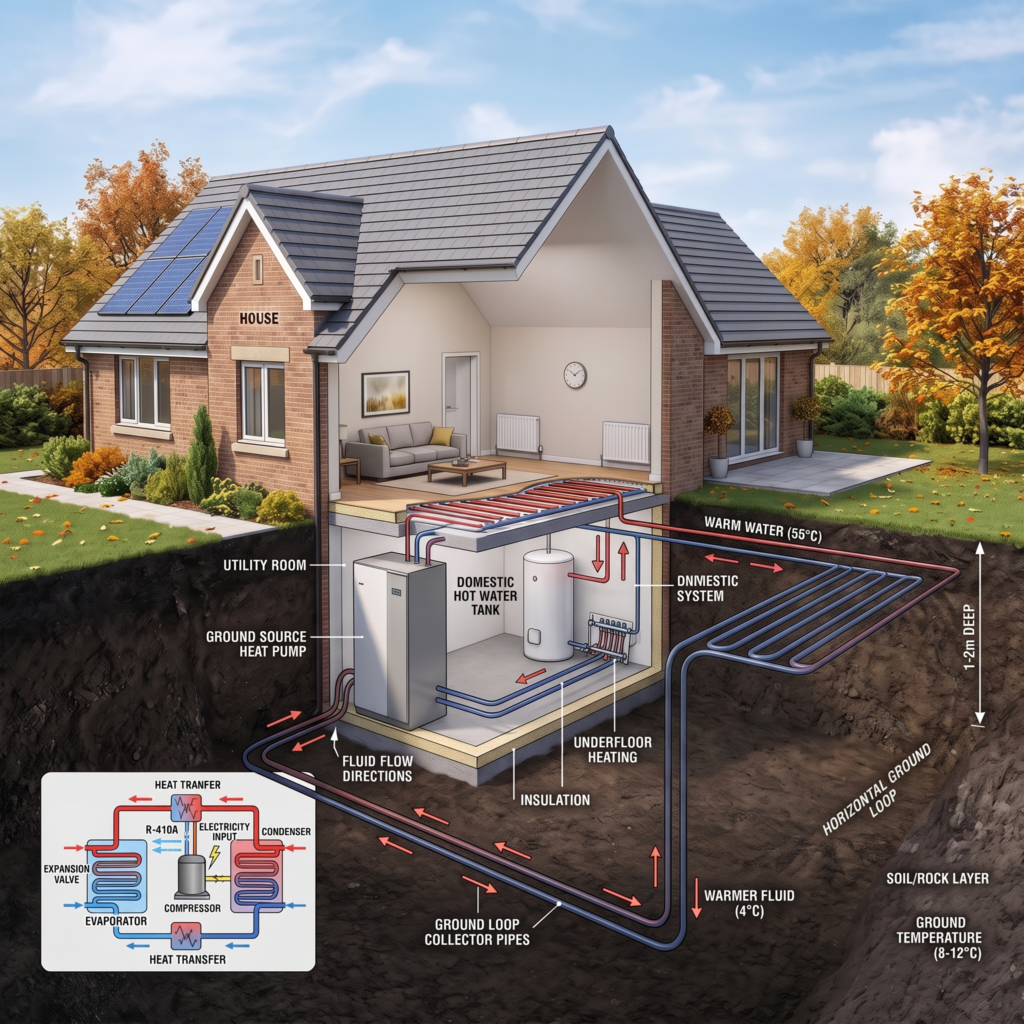
A ground-source heat pump extracts heat from the earth and uses it to warm your home and hot water. The ground a few metres down stays at a fairly constant 8–12°C all year round, even when the air above is freezing. A GSHP taps into that stored warmth and upgrades it to a useful temperature using a refrigeration cycle – the same basic principle as a fridge, but running in reverse.
Key points:
- GSHPs don’t burn fuel on site, so there are no combustion emissions at the property
- They use electricity to move heat, not generate it directly, which is why they’re so efficient
- The ground loop (the pipework buried outside) is the main thing that distinguishes a GSHP from an air source heat pump (ASHP)
How do they work?
The system has three main parts working together:
- The ground loop – a network of buried pipes filled with a water/antifreeze mixture, which absorbs low-grade heat from the soil or rock
- The heat pump unit – contains a compressor and refrigerant circuit that raises the temperature of the collected heat to a usable level
- The heat distribution system – usually underfloor heating (UFH) or larger radiators, plus a hot water cylinder for domestic hot water (DHW)
The cycle in simple terms:
- Fluid in the ground loop absorbs heat from the earth
- That warmed fluid passes through a heat exchanger, transferring heat to the refrigerant
- The refrigerant is compressed, which raises its temperature significantly
- This heat is passed to your heating system and hot water cylinder
- The refrigerant expands and cools, and the cycle repeats
Types of Ground Loop: Horizontal vs Vertical
The ground loop is usually the biggest factor in installation cost and disruption, and there are two main approaches.
Horizontal ground arrays:
- Pipes are laid in trenches roughly 1–2 metres deep
- Require a large plot of land — as a rough guide, two to three times the floor area you’re heating
- Generally cheaper to install than boreholes, since no specialist drilling rig is needed
- More disruptive to the garden during installation, though the area is usable again once loops are buried
Vertical boreholes:
- Pipes are inserted into boreholes drilled 50–150 metres deep
- Ideal where garden space is limited
- More expensive due to specialist drilling equipment and site access requirements
- Less land disturbance at the surface once complete
Efficiency and SCOP
Efficiency is usually expressed as SCOP (Seasonal Coefficient of Performance) — the ratio of heat output to electricity input averaged across a heating season.
- Well-designed GSHP systems typically achieve a SCOP of around 3.5–4.5
- This means for every 1kWh of electricity used, you get roughly 3.5–4.5kWh of heat
- GSHPs tend to have more stable, and often slightly higher, efficiency than ASHPs because ground temperatures don’t swing with the weather the way air temperatures do
- Actual efficiency depends heavily on system design, ground conditions, and how well the heat distribution system (UFH vs radiators) is sized
GSHP Costs in the UK
This is usually the deciding factor for homeowners, so it’s worth being realistic about the numbers.
- Installation costs are typically higher than ASHPs, largely due to the ground loop works
- Horizontal arrays and vertical boreholes both add significant cost compared with an ASHP’s simpler outdoor unit
- Running costs are usually lower than an ASHP over the system’s lifetime, thanks to the more stable ground temperature
- The Boiler Upgrade Scheme (BUS) grant is available for GSHP installations in England and Wales, which can offset a meaningful portion of the upfront cost
- MCS-certified installers and equipment are required to qualify for the grant
Because of the upfront cost difference, GSHPs tend to make the most financial sense in the following situations:
- New builds, where ground works can be planned in from the start
- Properties with large gardens or land available for horizontal arrays
- Renovation projects that already involve extensive groundworks
GSHP Pros and Cons
Advantages:
- High, stable efficiency regardless of outdoor air temperature
- Quiet operation — no outdoor fan unit, unlike an ASHP
- Long equipment lifespan; ground loops can last 50+ years, well beyond the heat pump unit itself
- No outdoor unit to consider for planning permission or permitted development restrictions
Drawbacks:
- Higher upfront installation cost than ASHPs
- Requires significant garden space (horizontal) or drilling access (vertical)
- Installation is more disruptive and takes longer
- Fewer installers are experienced with ground works compared with ASHP installation
Ground Source Heat Pump vs Air Source Heat Pump
A common question when comparing renewable heating options:
- Space: GSHPs need land for the ground loop; ASHPs just need outdoor unit clearance
- Cost: ASHPs are cheaper to install; GSHPs often cost less to run
- Noise: GSHPs have no outdoor fan, so they’re quieter than ASHPs
- Suitability: ASHPs suit most retrofit projects; GSHPs suit new builds or properties with space and budget for ground works
- Grants: Both are eligible for the Boiler Upgrade Scheme in England and Wales
Neither is universally “better” – it depends on your plot, budget, and how long you plan to stay in the property.
Are They Right for Your Home?
Before considering a GSHP, it’s worth checking:
- Do you have enough garden space for a horizontal array or budget for boreholes?
- Is your home reasonably well insulated? Like all heat pumps, GSHPs work best with lower flow temperatures, which suits good insulation and UFH or appropriately sized radiators
- Are you planning to stay in the property long enough to benefit from lower running costs offsetting the higher install cost?
- Have you got quotes from MCS-certified installers who can survey your ground conditions?
Final Thoughts
Ground-source heat pumps aren’t the right fit for every home, but where the land and budget allow, they offer some of the most stable, efficient heating available. The key is getting a proper site survey and heat loss calculation done before committing — groundwork isn’t something you want to redo.
This guide is intended as general information for UK homeowners researching heating options and isn’t a substitute for a professional site survey.