
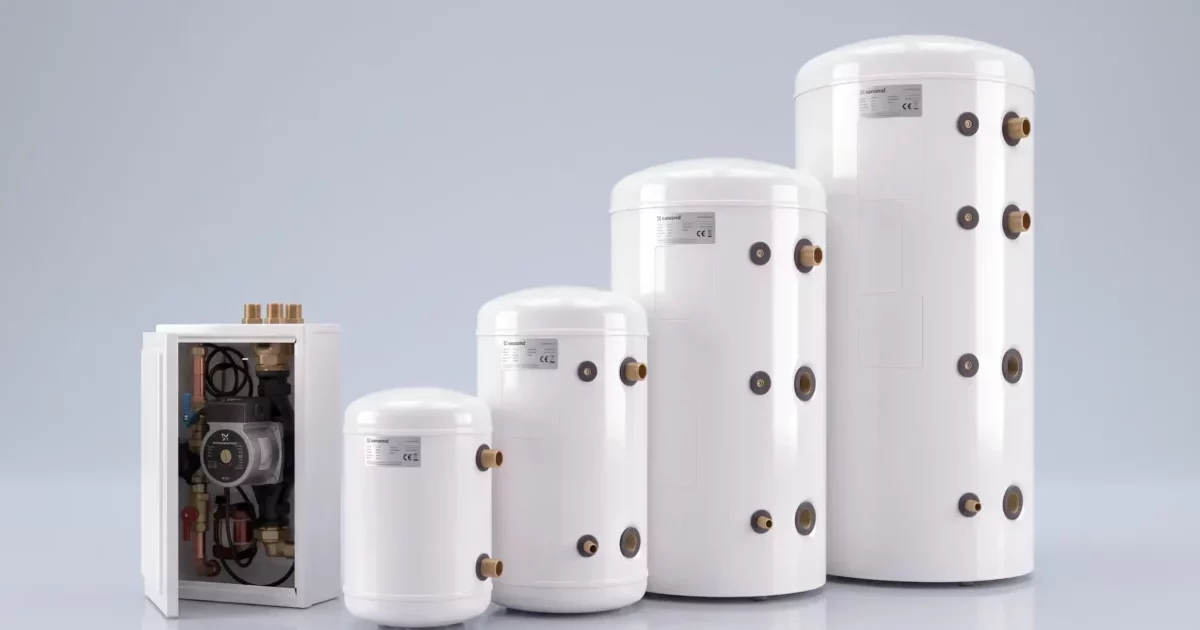
If you’ve been researching air source heat pumps, you’ve probably come across the term “buffer tank” and wondered whether you need one. It’s a good question; a buffer tank isn’t something most homeowners have ever had to think about with a gas boiler, and installers don’t always agree on when one is required.
This guide covers what a buffer tank does, when it earns its place in a system, how to size one, and what to check before it’s installed.
On this page
What is a buffer tank?
A buffer tank is an insulated vessel of water plumbed into the heating circuit between the heat pump and the property’s radiators or underfloor heating. It doesn’t heat water itself; it stores water that’s already been heated, adding thermal mass and volume to the system.
Think of it as a shock absorber for the heating circuit. Without one, a heat pump is directly exposed to whatever the rest of the system is doing: TRVs closing, zone valves shutting, and individual room thermostats being satisfied. A buffer tank sits between the two and smooths that out, storing excess heat produced by the heat pump so it’s available the moment demand picks back up, easing the strain that constant on/off cycling would otherwise put on the system.
How they improve heat pump efficiency
The efficiency case for a buffer tank comes down to two related problems: short-cycling and minimum flow.
Short-cycling. Heat pumps, like most heat sources, are least efficient when they’re constantly starting and stopping. Every start draws a spike of current to get the compressor moving, and the unit doesn’t reach its most efficient running state until it’s been going for a few minutes. If the heating circuit’s water volume is small, a common issue in modern, well-zoned homes with several rooms independently controlled by TRVs or smart thermostats, the heat pump can satisfy demand and shut off within a minute or two, then fire straight back up. A buffer tank adds volume and thermal inertia, so the heat pump runs in longer, steadier cycles instead.
Minimum flow rate. Heat pumps need a minimum flow rate of water across the heat exchanger to move heat away from the refrigerant circuit safely and efficiently. As a room’s TRVs close or zone valves shut off through the day, the flow available to the heat pump can drop below that minimum. A buffer tank, particularly in a 4-pipe, hydraulically separated configuration guarantees the heat pump always has an unrestricted loop of water to circulate through, regardless of what’s happening on the distribution side.
There’s a genuine trade-off here worth being upfront about: a buffer tank isn’t free efficiency. It introduces an extra pump (and its electrical draw) and some standing heat loss from the tank’s surface even when well insulated, and in some configurations it can push the heat pump to run at a slightly higher flow temperature than it otherwise would. The efficiency gain comes from more stable, longer compressor cycles.
Benefits of buffer tanks in heat pump systems
- Protects the compressor: fewer starts per hour means less mechanical wear and a longer service life
- Maintains minimum flow: keeps the heat pump running safely even when most of the distribution circuit is shut down
- Supports defrost cycles: gives the heat pump a store of warm water to draw on during an air-source unit’s defrost cycle, without dumping cold water into radiators
- Enables hydraulic separation: fully decouples the heat pump’s primary circuit from the distribution circuit’s pump, pipe sizing and pressure, simplifying design in larger or more complex systems
- Allows multiple heat sources: a buffer tank can act as a shared point of connection for a heat pump alongside solar thermal or a wood-burning stove with a back boiler
- Smooths out zoned heating: useful where a home has several independently controlled zones or rooms with heavy TRV use, which would otherwise restrict flow to the heat pump
Not every installation needs one. A correctly sized, modern inverter-driven heat pump paired with well-designed emitters and enough “unbuffered” system volume system designers often work to a rule of thumb of around twenty-five to thirty per cent of total system volume left uncontrolled, i.e., without TRVs, can often run efficiently without a dedicated buffer tank at all. It’s a design decision, not a default.
Buffer tank sizing for heat pumps
There’s no single official figure; different manufacturers and standards use different rules of thumb, and the right answer depends on the heat pump, the emitters, and how the system is zoned. That said, here’s how the commonly used guidance lines up.
As a simple starting point for a domestic air source system, 10–20 litres per kW of rated heat pump output is a reasonable planning figure, with the higher end of that range favoured for homes with heavy zoning, underfloor heating (which has lower water temperatures and less thermal mass per room), or a heat pump that struggles to modulate down at low loads.
Common off-the-shelf buffer tank sizes for domestic ASHP installations run 25, 50, 70, 100, 150 and 200 litres, with larger commercial and multi-heat-source vessels available well beyond that. Oversizing has a real cost too; a bigger tank means more standing heat loss, more floor space, and a higher flow temperature needed to “charge” it, so it’s not simply a case of bigger being better.
Installation considerations
A good installation design should consider the following when deciding on a buffer tank:
- Building heating demand
- Building hot water demand
- Existing system size and type
- Existing radiator pipe size
- Existing system flow rates
- Number of heating zones
- Heat pump size
- Types of heating controls
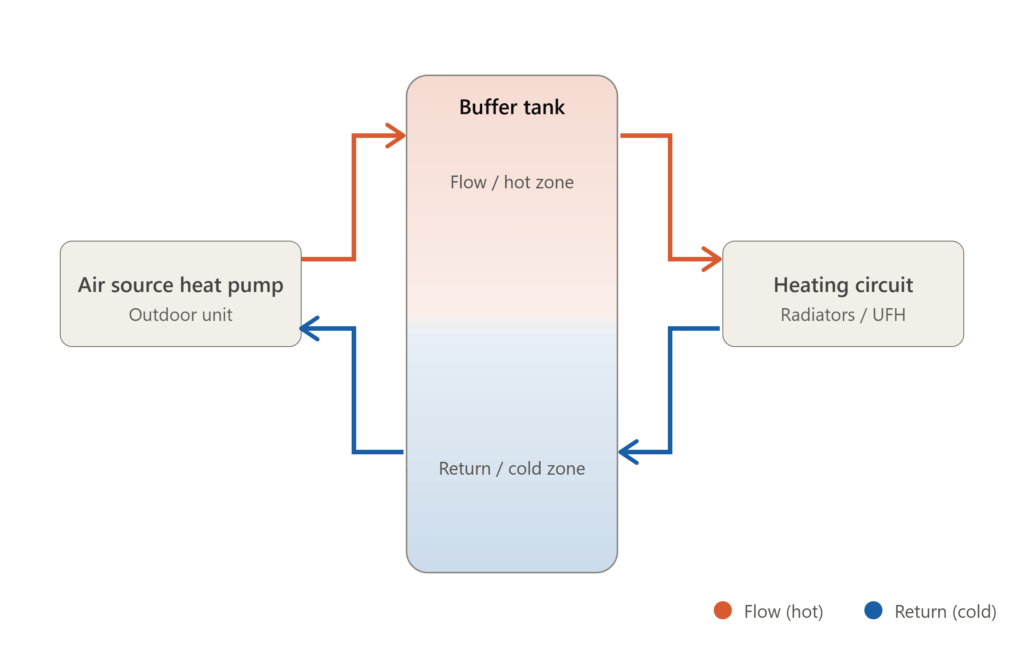
2-pipe vs 4-pipe configurations
2-pipe configuration. (in-line) buffer sits directly in the flow and return pipework, with the heat pump and distribution circuit sharing the same water. This is commonly known as a volumiser.
4-pipe configuration. Provides full hydraulic separation: the heat pump has its own primary pump and loop into the tank, and the distribution circuit has a separate pump and loop out of the tank. The diagram above shows the 4-pipe arrangement, which is the more common approach where flow rates or pipe sizes differ significantly between the heat pump and the emitters.
Position in the system. The buffer should sit between the heat pump and the point where the distribution circuit branches off to radiators, underfloor manifolds, or a hot water cylinder’s diverter valve, not downstream of controls that could restrict flow back to the heat pump.
Insulation. Buffer tanks lose heat continuously from their surface, so factory-insulated units (or a well-fitted insulation jacket on-site) matter more than they might for a hot water cylinder that’s only heated intermittently. Where possible, siting the tank within the heated envelope of the building means any standing losses still contribute to space heating rather than being wasted.
Sensor and control placement. The heat pump’s flow and return sensors need to be positioned correctly relative to the buffer so the unit isn’t tricked into thinking demand is satisfied when it isn’t. It’s a common cause of a heat pump that seems to “give up” early, especially where a secondary heat source feeds into the same tank.
MCS compliance. For UK installations claiming Boiler Upgrade Scheme funding, the buffer tank and its pipework still need to be installed in line with MCS requirements, worth flagging to installers rather than treating the buffer as an afterthought bolted on outside the main system design.
Do you need a buffer tank?
As a rough guide for readers:
- Likely yes: multiple heating zones with TRVs on every radiator, underfloor heating with several manifold zones, a non-inverter or poorly modulating heat pump, or plans to connect a second heat source later
- Possibly not needed: a modern inverter-driven heat pump with good turndown, generously sized emitters, and enough of the system left uncontrolled to maintain flow without one
Conclusion
With the correct integration, buffer tanks can improve system efficiency and stability, offering long-term savings on energy consumption and maintenance costs alongside their immediate benefits.
Ease of integration with your existing heat pump system is worth factoring in too; some tanks come with features that simplify installation and connectivity, making them more appealing if you’re planning an upgrade or a new installation. Smaller buffer tanks can also come as part of a kit that sits directly on top of or underneath the hot water cylinder, saving space while giving a more integrated look. If you’re replacing the cylinder at the same time, our comparison of the best hot water cylinders for heat pump systems covers the models I’d shortlist.