
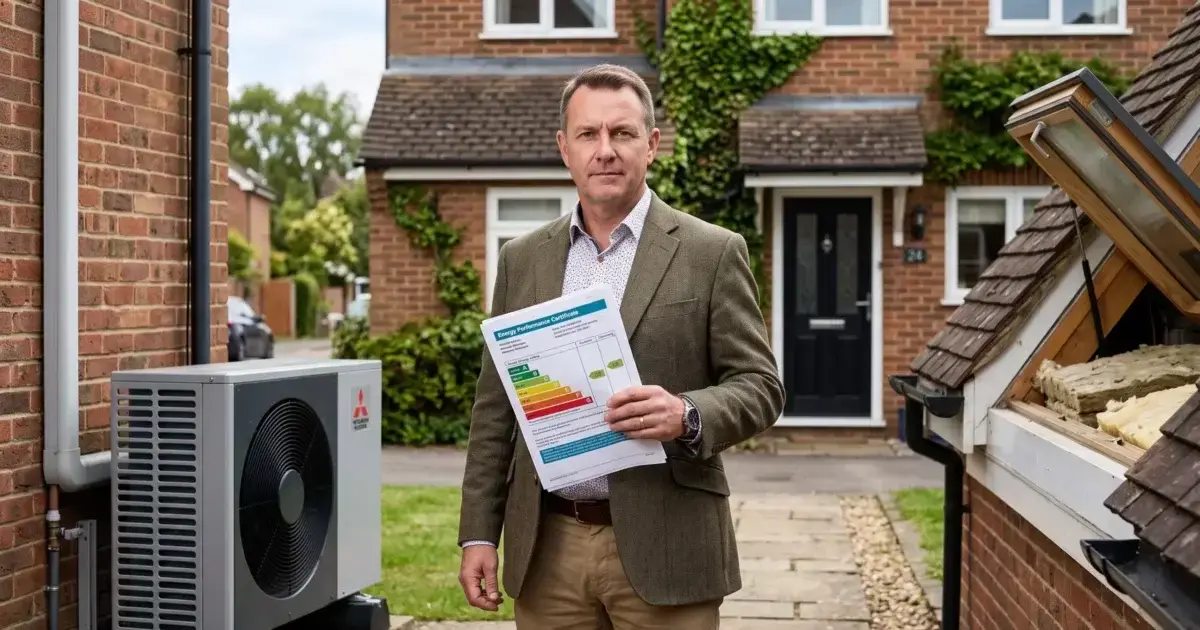
If you’re a landlord trying to get a property from D or E up to C within a realistic budget, the obvious instinct might be to jump straight to a heat pump. It’s the headline-grabbing upgrade, and it’s the one with a grant attached. But under today’s EPC methodology, it’s often not the cheapest, or even the most reliable, way to move the needle within the proposed £10,000 cost cap. Here’s what the numbers show:
| Measure | Typical cost | Typical SAP point gain | Rough cost per point |
|---|---|---|---|
| Heating controls upgrade | £200–£500 | 3–8 | ~£40–£100 |
| Loft insulation top-up | £300–£600 | 5–10 | ~£40–£90 |
| Cavity wall insulation | £800–£2,500 | 10–15 | ~£65–£165 |
| Double glazing | £4,000–£8,000 | 3–8 | ~£700–£1,750 |
| Solid wall insulation | £5,000–£10,000 | 10–20 | ~£400–£750 |
| Air source heat pump | £8,000–£15,000 (before BUS grant) |
10–30 (highly variable) |
~£270–£1,500 |
Figures are typical industry ranges, not guarantees: the actual gain from any measure depends heavily on your property’s starting point and what’s being replaced. Always get a property-specific Recommendations Report from an accredited assessor before committing budget.
Why a heat pump doesn’t automatically fix your EPC
This is the part that surprises a lot of landlords: today’s EPC calculation isn’t purely about efficiency; it factors in the cost of running the system, using fuel price assumptions baked into the methodology. Electricity has historically cost several times more per kWh than gas, so even though a heat pump can produce three or four units of heat per unit of electricity it uses, that running-cost penalty can cancel out a meaningful chunk of the efficiency gain in the score itself. The result is genuinely variable: replacing a very old, inefficient oil or LPG boiler with a heat pump can produce a big jump, while replacing a reasonably modern gas boiler sometimes barely moves the rating at all or even nudges it the wrong way. The range you’ll see quoted (10 to 30 SAP points) reflects that real variable.
Fabric first: why insulation usually wins
Loft top-ups and cavity wall insulation don’t have that running-cost complication working against them: they simply reduce how much heat escapes, and the EPC calculation rewards that predictably. They’re also cheaper. A loft top-up at £300 to £600 delivering 5 to 10 points works out to somewhere around £40 to £90 per point, genuinely hard to beat with anything else on this list.
Where the money doesn’t stretch as far
Not every fabric measure is good value purely for EPC purposes. Double glazing is the clearest example: it’s expensive (£4,000 to £8,000) for a comparatively modest point gain, often £700 to £1,750 per point, which is poor value if EPC compliance is your main goal rather than comfort or noise reduction. Solid wall insulation sits in similar territory: a genuinely useful measure for an uninsulated solid-wall property, but expensive enough per point that it’s rarely the first thing worth doing.
So does a heat pump make sense at all?
Yes, just not necessarily as your first move for hitting C cheaply today. Two things change the calculation: the Boiler Upgrade Scheme grant covers £7,500 of the cost, which dramatically improves the cost-per-point maths once you factor it in, and the EPC calculation itself is changing. Under the Home Energy Model that’s replacing the current system, heating system performance becomes its own dedicated metric rather than being blended into an overall cost calculation, which is expected to reward heat pumps more consistently than today’s approach does. A heat pump installed now may not be the cheapest route to C under today’s rules, but it’s a reasonable hedge against the rules that are coming.
A sensible order of operations within £10,000
Start with a fresh recommendations report specific to your property rather than relying on generic figures, since the actual gain from any measure genuinely depends on what you’re starting from. From there, the pattern that tends to work well is cheap fabric and controls measures first (often well under half the £10,000 cap), reassess where that leaves you, and only then decide whether a heat pump is needed to close the remaining gap or worth doing anyway given the grant and where the rules are heading.
FAQs
Will a heat pump definitely improve my EPC rating?
Not reliably under today’s methodology. It depends heavily on what it’s replacing: bigger gains are typical when replacing an old oil or LPG system, smaller or inconsistent gains when replacing a modern gas boiler.
Is double glazing worth it for EPC purposes?
Usually not as a first step. It’s expensive relative to the SAP points it typically delivers, so cheaper fabric measures tend to make more sense first if EPC compliance is the main goal.
Should I wait for the Home Energy Model before deciding?
Not necessarily. Cheap fabric measures are worth doing regardless of which methodology assesses them. The heat pump decision is the one worth weighing against the upcoming changes specifically.
How do I know which measures my specific property needs?
Get a Recommendations Report from an accredited EPC assessor. It’s tailored to your actual property rather than generic averages, and it’s the only reliable way to know your real starting point.
Final thoughts
The honest answer is that insulation is usually the cheapest route to EPC C today, but “cheapest today” and “best long-term decision” aren’t quite the same question. Do the fabric measures first because they’re reliably good value regardless of what else happens; decide on the heat pump with the grant and the coming methodology change in mind, not purely on today’s EPC arithmetic.