
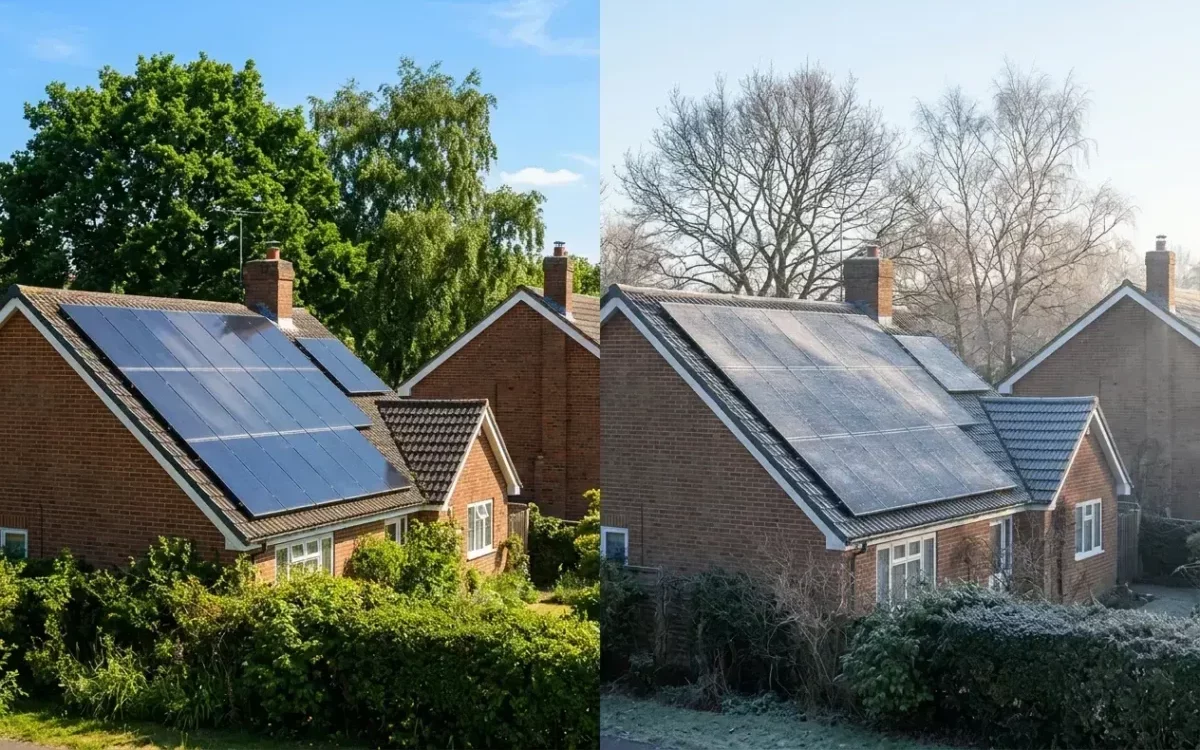
Solar panels can supply part of a heat pump’s electricity, but not most of it over a full year. Output peaks between May and August, when a house needs almost no space heating, and falls to a fraction of that between November and February, when the heat pump is working hardest. For most UK homes the realistic aim is to cover hot water for much of the year, space heating in spring and autumn, and the odd bright winter afternoon.
This article sets out which jobs line up with your generation, which timing tools earn their cost, and how to check your own figures instead of trusting a sales estimate.
Solar and heat pumps in short
- Solar covers part, not most, of a heat pump’s electricity over a year: output peaks in summer, heating demand in winter.
- Hot water is the best match. Schedule the cylinder to heat at midday, including the legionella cycle.
- Spring and autumn give real overlap; deep winter gives very little.
- Keep weather compensation on. Chasing solar with high flow temperatures loses more than it saves.
- Fit the cheap controls first, measure a few months, then decide whether a battery or diverter pays.
Why solar output and heat demand pull in opposite directions
A typical UK array produces the bulk of its annual yield in the six months from April to September. In December it may produce very little, and most of that arrives in a few hours around midday. Heating demand follows the reverse pattern, and it is highest on the cold, dark mornings and evenings when the panels produce nothing.
| Time of year | Solar output | Heat pump demand | What solar can realistically cover |
|---|---|---|---|
| December to February | Very low, mostly around midday | Highest, with morning and evening peaks | Little: some hot water on bright days |
| March, April, October, November | Moderate | Moderate, mostly mornings and evenings | Hot water and some daytime heating |
| May to September | Highest | Hot water only | Most of the hot water; the rest of the surplus is exported unless stored or diverted |
There is a second mismatch within each day. Panels peak around midday, while a household’s heat demand peaks early morning and early evening. Unless you are home during the day with the heating on, much of the midday generation arrives when the house does not need it.
A heat pump does not fix this by being efficient. It delivers several units of heat for each unit of electricity, which lowers the amount of solar you need, but the timing problem remains. A winter’s heating load, even at that efficiency, is more than a modest array can meet in the months it is needed.
Where the overlap is: hot water, spring and autumn, and mild winter days
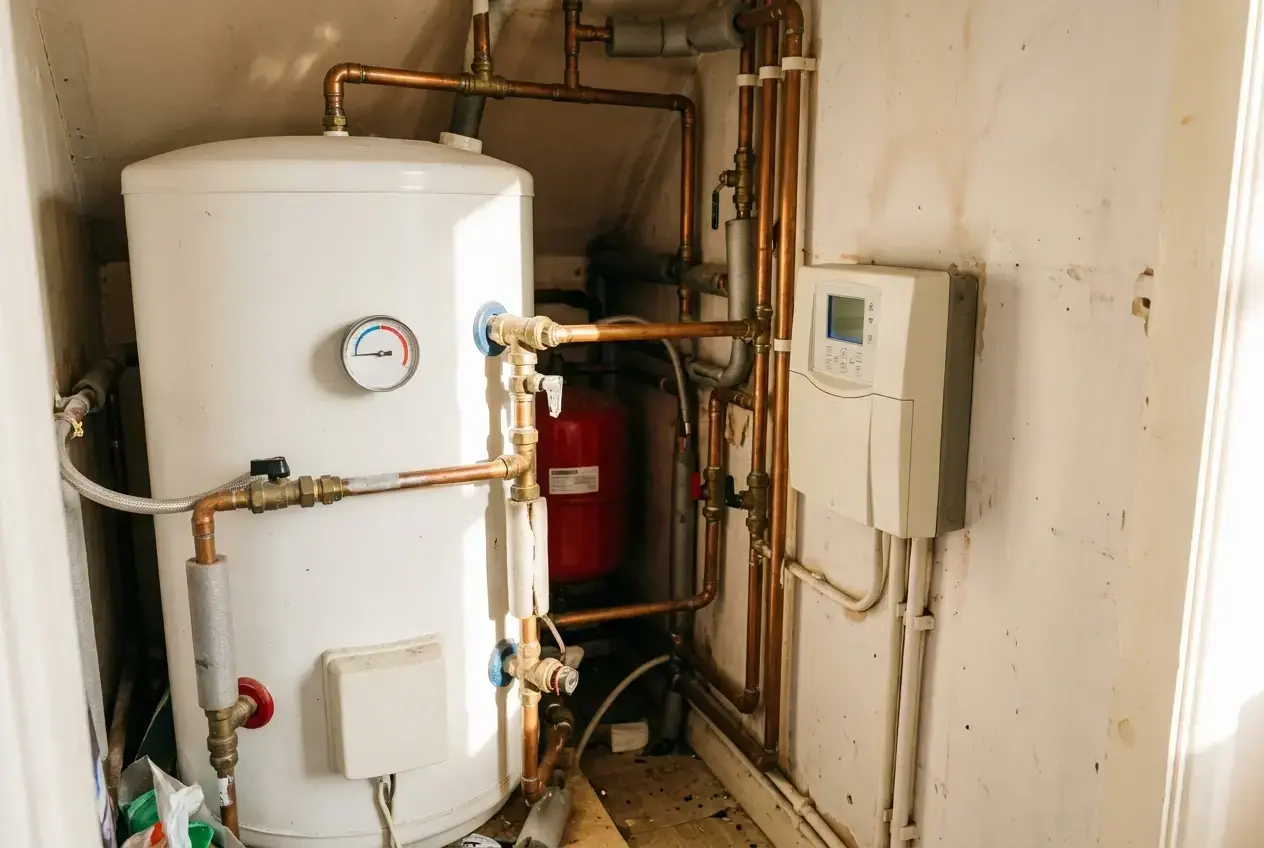
Hot water is the best match. A cylinder needs heating all year, so there is demand in July as well as January, and it is flexible: the water can be heated at midday and used in the evening. For many households, hot water is where a heat pump and solar work best together.
Spring and autumn are the second area. In March, April, October and sometimes November, days are cool enough to need some heating but bright enough for useful solar. A heat pump running at low output through the middle of the day can draw much of its power from the roof. Well-insulated homes see more of this, because their heating season is shorter and their daytime heat demand is lower.
Mild winter days give some further overlap. A clear, bright January day can produce a worthwhile midday yield, though a typical grey one will not. You should treat those days as a bonus rather than something to plan around.
Three things sit outside the overlap:
- Cold, still, overcast winter weeks, which are common and account for a large share of annual heating demand.
- Early morning and evening heating peaks, which fall outside generation hours.
- Summer generation beyond what the hot water cylinder can absorb, which goes to the grid unless you have other uses for it.
Timing the heat pump: cylinder scheduling, pre-heating and weather compensation settings
Cylinder scheduling is the cheapest timing tool because it only needs a change to the controls. Most heat pumps let you set when the hot water cycle runs. Moving it to late morning or early afternoon, when the panels are producing, means the cylinder is heated mainly from solar rather than from the grid.
Heat pump cylinders also have a periodic higher-temperature cycle to control legionella, which often relies on the immersion heater. If that cycle runs in the small hours, it draws grid electricity at the least efficient point in the system. Ask your installer whether it can be moved to midday, so it uses surplus solar.
Pre-heating the house works on the same principle. In spring and autumn, you can let the heat pump raise the house temperature slightly in the afternoon while solar is available, then let it coast into the evening. This only works well in a house that holds heat. A poorly insulated or leaky home loses it too fast for it to be worth much. A house with underfloor heating in a screed stores heat well but responds slowly, so any pre-heating needs to start earlier in the day.
Weather compensation, which adjusts the flow temperature to the outdoor temperature, matters for a different reason. It keeps the heat pump running steadily at a low flow temperature, which is the efficient way to operate. Do not abandon it in order to chase solar. A heat pump pushed to higher flow temperatures for a short burst of midday heating will lose more efficiency than the solar saves. The settings that matter on cold days are covered in heat pump efficiency tips for winter, and the solar timing should sit on top of those, not replace them.
One limit to be aware of: a heat pump does not follow a fluctuating surplus closely. Its compressor has a minimum output, so on a patchy day it will draw more than the solar is producing at that moment, and the shortfall comes from the grid. Scheduling improves the share of solar you use. It does not make the heat pump run on solar alone.
Do you need a battery, a solar diverter, or neither?
The answer depends on what you want to do with the surplus.
| Option | What it does | Relative cost | Best for | The catch |
|---|---|---|---|---|
| Scheduling only | Runs hot water and pre-heating in generation hours | None | Every solar and heat pump home | Cannot store anything for the evening |
| Solar diverter | Sends surplus to the immersion heater | Low | Homes with a lot of summer surplus | Heats water at 1 unit of heat per unit of electricity, not the heat pump’s 3 or more |
| Battery | Stores midday surplus for the evening | High | Evening hot water and heating in spring and autumn, plus cheap overnight charging on a smart tariff | Rarely full in winter, when the heat pump uses most |
| Neither | Exports surplus under the Smart Export Guarantee | None | Homes with a good export rate and little surplus | Earns less per unit than using it yourself at the daytime rate |
A solar diverter sends surplus generation to an immersion heater in the cylinder instead of exporting it. It is a lower-cost device than a battery, and it suits homes with a lot of summer surplus. The catch with a heat pump is that the cylinder is already heated by the heat pump, which is a far more efficient way of making hot water than an immersion element. Using a diverter to heat the cylinder electrically with surplus solar means you are using the solar at an efficiency of one unit of heat per unit of electricity, rather than the several the heat pump provides. It is still better than exporting at a low rate, but it is not as good as scheduling the heat pump to use the same solar. A diverter is most useful once the heat pump’s own cycle has already finished heating the cylinder and there is still surplus, or in summer when you have more solar than the heat pump will use.
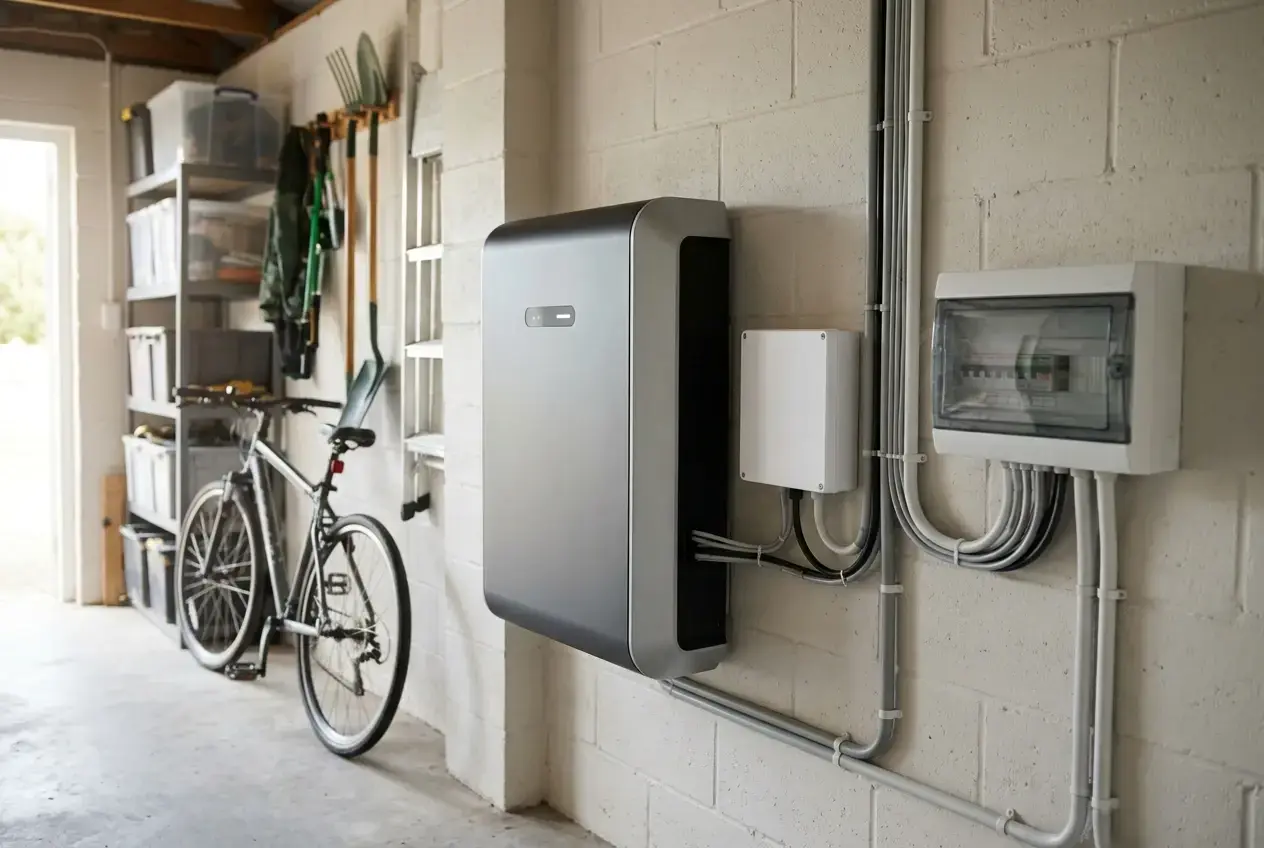
A battery stores midday surplus and releases it in the evening. For a heat pump household, that covers the evening hot water draw and some early evening heating. A battery is most valuable between spring and autumn, when there is surplus to store. In December, the battery is rarely full, and in most homes it will mostly be charged from solar for lighting, cooking and appliances, with the heat pump taking a small share. A battery also earns more when paired with a smart tariff that lets it charge cheaply overnight, because it can then cover the heat pump’s peak-rate hours all year, not only in the sunny months.
Neither is a reasonable choice. If you have good scheduling controls and an export rate you are happy with, the extra cost of a diverter or battery may not be recovered. Fit the cheap controls first, measure a few months of data, and add hardware only if the figures show a surplus going spare.
Smart tariffs, export rates and when selling back beats using it yourself
Self-consumption has a value, and so does export, and the two are not equal. Each unit of solar you use saves you the price of the unit you would have bought. Each unit you export earns the export rate, usually paid under the Smart Export Guarantee, and that rate varies a great deal between suppliers.
The comparison turns on what you would otherwise have paid. If you would have bought that electricity at a standard daytime unit rate, using your own solar is worth more than exporting it. If you would have heated the cylinder overnight on a cheap off-peak rate, the saving from using solar is smaller, and it may be close to the export rate you could earn. In that case the gap between self-use and export is small, and the extra work of shifting loads buys little.
| If you would otherwise buy that electricity at | Using your own solar is worth | Compared with exporting it |
|---|---|---|
| A standard daytime rate | The full unit rate you avoid | Usually much better |
| A cheap off-peak or overnight rate | Only that low rate | Often close to the export rate, so shifting loads gains little |
| A peak rate on a time-of-use tariff | The higher peak rate | The best use of solar, or of a battery |
A time-of-use tariff changes the arithmetic in three ways:
- Cheap overnight or off-peak periods let the heat pump, or a battery, take grid power at a low price when solar is unavailable.
- Some tariffs pay a higher export rate when you meet certain conditions, so check the terms before assuming a number.
- Tariffs that require a particular battery, inverter or smart meter setup can limit your choice of equipment, so check compatibility before you buy.
Compare tariffs using your own half-hourly data rather than the headline unit rates. A tariff that looks cheapest on paper may not suit a household that heats mostly in the evening. Our guide to the best electricity tariffs for heat pump owners compares the main options.
Sizing the solar array and heat pump together, and what to tell your installer
Solar and heat pumps are often quoted by separate companies, which means nobody designs the two as one system. A few decisions are worth making together:
- Annual electricity use. A heat pump will add a large amount to your current consumption. If you are building new, our guide to solar PV on new builds covers what the Future Homes Standard requires. Size the array against the combined figure, not just what you use now.
- Roof orientation. South-facing gives the highest midday peak. East-west splits generation across morning and afternoon, which can match a household’s heat and hot water pattern better, at the cost of a lower peak.
- Cylinder size. A larger cylinder stores more solar-heated water, but it also loses more heat while standing. Ask your installer to size it to your household’s use.
- Occupancy. If the house is empty from 8am to 5pm, much of your generation will be exported unless a battery or scheduling covers the gap.
- Future loads. An electric vehicle or a battery added later changes how much surplus you have. Say so now, so the inverter and grid connection are specified to allow for it.
- Grid connection. Most domestic systems, with an inverter of up to about 3.68 kW per phase, only need the installer to notify the local network operator after fitting. Larger arrays, and some combinations of solar and battery, need approval before connection, which can take weeks. Your installer should handle it, but ask who is responsible.
If you already have panels, give the installer your generation data and your inverter details. If you are planning solar, tell the heat pump installer before the design is fixed. Heat pump quotes that ignore the solar are a missed opportunity to put the cylinder controls in the right place.
How to measure your own self-consumption, so you stop guessing
Self-consumption is the share of your generation that you use in the house, rather than export. The calculation is simple: generation minus exported units, divided by generation. Most inverter apps show generation, and your smart meter or supplier app shows export.
Self-consumption = (generation − export) ÷ generation
For example, if the panels produced 3,400 kWh in a year and you exported 1,900 kWh, you used 1,500 kWh in the house: a self-consumption of about 44%.
Generation comes from your inverter app; export comes from your smart meter or supplier app.
For a heat pump you also want to know how much of its electricity came from solar. That is harder, because the heat pump’s draw and your generation are measured separately. Many heat pumps report their own electricity use in their app, and a clamp-on monitor or a sub-meter on the heat pump’s circuit gives you the same figure. Compare the two by hour, and you can see how much of the heat pump’s running time fell within your generation hours.
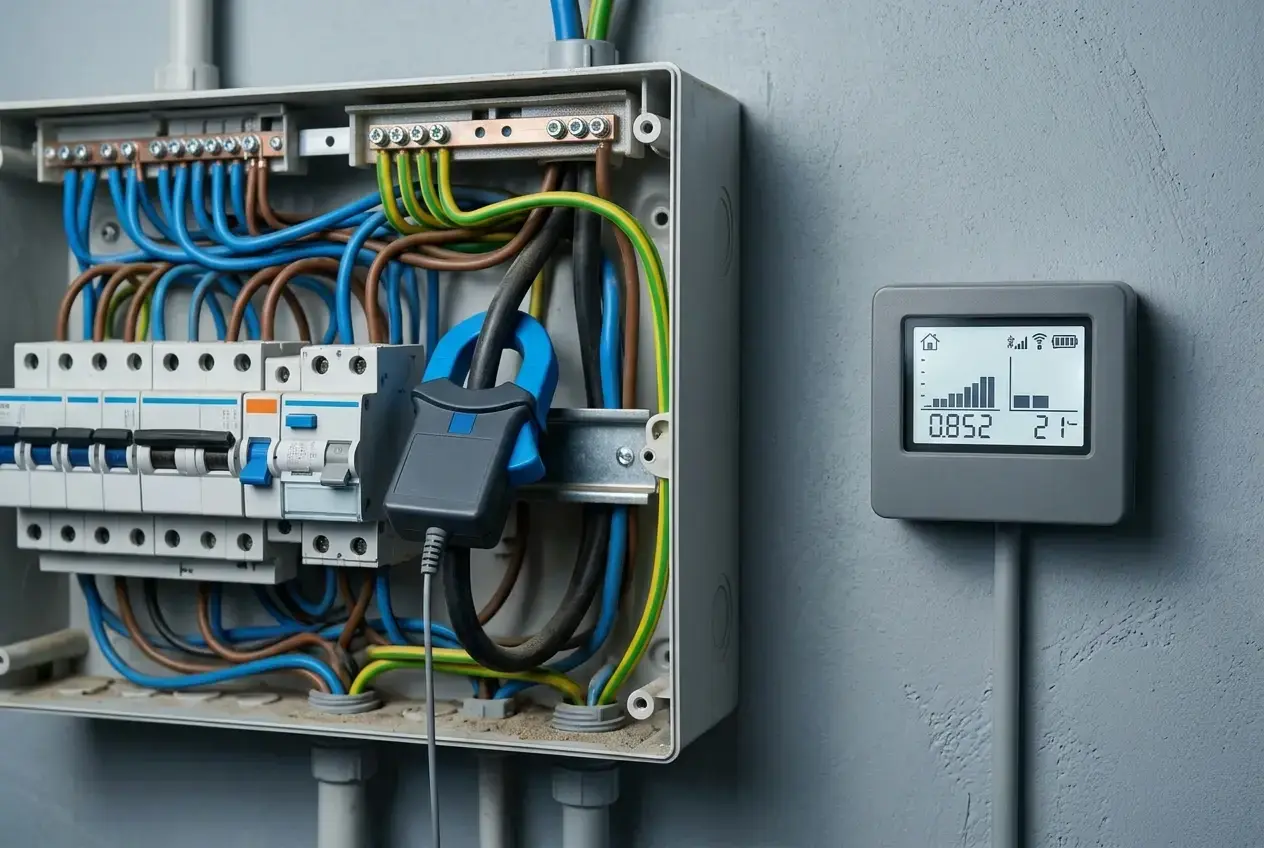
Check three things over a few months:
- How much of your generation you are exporting in summer, which shows whether a diverter or battery has anything to work with.
- When the heat pump runs hot water cycles, and whether they fall in generation hours.
- What you pay on the evening and overnight units, which shows what a battery would have to replace.
A comparison of the apps that do this well is in best energy monitor apps for tracking your heating costs.
When solar and a heat pump together is not worth the money
The two are separate investments, and each should justify itself on its own figures. A few situations make the combination hard to justify:
- A shaded or poorly oriented roof, where generation is low in the shoulder months you most want it.
- A very small heat demand, such as a well-insulated flat, where the heat pump’s electricity use is low enough that solar adds little to it.
- A household that is out all day with no battery and no way to schedule loads, so most generation is exported at a low rate.
- Money better spent elsewhere. If the home still has poor insulation, draughts or undersized radiators, fixing those lowers the heat pump’s running cost more cheaply than adding panels.
If your reason for adding solar is mainly to cut heating bills, check how much of that saving the heat pump delivers on its own. The comparison of fuel costs over a decade is in heat pump or gas boiler: what ten years of running costs look like, and it makes a useful baseline before you add the cost of an array.
Solar and heat pump questions
Can solar panels run a heat pump in winter?
Only a little. In December and January a typical UK array produces a small fraction of its summer output, mostly around midday, while the heat pump works hardest in the mornings and evenings. Expect solar to cover some hot water on bright days rather than the heating.
What size solar array do I need for a heat pump?
There is no size that covers it all year. Size the array against your total electricity use including the heat pump, and expect it to cover much of the hot water from spring to autumn and some spring and autumn heating.
Is a battery worth it with a heat pump and solar?
It can be, mainly between spring and autumn and when paired with a smart tariff for cheap overnight charging. In midwinter it is rarely filled by solar. Fit the scheduling controls first and measure before you buy one.
Should I use a solar diverter with a heat pump?
Only for surplus the heat pump cannot use. A diverter heats water with the immersion element, which is far less efficient than letting the heat pump heat the cylinder at midday. It is most useful in summer once the heat pump’s own cycle has finished.
Do I need permission to connect solar panels?
Your installer must notify the local network operator. Most domestic systems fall under a simple notify-after-fitting process; larger arrays, or solar with a battery above that size, need approval before connection.
If you have solar panels, or plan to fit them, say so when you request a heat pump quote, so the installer designs the hot water cylinder and controls around your generation.