
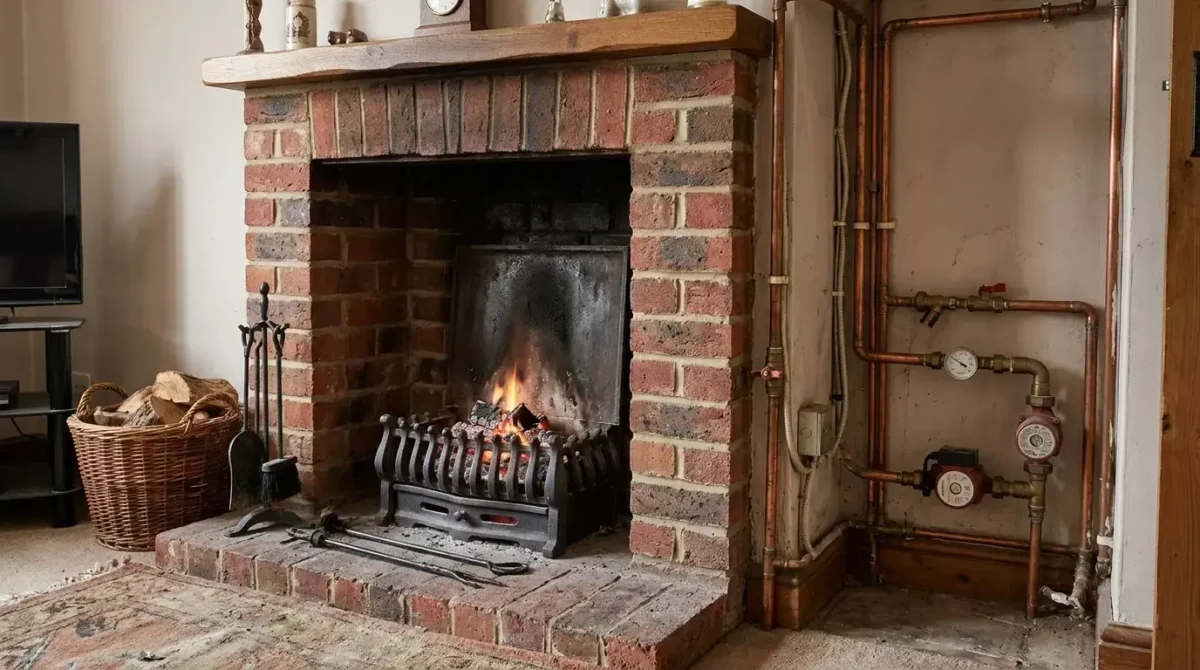
If your house has a gas fire in the living room with a boiler behind it, that fireplace is doing two jobs. It heats the room, and the boiler tucked into the chimney breast heats the radiators and probably the hot water too. Taking the boiler out changes the room, the chimney and the way the whole house gets its heat. That is why replacing a back boiler is a different job from swapping one wall-mounted boiler for another.
This guide starts at the fireplace and works outwards. What happens there decides most of what comes after, including whether a gas boiler or a heat pump is the sensible replacement.
Replacing a back boiler in short
- It is a bigger job than a boiler swap: the fireplace, the chimney and the hot water all change.
- Gas decommissioning is Gas Safe work; solid fuel back boilers are a job for a HETAS-registered installer.
- Decide what the fireplace becomes: a new fire with its own flue, a decorative fireplace, or closed off with ventilation.
- Replacements: a combi, a system boiler with an unvented cylinder, a heat pump or a hybrid, depending on hot water use and space.
- Expect pipework, radiator and control work. Ask for it to be itemised in every quote.
Do you have a back boiler, and what does it do for your house now?
A back boiler sits in the fireplace recess, behind the fire. Remove the fire surround or look at the heat source in the room, and you will usually find a metal casing set into the chimney breast. Sometimes the fire and boiler are one combined appliance. More often, a gas fire is fitted in front of a separate boiler, sharing the chimney as the way out for the combustion gases.
-
Signs you have a back boiler
- There is no boiler anywhere else in the house, in the kitchen, loft or airing cupboard.
- Pipework runs from the fireplace into the floor or wall, usually towards a hot water cylinder.
- There is a small cold water tank in the loft, which feeds an open-vented system.
- The radiators only come on when the fire is lit, or the boiler has its own pilot light and control knob.
A rating plate on the boiler or the fire tells you the make and model. The model number is worth photographing before anyone touches it, because installers will ask for it.
Solid fuel back boilers exist too, behind an open fire or a stove, and they work the same way: the fire heats a water jacket in the chimney breast. The decommissioning route is different, and the next section covers it.
What the back boiler does for the house now matters when you plan the replacement. It usually heats a hot water cylinder by gravity or pump, runs a set of radiators on a simple open-vented system, and often has very basic controls. A modern system will want to replace all of those, so list what the old one currently heats: how many radiators, whether there is a cylinder and how big it is, and whether any rooms rely on the fire itself.
What safe decommissioning involves, and why it is a Gas Safe job
Disconnecting a gas appliance is legal gas work, so in Great Britain it must be done by an engineer on the Gas Safe Register. Ask to see their ID card and check that the back of it lists the right gas category for the appliance type. You can also check the registration on the Gas Safe website.
A proper decommission covers several steps:
| Step | What happens | Who does it |
|---|---|---|
| Gas isolated and capped | The appliance is disconnected and a proper cap fitted to the pipe; a closed tap alone is not enough | Gas Safe registered engineer |
| Gas pipework tested | The remaining supply is tightness-tested before it is left live | Gas Safe registered engineer |
| Water side drained | The heating circuit and cylinder connections are drained and isolated | Heating engineer |
| Flue checked | The chimney is checked and made safe, or prepared for a new use | Engineer; a chimney sweep if it needs sweeping |
| Fire removed or checked | A combined unit comes out; a separate gas fire can stay if it passes a safety check | Gas Safe registered engineer |
| CO alarm fitted | A carbon monoxide alarm in the room, and wherever a combustion appliance remains | Installer or homeowner |
Never cap a gas pipe or pull a boiler out yourself, and avoid hiring a general builder to do it. Old back boilers have often sat for decades with deteriorating flue linings, and carbon monoxide risk is a real reason for concern. Whoever does the work, fit a carbon monoxide alarm in the room afterwards. It is cheap, and in England, building regulations require one whenever a new or replacement fixed combustion appliance is fitted, whatever the fuel; rented homes also need one in any room with a fixed combustion appliance other than a gas cooker.
A solid fuel back boiler is not Gas Safe work, but the same logic applies. A HETAS-registered installer is the usual person for solid fuel appliances and flues, and the chimney needs sweeping before anything is capped or altered.
What happens to the fireplace, the flue and the chimney afterwards?
Once the boiler is out, you have three things to decide: what the fireplace becomes, what the flue does, and what happens to the chimney stack above the roof.
| What the fireplace becomes | What it needs | Who signs it off |
|---|---|---|
| A new gas fire | The gas supply to the hearth kept, and a suitable flue | Gas Safe registered engineer |
| A wood-burning or multi-fuel stove | A flexible stainless steel liner, a CO alarm and usually an air vent above 5 kW | HETAS installer or building control |
| A decorative fireplace | The chimney swept and safely ventilated | No sign-off needed |
| An electric fire in the hearth | A socket nearby; no flue | No sign-off needed |
| Closed off completely | A ventilated cap on the stack and an air vent in the boarded opening | No sign-off needed; sweep it first |
| A flue route for a new gas boiler | A flexible liner, a clear route and a way to drain condensate | Gas Safe registered engineer |
Keeping a fire
You can keep a real or gas fire in the room, but it needs its own approved flue arrangement, because the boiler is no longer sharing it. Options include:
- A new gas fire, if the existing gas supply to the hearth is kept and the flue is suitable.
- A wood-burning or multi-fuel stove fitted with a flexible stainless steel liner. A stove needs a HETAS installer or building control sign-off, a CO alarm, and in most cases a permanent air vent if its output is above 5 kW.
- A purely decorative fireplace, with no working fire at all.
An electric fire in the old hearth is also an option and needs no flue. It adds warmth to the room but should be treated as decoration, not as a heating system.
Closing the fireplace
If you do not want a fire, the opening can be blocked up and the chimney made safe. The chimney should be swept first. A redundant flue should not be sealed airtight, because trapped damp air causes staining and decay in the brickwork. The usual solution is a ventilated cap at the top of the stack and an air vent in the closed-off fireplace, so air can move through the flue.

This matters especially in older houses with solid brick chimneys. If the stack has been left unmaintained, an inspection of the pots, flashing and pointing is worth doing while scaffolding or access is in place. Our guide to heating a period property efficiently without damaging it covers the wider issue of moisture and breathable walls.
Reusing the chimney
For a gas boiler, some houses allow the old chimney to carry a new flue. A flexible liner is run down the stack, and the new boiler is placed at the base of it. The installer has to confirm the chimney can take a liner, the route is clear, and the condensate from the new boiler can be drained away. This option is not universal, and many installers prefer a new external flue instead. A heat pump has no flue, so it makes the chimney free to be left, capped or used for a stove.
Your replacement options: combi, system boiler, heat pump or a hybrid
The type of replacement depends on how your house uses hot water, how much space you can give up, and how far you want to go with the heating system.
| Combi boiler | System boiler and unvented cylinder | Air source heat pump | Hybrid | |
|---|---|---|---|---|
| Hot water | On demand, one outlet at a time works best | Stored at mains pressure; several outlets at once | Stored in a larger cylinder | Stored; the boiler can top up |
| Space needed | Least: no cylinder or loft tanks | A cylinder and a discharge pipe | An outdoor spot and a larger cylinder | Both an outdoor unit and a boiler |
| Flue | Yes | Yes | None | Yes, for the boiler |
| Boiler Upgrade Scheme grant | No | No | Yes, £7,500 in England and Wales | No |
| Best for | Smaller homes with one bathroom and good mains pressure | Homes that want to keep a cylinder and strong showers | Homes ready for lower flow temperatures, or willing to upgrade | Homes not yet ready for heat pump temperatures |
Combi boiler. A combi heats water on demand and removes the need for a cylinder and the loft tanks. It suits smaller households with one bathroom. It relies on good mains pressure and flow, and a house with two bathrooms in use at once will struggle. Converting an old gravity-fed system to a combi also changes how the radiator circuit works, and old pipework may not like higher pressure.
System boiler with an unvented cylinder. Here the boiler heats a stored cylinder at mains pressure, so showers and taps run strongly together. It needs space for the cylinder and a discharge pipe, but it is the closest match for homes that currently rely on a cylinder and want to keep one.
Air source heat pump. The unit sits outside and heats a cylinder and the radiators at lower temperatures than a gas boiler. A heat pump needs no flue, so losing the chimney as a flue route does not matter, and the fireplace no longer has to be the centre of the plan. It does need an outdoor spot, a larger cylinder and a heat loss calculation. Our heat pump or gas boiler running costs comparison sets out the longer-term numbers, and how loud a heat pump is helps with the siting question.
Hybrid system. A hybrid combines a heat pump with a gas boiler, with controls deciding which one runs. It can suit houses where radiators and insulation are not yet ready for heat pump temperatures or where upgrades will be phased. It carries the cost and servicing of two systems, so it is worth asking whether a staged approach to a full heat pump works out better.
For an old house with a back boiler, the useful question is how well the building holds heat. Poor loft insulation and draughty rooms make any system more expensive to run, and a heat pump in particular performs best when the building is reasonably tight. Deal with the cheap fabric fixes first where you can.
Where the new boiler and hot water cylinder go
The old boiler lived in the chimney breast, so the new equipment needs a different home. A few layouts come up often:
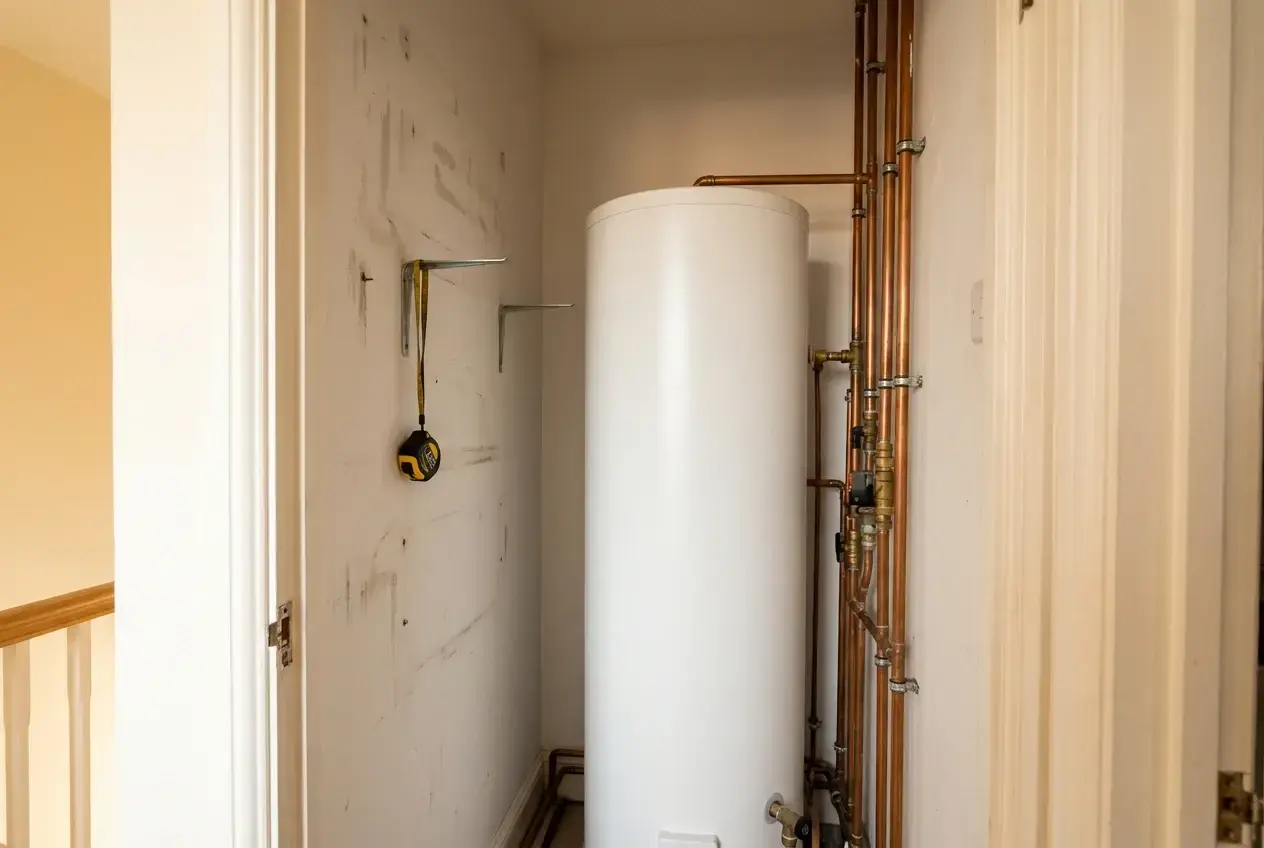
- Kitchen or utility room. The traditional place for a wall-hung gas boiler, with an external wall behind it for the flue and a drain close by for condensate.
- Airing cupboard or landing cupboard. Common for a cylinder, and sometimes enough for a system boiler too. Floor loading and pipework routes need checking.
- Loft. Possible for some boilers and cylinders, but access, frost protection and safe working space are all requirements, and not every installer will propose it.
- Under the stairs or in a garage. Worth considering for a heat pump cylinder, subject to insulation and pipe length.
Flue positions are governed by rules on distance from windows, doors, vents and boundaries, so the installer has to check an external wall can take the terminal. A combi or system boiler also needs a condensate pipe to a drain, kept from freezing in cold weather.
For a heat pump, the outdoor unit needs clear air flow, a stable base and a sensible distance from neighbouring windows. The cylinder is usually larger than the copper cylinder it replaces, so measure the existing cupboard. If you currently have a gravity-fed cylinder with a loft tank, the old tank and its pipework generally come out, which frees some loft space.
Pipe runs matter too. A short run from the heat source to the cylinder keeps heat loss and cost down. If the fireplace was central and the new equipment goes to the far side of the house, the installer will have to lift floors, and that belongs in the quote.
Whether your existing pipework and radiators will cope with the change
A back boiler system is typically old. Pipe condition, radiator sizing and water quality all decide how much extra work the new heat source needs.

Things to check before choosing:
| What to check | Why it matters | Typical fix |
|---|---|---|
| Open-vented or sealed | Converting to a sealed system raises the pressure, which some old joints and parts do not tolerate | Replace weak components when converting |
| Pipe size | Heat pumps move more water at lower temperatures; narrow or microbore pipe restricts flow | Upsize key runs where needed |
| Radiator output | Radiators sized for hot boiler water may be too small for a heat pump | Upgrade the rooms the heat loss calculation flags, often only two or three |
| Sludge and scale | Old systems carry magnetite that damages a new heat source | A chemical clean or powerflush and a magnetic filter |
| Controls | Old systems often have little more than a timer | A room thermostat or weather compensation, TRVs and a programmer |
If you plan a heat pump, how to prepare your home for a heat pump covers what to do before the installer visits, including radiators, insulation and what to have ready for the survey. Bleeding radiators and balancing the system beforehand also helps the installer see the real state of things.
What to ask in quotes, and where grant funding may apply
Back boiler replacements vary widely between houses, so a quote based on a phone call alone cannot be reliable. Ask for a site visit, and use the visit to cover these points:
-
Questions for every quote
- Who does the gas decommissioning, and are they Gas Safe registered?
- What happens to the fireplace, flue and chimney, and who pays for making them safe and ventilated?
- Is the loft tank removed, and is the system converted to sealed?
- Where do the new heat source and cylinder go, and what flooring, plastering or decorating is included?
- Does the price include a system clean, magnetic filter and new controls?
- For a heat pump, has a room-by-room heat loss calculation been done, and which radiators change?
- What warranty applies to the equipment and the workmanship, and what does the small print exclude? The heat pump warranties comparison explains where cover tends to fall short.
- Will building control and any required certificates be handled for you?
Compare quotes line by line, not just on total price. A low quote that leaves out the flue works, cylinder or radiators will cost more later. If you want to check how a gas boiler job is priced, our guide to new boiler cost in the UK sets out typical figures. To judge installers, read choosing the right heat pump installer.
Grants
Grant funding exists for heat pumps in the UK, and its terms differ by nation and change over time. In England and Wales the Boiler Upgrade Scheme gives £7,500 towards an air source or ground source heat pump, applied for by the installer and taken off the bill. Scotland has its own support through Home Energy Scotland. Gas boiler replacements do not qualify for the Boiler Upgrade Scheme, and eligibility rules can exclude certain property types or installations. Check the current amounts and conditions on the official government pages before relying on any figure. Our guide to UK heating grants covers what is available and what tends to be turned down.
Ask each installer whether the grant is deducted from the quote, and whether they are registered to apply for it. A heat pump installation must be carried out by an MCS-certified installer to qualify, which is another check to run when comparing quotes.
Back boiler questions
Can I keep my gas fire when the back boiler is removed?
Often, if it is a separate appliance with its own gas supply and the flue is suitable for it on its own. A Gas Safe engineer must check it. A combined fire and boiler unit comes out as a whole.
Does the chimney need to be capped when a back boiler is removed?
If you are not using it, yes, but not sealed airtight. Sweep it, fit a ventilated cap on the stack and an air vent in the closed fireplace, so damp air can escape.
Can a heat pump replace a back boiler?
Yes. A heat pump needs no flue, so the chimney is freed up. It needs an outdoor spot, a hot water cylinder and usually some radiator upgrades, decided by a room-by-room heat loss calculation.
Can I get a grant to replace a back boiler?
If you replace it with a heat pump, the Boiler Upgrade Scheme gives £7,500 in England and Wales through an MCS-certified installer, and Home Energy Scotland offers support in Scotland. A replacement gas boiler does not qualify.
Is a back boiler dangerous?
Not if it is serviced and the flue is sound, but many are decades old with worn flue linings. Have it checked by a Gas Safe engineer, and fit a carbon monoxide alarm in the room whatever you decide.
Take the next step
Ready to see what a modern system would look like in your house? Request a heat pump quote and an installer will assess your property and the fireplace it is replacing.