
If you have two heat pump quotes, one with a buffer tank and one without, the obvious question is which installer is right. Often both are, because the answer depends on how the rest of the system is designed. So do I need a buffer tank with a heat pump? Sometimes. The way to find out is to check three things: how much water the circuit holds, whether flow through the heat pump can drop below its minimum, and how the heat pump behaves in mild weather.
The three checks that decide it:
- System water volumeHow many litres does the circuit hold, and is that above the manufacturer’s minimum for the chosen model?
- Minimum flowCan TRVs or zone valves close enough of the circuit to drop flow through the heat pump below its minimum?
- Mild-weather behaviourCan the unit modulate low enough for a mild day, or will it start and stop repeatedly?
Buffer tanks in short
- A buffer tank adds water volume and, if fitted in parallel, separates the heat pump’s flow from the radiators’ flow.
- It solves two problems: short cycling in small circuits, and flow dropping below the heat pump’s minimum when controls close.
- It is not always needed. A well-designed open circuit with enough volume can do without one.
- It has costs: space, a second pump, a little standing heat loss and, in parallel, a small efficiency penalty.
- Ask for the numbers: circuit volume against the manufacturer’s minimum decides it, not a rule of thumb.
What a buffer tank does in a heat pump system, in plain terms
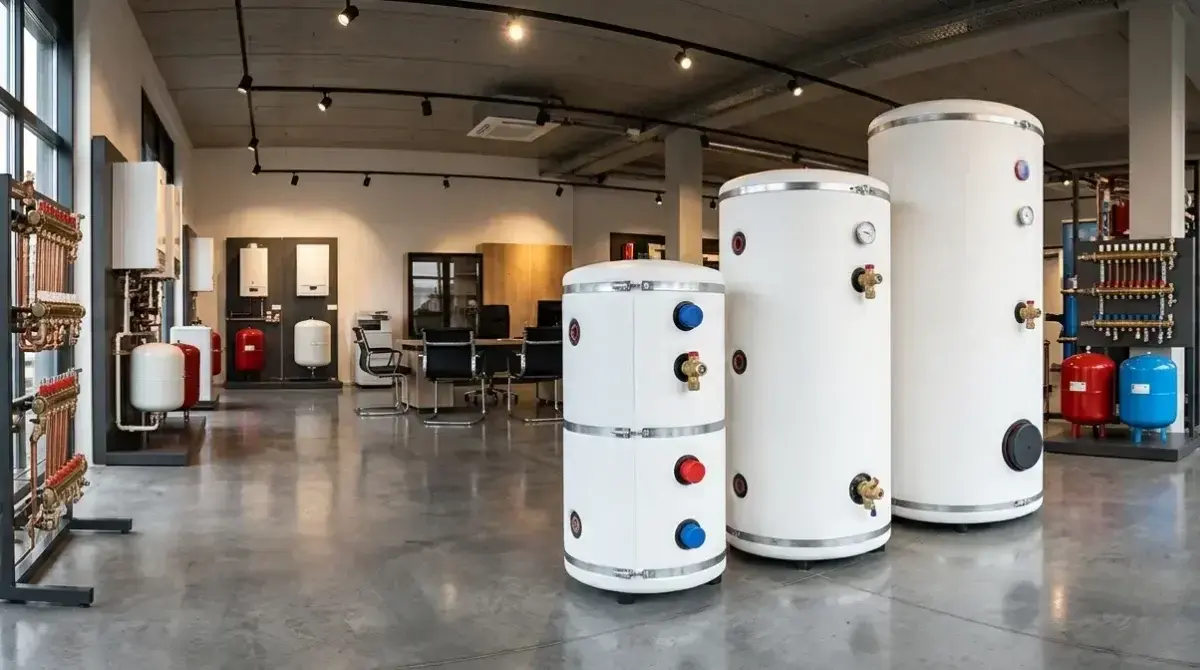
A buffer tank is an insulated cylinder of water fitted into the heating circuit between the heat pump and the radiators or underfloor heating. It adds water volume to the system and, in some layouts, separates the water flowing through the heat pump from the water flowing through your heating.
There are two common ways to fit one:
- In series (sometimes called a volumiser): all the water passes through the tank on its way round the circuit. It adds volume and nothing else and needs only the heat pump’s own pump.
- Parallel (hydraulic separation): the heat pump has its own pump and circulates water through the tank. A second pump takes water from the tank to the radiators. The two circuits run at different flow rates and are connected only through the tank.
The difference matters when you read a quote. A volumiser is a small addition. A parallel tank changes how the whole system is plumbed and controlled.
| In series (volumiser) | In parallel (hydraulic separation) | |
|---|---|---|
| How water flows | All the water passes through the tank on its way round | Heat pump and heating run as two circuits, joined only through the tank |
| Pumps | The heat pump’s own pump only | A second pump for the heating circuit |
| What it solves | Too little water in the circuit | Too little water, and flow dropping when controls close |
| Efficiency cost | Very small | Small but real: mixing means a slightly higher flow temperature |
| Cost and complexity | Lower | Higher: changes how the system is plumbed and controlled |
Short cycling, and why water volume matters
A heat pump is sized for the coldest days, so on a mild day it can produce far more heat than the house needs. Modern inverter units reduce their output to compensate, but every unit has a lowest output it can modulate down to. When the demand falls below that, the unit heats the water to its target quickly, switches off, and starts again a short time later.
That repeated starting and stopping is short cycling. The compressor draws its highest current and takes the most mechanical stress at start-up, and the unit is least efficient in the first minutes of each run. A heat pump that runs steadily for long periods at low output is doing the job it was designed for. One that starts and stops many times an hour is using more electricity for the same heat and wearing its compressor faster.
A circuit with little water in it makes this worse. The water heats up fast, the return temperature rises, and the unit reaches its target before it has settled into a steady run. More water in the circuit gives the compressor longer to run before it hits the target. That extra volume is the reason a buffer tank is sometimes fitted.
Minimum flow rate: the problem a buffer tank is often fitted to solve
The heat pump passes heat to the heating water through a heat exchanger. For that to work, a minimum amount of water has to flow through it. If flow drops too low, the heat exchanger cannot shed its heat, temperatures climb, and the unit shuts itself down on a fault or protection setting.
Flow can drop when heating controls close off the circuit. Thermostatic radiator valves (TRVs) shut as rooms reach temperature, and zone valves close when a zone is satisfied. If enough of them close at once, too little water is left moving through the heat pump.

A parallel buffer tank solves this directly. The heat pump circulates water through the tank at its own flow rate, whatever the radiators are doing. The radiator pump then draws from the tank at whatever rate the house needs.
A buffer is not the only solution. A circuit can be designed so that some flow path always stays open or with enough volume that the controls cannot starve the unit. An automatic bypass valve is a cheaper fallback, but it sends hot water straight back to the heat pump, which costs some efficiency. Each option has a trade-off, which is why the quote should say which one has been chosen and why.
| Way to protect minimum flow | How it works | Trade-off |
|---|---|---|
| Parallel buffer tank | The heat pump circulates through the tank whatever the radiators do | Cost, space, a second pump and a small efficiency loss |
| An open circuit | One room, often the hall, has no TRV, so flow always has a route | Needs a sensible choice of room; that room is not controlled separately |
| Enough system volume | Larger pipework, emitters or a volumiser so the controls cannot starve the unit | Depends on the design; may still need a volumiser |
| Automatic bypass valve | Opens to send water back to the heat pump when flow drops | Cheapest, but returns hot water to the unit, which costs efficiency |
Systems that usually need a buffer tank and ones that usually don’t
The manufacturer’s installation manual is the deciding document. Most state a minimum system water volume and a minimum flow rate for each model, and a design that meets both may need no tank at all.
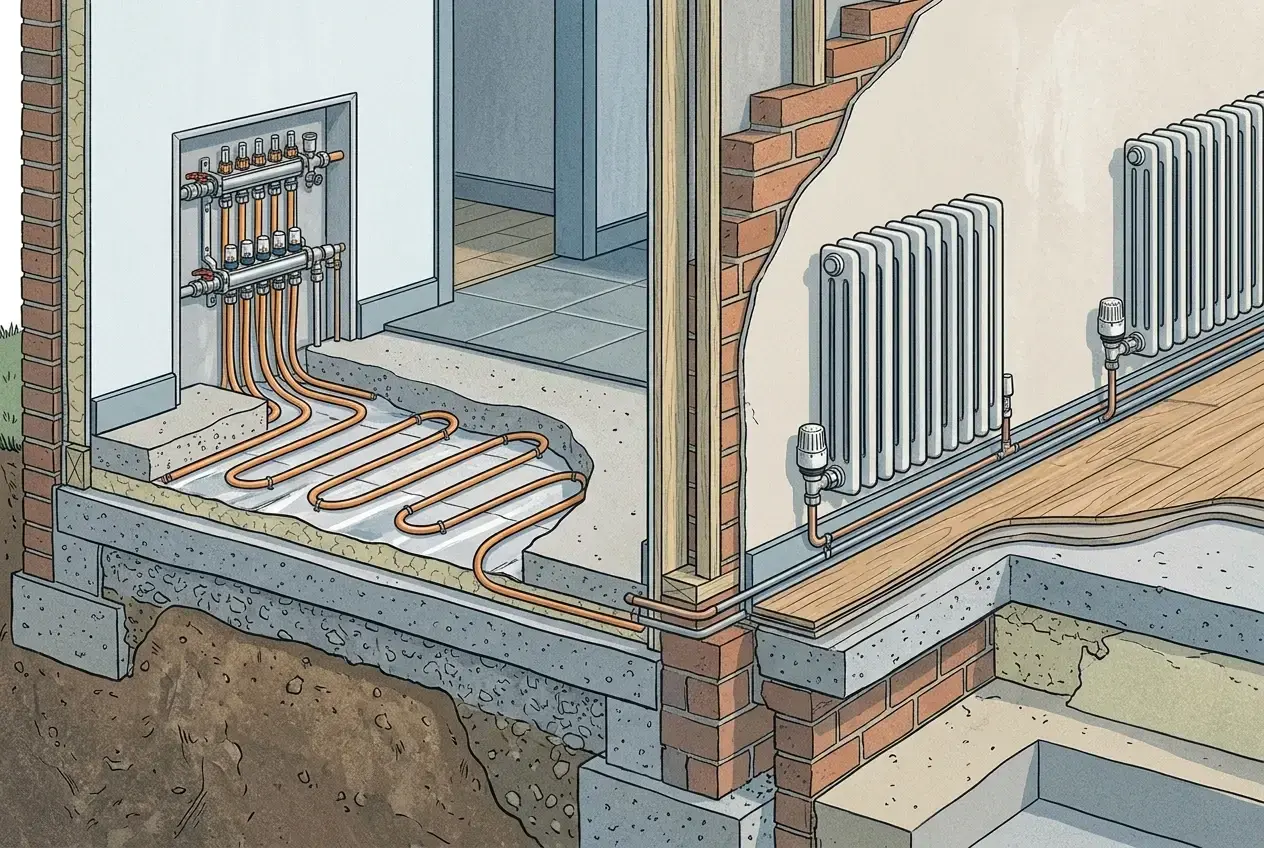
Often justify a buffer tank
- Radiator circuits where every room has a TRV or smart TRV, so all flow can close off on a mild day.
- Multi-zone systems with zone valves that can shut down every zone at once.
- Houses with a low heat loss, such as a well-insulated or modern property, fitted with a heat pump that is large for the demand. The unit has little to do on mild days and cycles on and off.
- Small circuits with short pipe runs and low-volume radiators, where the total water in the system is under the manufacturer’s minimum.
- Systems combining underfloor heating on one zone with radiators on another at different temperatures, if the design cannot otherwise guarantee flow.
Often work without one
- Underfloor heating on the ground floor with loops that stay open. The pipework holds a lot of water, and the slab stores heat.
- Radiator systems with larger pipework and a designated room, often the hall or living room, left without a TRV so flow always has a route.
- A heat pump correctly sized to the calculated heat loss, rather than rounded up, so it spends more time at steady output.
- Units with a wide modulation range and a stated minimum system volume that the circuit already meets.
- A single-zone system with a weather-compensated flow temperature and no zone valves.
None of this is absolute. Two houses that look alike can need different answers because one holds 80 litres in the circuit and the other holds 200. What decides it is a calculation of system volume against the manufacturer’s minimum, not a rule of thumb.
The costs of fitting one: lost efficiency, extra space, extra pump and where the money goes
A buffer tank adds to the quote and to the running costs, so it is worth fitting only where it earns its place.
| What the buffer adds | One-off or ongoing | Notes |
|---|---|---|
| Tank, valves, pipework and insulation | One-off | Ask for it to be itemised on the quote |
| Second circulation pump (parallel only) | Both | Bought once, then runs whenever the heating is on |
| Fitting, controls and commissioning | One-off | Poorly set pump speeds are a common cause of waste |
| Slightly higher flow temperature (parallel) | Ongoing | Every degree costs a little efficiency on every unit of heat |
| Standing heat loss from the tank | Ongoing | Useful in winter if the room needs heat; wasted otherwise |
| Floor or wall space | One-off | Can decide whether a design fits a small utility or airing cupboard |
Efficiency. In a parallel layout, the water from the heat pump mixes with the water already in the tank. To deliver the temperature the radiators need, the heat pump has to make water a little hotter than it otherwise would. Heat pump efficiency falls as flow temperature rises, so every degree costs a small amount on every unit of heat. A well-designed system keeps that penalty small, but it never reaches zero.
Pump electricity. A parallel layout needs a second circulation pump, which runs whenever the heating is on. Modern pumps are efficient, but the cost is a continuing one.
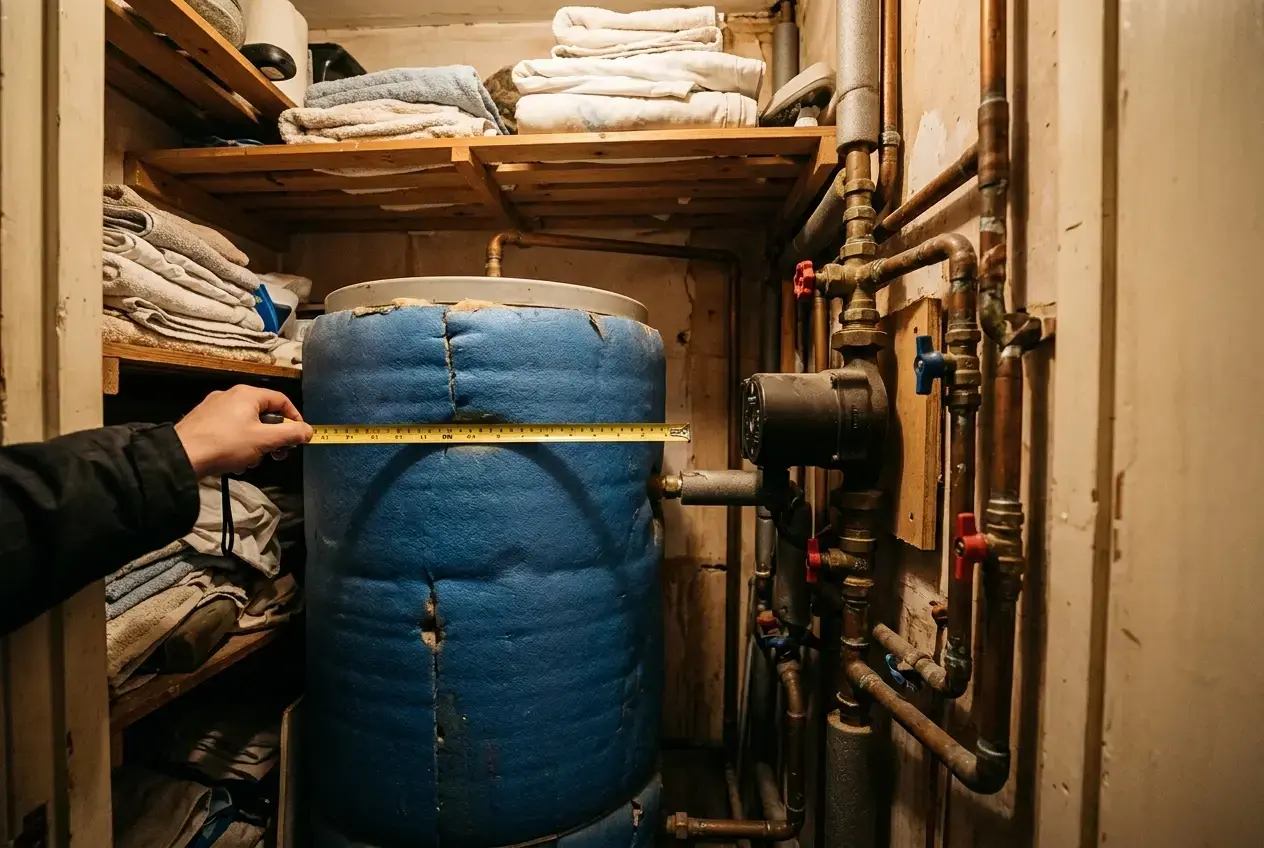
Heat loss from the tank. Even a well-insulated tank loses some heat to the room it sits in. That is useful in winter if the room needs warming, and a waste otherwise.
Space. The tank is a floor-standing or wall-hung cylinder that needs room near the heat pump, plus access for pipework and a drain point. In a small utility room or airing cupboard, that can be the difference between a design that fits and one that doesn’t.
The quote itself. The money goes on the tank, the second pump, valves, extra pipework and insulation, controls, and the labour to fit and commission it all. Ask for these to be itemised so you can see what the buffer adds.
Questions to ask your installer when a quote includes a buffer tank
These are fair questions for any installer to answer in writing:
- What problem is this tank solving on my system? A good answer refers to a specific figure, such as the circuit volume or the minimum flow for the chosen model.
- How much water does my circuit hold without the tank, and what is the manufacturer’s minimum? If the circuit already meets the minimum, ask why a tank is still needed.
- Is it fitted in series or in parallel, and why? A series volumiser costs less and carries less efficiency penalty than a parallel layout.
- Does the manufacturer require it for this model? If so, ask to see the page in the installation manual.
- What is the expected flow temperature with the tank in place, compared with without it? This shows whether the efficiency cost has been considered.
- How big is the tank, and where will it go? Check the dimensions against the space you have.
- What happens to the warranty if it is left out or if it is fitted? Some manufacturers set conditions, and the warranty small print is worth reading before you sign.
- Which controls manage the two pumps, and who sets them up? Poorly set pump speeds are a common reason a parallel layout wastes energy.
What to do if your quote leaves one out
A quote without a buffer tank is not a warning sign on its own. It may reflect a well-designed open circuit, or it may reflect a design that has not looked at minimum flow at all. You need to find out which.
Ask the installer for the heat loss calculation, the system water volume, and the manufacturer’s minimum volume and flow rate for the chosen unit. If they can show that the circuit meets both, the omission is justified. Ask what keeps flow open when TRVs and zone valves close: a designated open room, a bypass, or a large enough volume.
If they cannot answer, treat that as information about the rest of the design. A tank can usually be added later, but only if the pipework and floor space were planned for it, so ask that the layout leaves room for one. The same questions apply to comparing installers more generally, and the guide to vetting a heat pump installer covers what else to check beyond this single decision.
Where does this fit with the rest of your heat pump decision?
The buffer tank is one design choice among many. For more on how buffer tanks are sized and piped, see our guide to buffer tanks for heat pumps. It sits alongside the heat loss calculation, the emitter sizing, the flow temperature and the choice of unit. A quote that gets those right will usually get the tank decision right too, whether it includes one or not.
Treat it as a question of evidence. An installer who can show you the circuit volume, the manufacturer’s minimum and the reasoning behind the layout deserves more of your trust than one who simply says you need a tank or says you don’t. Once the system is running, the settings you choose also affect cycling, which the winter efficiency guide covers.
Buffer tank questions
Do all heat pumps need a buffer tank?
No. Many systems run well without one, particularly underfloor heating with open loops, or radiators with one room left without a TRV and enough water in the circuit. The manufacturer’s minimum volume and flow rate decide it.
What is the difference between a buffer tank and a volumiser?
A volumiser is a tank fitted in series that simply adds water volume. A buffer tank fitted in parallel also separates the heat pump circuit from the heating circuit, using a second pump.
Does a buffer tank make a heat pump less efficient?
A parallel buffer tank usually costs a little efficiency, because mixing in the tank means the heat pump has to run slightly hotter. A well-designed system keeps the penalty small. A series volumiser has very little effect.
Is a buffer tank the same as a hot water cylinder?
No. A buffer tank holds heating water for the radiators or underfloor heating. A hot water cylinder holds the water for your taps and showers. A heat pump system often has a cylinder and sometimes a buffer as well.
Can a buffer tank be added later?
Usually, if the pipework and floor space allow for it. If your quote leaves one out, ask the installer to plan the layout so one can be added without major changes.
If a quote you have received includes a buffer tank, or leaves one out, and you want a second opinion, use our heat pump quote page to have your system design reviewed by an installer.