
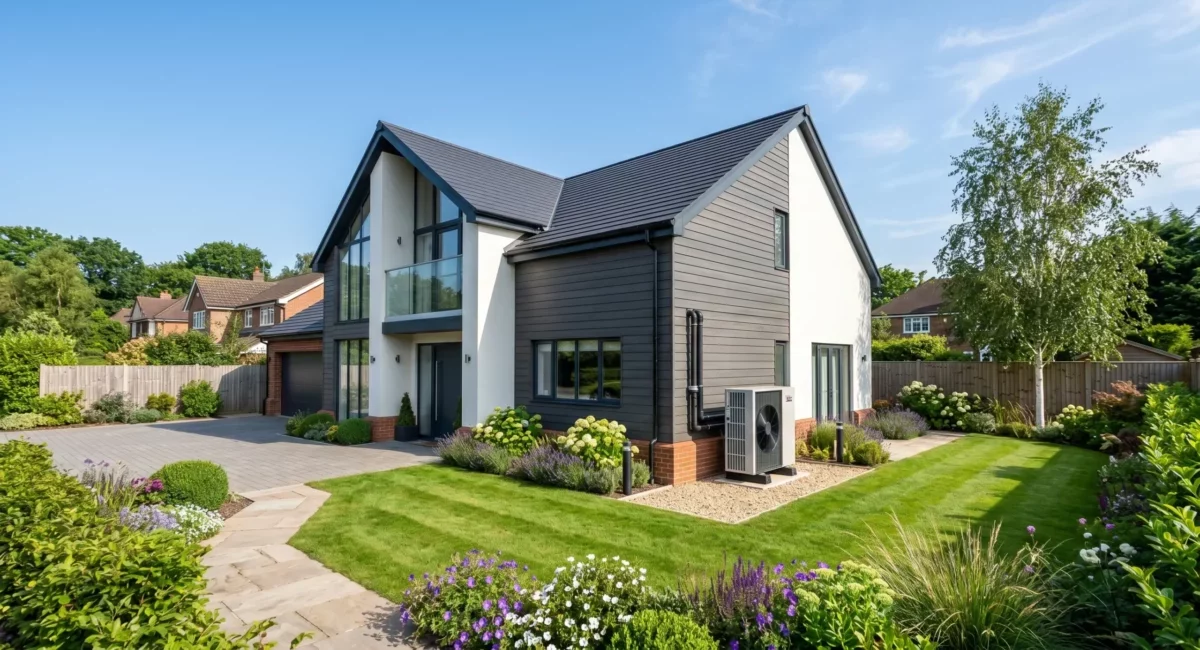
Air-source heat pumps take heat from the outside air and use it to warm your home. They’re one of the main low-carbon alternatives to gas boilers in the UK, and government grants have made the upfront cost more manageable for many homeowners.
This guide covers how the units work, what installation involves, and what to check before committing.
Table of Contents
- The Best Choice For Homes
- Harnessing Energy from the Environment
- Delivering Warmth Throughout the Home
- Air to Water System
- Domestic Hot Water
- Considerations when Investing in a Heat Pump
- Cost Analysis and Financial Support Options
- New Radiators and Underfloor Heating
- Heat Pumps vs Boilers for Hot Water
- Why Choose Air Source Heat Pumps?
The Best Choice For Homes
Heat pumps have grown in popularity for a straightforward reason: run well, they can lower running costs compared with gas or oil heating, particularly in a well-insulated home. The Boiler Upgrade Scheme also reduces the upfront cost, which has made the switch more accessible than it was a few years ago.
They also draw on an electricity grid that’s getting cleaner each year as more wind and solar capacity comes online, which means the carbon savings from switching tend to improve over time, not just at the point of installation.
If you’re weighing up whether a heat pump makes sense for your home, it’s worth looking at your current insulation, radiator sizing, and hot water habits first, the answer depends more on those factors than on the technology itself.
Harnessing Energy from the Environment
Sitting somewhere around your house, the outdoor unit plays its part by drawing energy from the air outside. Rain or shine, it’s all good; they are built to be tough and made to handle the UK’s notoriously unpredictable weather.
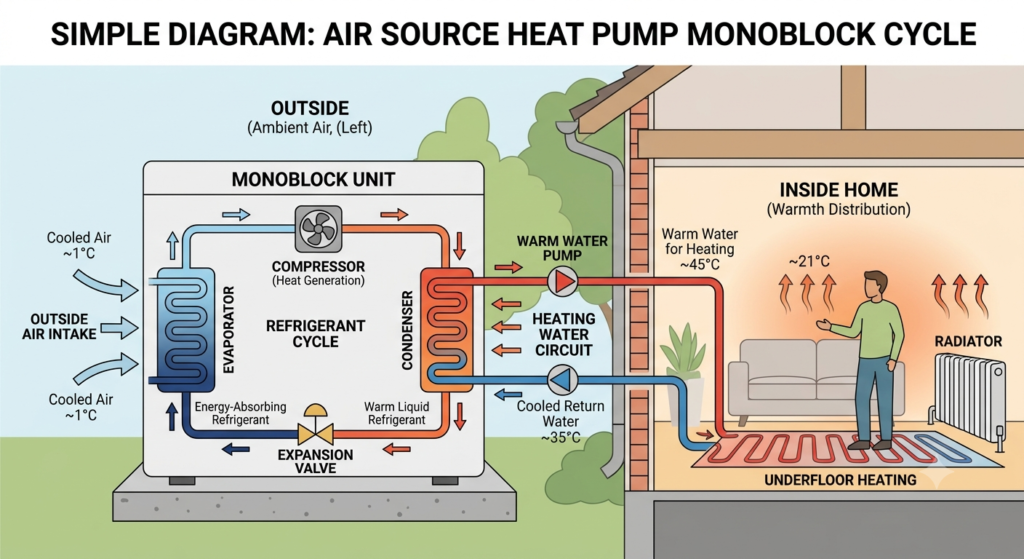
Inside this outdoor unit are a fan, compressor and evaporator. They get to work by pulling in air and absorbing its heat via a refrigerant, which basically functions as the delivery for thermal energy transfer.
Finding the perfect spot is important. Ideally, it lands somewhere with good air flow, away from noise-sensitive areas like bedrooms. The garden or a back patio is normally the best place. There will always be expert advice from your heat pump installer.
The outdoor unit is usually a monoblock heat pump, which has all the required components inside and simply sends the already heated water to the inside of the home.
Electrical installation: Professional installation is key, not just for regulations but to make sure everything runs smoothly from day one. The electrical system includes outdoor work as well as indoors.
Delivering Warmth Throughout the Home
Bringing the magic indoors, heat pumps can integrate with your existing heating system to save on complete pipework replacement. A buffer tank or low-loss header is available to enable hydraulic separation between the new heat pump installation and the existing heating system.
Older vented heating systems will typically undergo an upgrade to an unvented mains feed to accommodate the new heat pump setup. A new hot water cylinder will almost always be fitted with any extra volumiser units that may be needed to allow the pairing of the two hydraulic systems.
For those well-worn radiators or the latest underfloor heating systems, heat pumps work well with both. Some or all of the radiators may need to be renewed, but on the plus side, underfloor heating is a perfect pairing because it distributes heat evenly.
New builds will have already had the design built in with underfloor heating and pre-plumbed cylinders. The home’s pipework will have the required bore size for heat pump flow rates. A full heat pump installation is much easier on a new build than retrofitted in existing homes
Heat pump installations come with many different adaptations for inside the home; the upfront cost will depend on how much of the original heating system can be used and what needs to be added to make it all work effectively.
Air to Water System
Jargon buster
- MONOBLOCK: The most commonly used heat pump that contains all of the refrigerant cycle components within one unit, sending heated water into the house.
- SPLIT UNIT: These look similar to the monoblock but send the heated refrigerant to a heat exchanger in the house to heat the air or water.
- AIR-TO-AIR: These are heat pumps that send heated refrigerant from the outside unit into an inside fan blower unit to warm the house using warm air.
- AIR TO WATER: These can be either monoblock or split systems, which send the heated refrigerant to a heat exchanger to heat the water used in the home.
Domestic Hot Water
A hot water cylinder is usually part of an ASHP system, storing heated water so it’s ready on demand rather than heated instantaneously.
Location: Cylinders are reasonably flexible when it comes to placement — a garage, airing cupboard, or utility room all work, provided there’s roughly 80 x 80 cm of floor space plus clearance for servicing.
If space is tight, a few alternatives are worth knowing about:
- Hybrid systems pair the heat pump for space heating with a boiler handling hot water on demand, which avoids needing a full cylinder.
- Heat batteries are a more compact alternative to a traditional cylinder, storing thermal energy rather than hot water directly.
- Instantaneous water heaters suit smaller, single-outlet needs (e.g., under a kitchen sink) but aren’t a substitute for whole-home hot water.
The right choice depends on your household’s hot water usage patterns — a family running multiple showers a day has different needs than a couple mostly using a kitchen tap.
Considerations when Investing in a Heat Pump
Before committing to a heat pump, it’s worth working through a few practical points with an installer.
Budget: Costs vary by property, but government grants can reduce the upfront outlay significantly. It’s worth checking current eligibility, since scheme terms and funding levels are reviewed periodically.
Existing radiators: Because heat pumps run at lower flow temperatures than gas boilers, some radiators may need upsizing to maintain comfortable room temperatures. This is typically assessed via a room-by-room heat loss calculation, not a guess.
Available space: You’ll need suitable outdoor space for the unit (with adequate airflow, away from bedroom windows where possible) and indoor space for a cylinder if one’s needed.
Your household’s routine – how many people are showering, when, and how much hot water you typically use – will influence system sizing; this is worth discussing honestly with your installer rather than defaulting to the largest option.
A proper assessment should always include an in-home survey.
Cost Analysis and Financial Support Options
Upfront costs for a heat pump typically start around £4,000 once government grants are factored in, though the final price depends on your property size, existing heating system, and how much groundwork is needed.
Compared with the lifetime running costs of a gas or oil system, many homeowners find the difference narrows over several years — though this depends heavily on your electricity tariff and how well-insulated your home is.
The Boiler Upgrade Scheme is the main government grant currently available for ASHP installations in England and Wales. Some installers also offer financing plans, with monthly payments starting from around £40 per month, which can spread the cost rather than requiring the full amount upfront.
When weighing up finance options, it’s worth thinking about how long you plan to stay in the property — the payback period for a heat pump is usually measured in years, so the calculation looks different if you’re planning to move soon versus staying long-term.
New Radiators and Underfloor Heating
Getting good performance from a heat pump often means reviewing your existing radiators or fitting underfloor heating, since heat pumps typically run at lower flow temperatures than a gas boiler.
Radiators: Some radiators may need upsizing to release enough heat at these lower temperatures. This is usually a one-off cost during installation, and an installer will calculate room-by-room heat loss to work out which radiators (if any) need replacing.
Underfloor heating: UFH pairs well with heat pumps because it operates at even lower flow temperatures and distributes heat over a larger surface area, which suits the way heat pumps work efficiently.
Mixing both: It’s common in retrofits to keep underfloor heating downstairs (where it may already exist, e.g., in kitchens or extensions) and use upsized radiators upstairs. An installer will typically map this out room by room as part of the design process – this isn’t something to guess at without a proper heat loss survey.
Heat Pumps vs Boilers for Hot Water
Heat pumps and gas boilers heat water differently, and it’s worth understanding the difference before you switch.
Heat pump systems typically heat water to around 48–55°C, compared with 60–70°C from a standard gas boiler (some heat pump models can go higher, but efficiency drops at higher output temperatures). In practice, this means slightly less need to mix in cold water when running a bath or shower.
One point worth adding: Most systems still need a periodic legionella cycle, where the cylinder is heated above 60°C for a short period, even if day-to-day heating runs cooler. Your installer will normally set this up as part of the system controls, so it’s not something you need to manage manually.
If on-demand hot water matters more than storage, for example, in a smaller property, hybrid systems (a heat pump for space heating, a boiler or a heat battery for hot water) are worth discussing with an installer, as is a standalone heat battery for lower-usage households.
Why Choose Air Source Heat Pumps?
If you’re moving away from oil or an ageing gas boiler, a heat pump can meaningfully cut both running costs and carbon emissions, provided the system is sized and installed correctly.
A few things are worth knowing if you’re considering the switch:
- Funding: Grant schemes like BUS are reviewed periodically, and support levels can change — it’s worth checking current eligibility before you plan your budget rather than assuming today’s terms will hold.
- Electricity supply: The grid’s carbon intensity continues to fall as renewable capacity grows, which improves the case for electric heating over time.
- Compatibility: Heat pumps can usually integrate with existing radiators or underfloor heating, though some radiators may need upsizing to work efficiently at lower flow temperatures.