
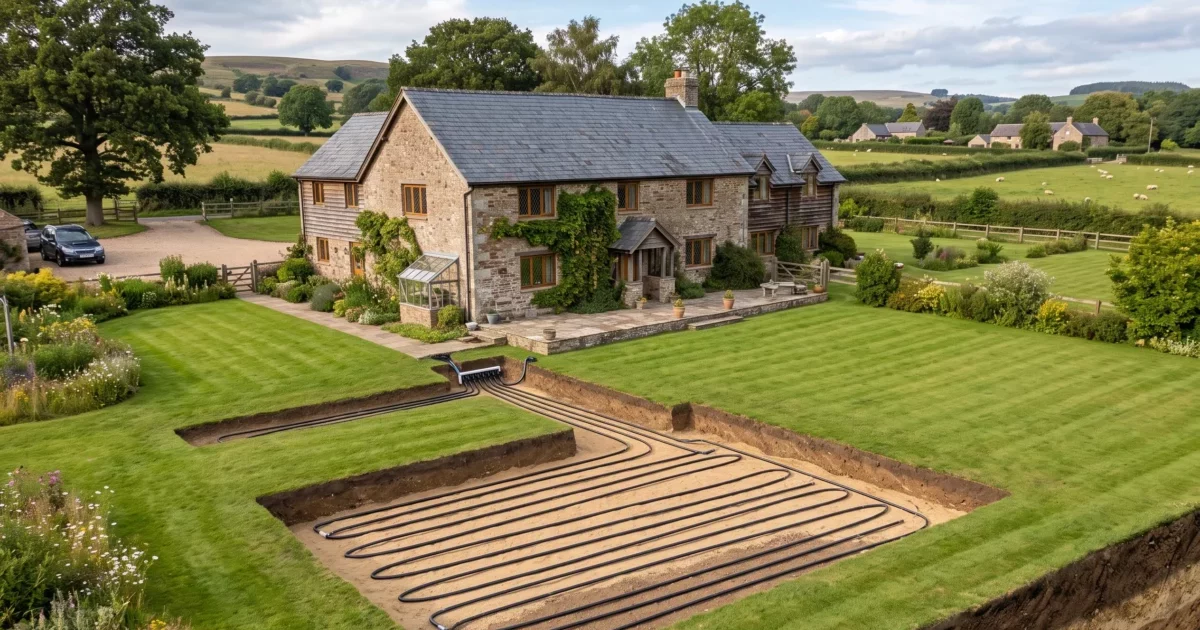
Ground source heat pumps are one of the most efficient ways to heat a UK home and one of the least understood. Most of what decides whether one suits you happens outside: how much land you have, what the ground is like, and whether a digger or drilling rig can reach it.
I have fitted heat pumps for years, and this guide sets out what a ground source system costs in 2026, how much space it needs, what the grant covers and the paperwork involved, in plain language and without the sales pitch.
Ground source heat pumps in short
- What it is: a heat pump that collects heat from pipes buried in your garden or in boreholes, so there is no fan unit on the wall outside.
- Typical cost: about £15,000 to £25,000 with trenches, and £20,000 to £35,000 with boreholes, before the £7,500 Boiler Upgrade Scheme grant.
- Space: trenches need roughly two and a half times the footprint of the house in open, diggable land; boreholes need only room for a drilling rig.
- Efficiency: a well-designed system usually runs at a SCOP of about 3.5 to 4.5, a little better and steadier than air source.
- Best suited to: homes with land or a new build or major renovation, owners staying put for years, and off-gas homes replacing oil or LPG.
How a ground source heat pump works
A ground source heat pump collects low-grade heat from the ground and raises it to a useful temperature for your radiators, underfloor heating and hot water. The ground holds the sun’s warmth far better than the air does: a metre or two down it changes slowly with the seasons, and below about 10 to 15 metres it stays at around 10 to 12°C all year in most of the UK.
The system has three parts:
- The ground loop: pipes buried in trenches or boreholes, filled with water and antifreeze, which pick up heat from the soil or rock.
- The heat pump: an indoor unit, about the size of a fridge-freezer, with a compressor and refrigerant circuit that lifts the temperature of that heat.
- The heating system: radiators or underfloor heating sized for lower flow temperatures, plus a hot water cylinder.
The cycle, in simple terms:
- Fluid in the ground loop absorbs heat from the ground.
- A heat exchanger passes that heat to the refrigerant, which boils into a gas.
- The compressor squeezes the gas, which raises its temperature.
- That heat goes into your heating water and hot water cylinder.
- The refrigerant cools, turns back to liquid, and the cycle repeats.
It uses electricity to move heat rather than make it, which is why it delivers several units of heat for each unit of electricity. Nothing is burned on site, and with no fan outside, it is close to silent from the garden.
Trenches or boreholes: choosing the ground loop
The ground loop is the biggest part of the cost and the disruption. There are two main types, and your plot usually decides between them before the price does.
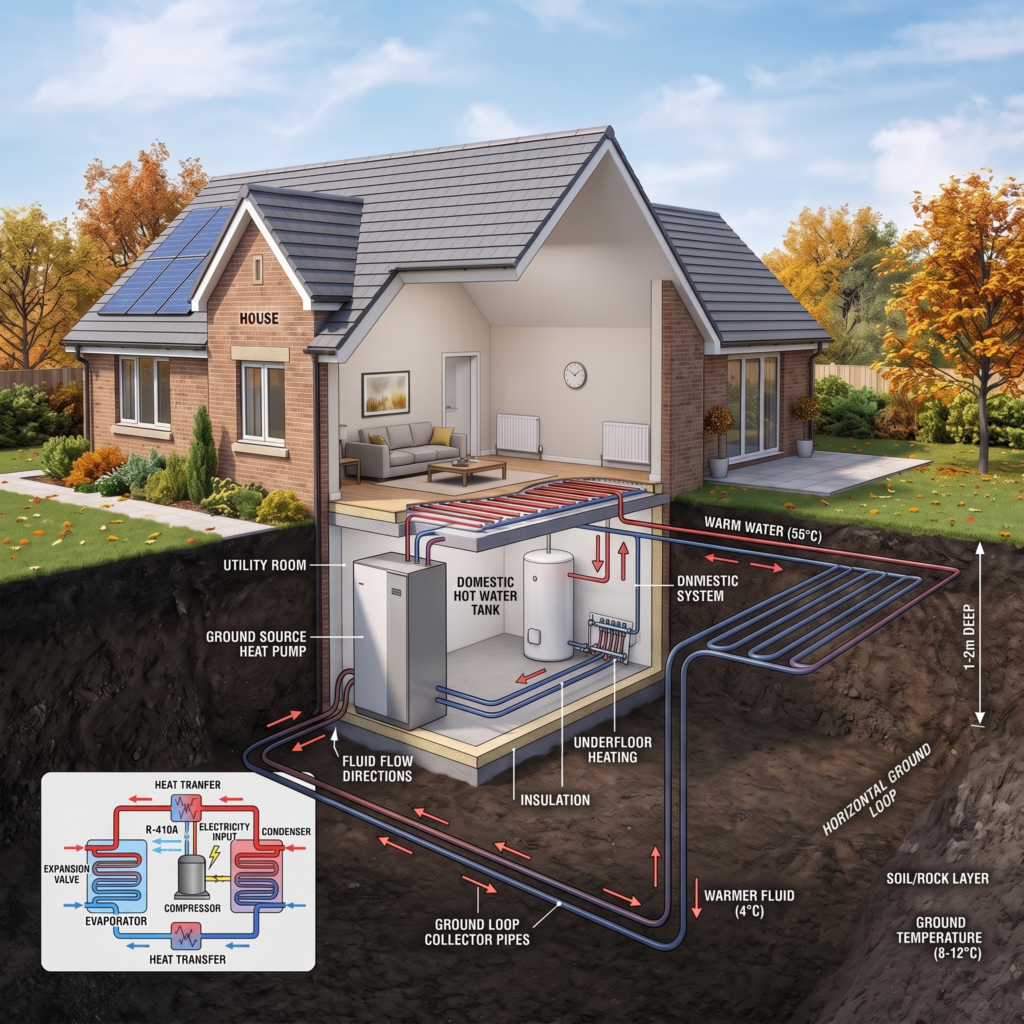
Horizontal trenches are the cheaper option where there is room. Pipe is laid straight or in overlapping coils, called slinkies, which need less trench digging. Slinkies do not collect more heat from the same area of land, though: the land area is what counts.
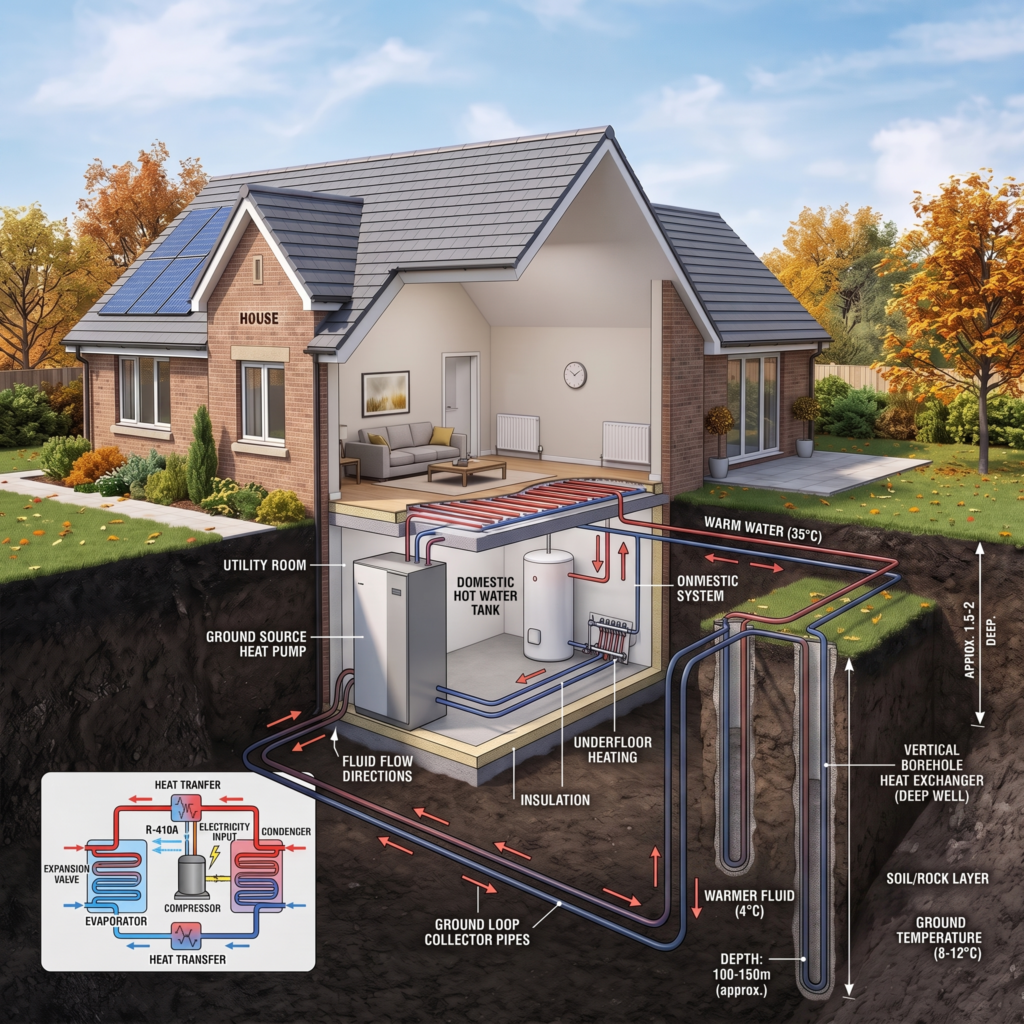
Vertical boreholes suit smaller plots. A specialist rig drills one or more narrow bores, and a U-shaped loop of pipe goes down each one. Drilling costs more, and the depth depends on the rock, so a ground survey is normally needed first.
Note: The utility room can be below ground or above ground and can also be a designated part of a garage; it depends on the survey and where the ground pipes are situated as to the ideal position for the pump and cylinders.
| Horizontal trenches | Vertical boreholes | |
|---|---|---|
| What goes in the ground | Straight pipe or coiled “slinky” pipe in trenches about 1 to 2 metres deep | U-shaped pipe loops in boreholes about 20 cm wide, typically 75 to 200 metres deep |
| Land needed | A lot: open ground clear of trees, with access for a digger | Very little: room for a drilling rig to get in and set up |
| Cost | Lower | Higher: specialist drilling adds roughly £5,000 to £10,000 |
| Disruption | The garden is dug up, then reinstated | A few days of drilling, mess around the rig, then a small surface footprint |
| Ground survey | Soil type and moisture matter | Usually needs a specialist ground survey, as geology sets the depth |
| Best for | Rural plots, paddocks and large gardens | Smaller plots, or where trenches would damage the landscaping |
Open-loop systems, which pump groundwater up from a well and return it, also exist. They need extra licences and permits and are rare on homes, so this guide covers closed loops.
How much space does a ground source heat pump need?
This is the question I am asked most. For trenches, the answer is more than most people expect; for boreholes, it is mostly about access.
| What needs space | Rule of thumb | Notes |
|---|---|---|
| Horizontal trenches | About 2.5 times the footprint of the house | A 148 m² four-bed detached needs roughly 364 m² of open land |
| Trench layout | About 10 m of slinky trench per kW, trenches about 5 m apart | For a new-build three-bed, the Energy Saving Trust suggests two trenches of 30 to 40 m |
| Boreholes | Roughly 100 m of borehole per 5 kW of heat | Can be one deep bore or several shorter ones, usually 5 to 10 m apart |
| Site access | A digger or drilling rig must reach the spot | Narrow side passages and steep gardens add cost or rule options out |
| Indoor unit | About 120 x 60 x 60 cm | Often with a hot water cylinder built in or alongside; a utility room or garage suits it |
Rules of thumb only. Your designer sizes the loop from your home’s heat loss, hot water use and the ground conditions.
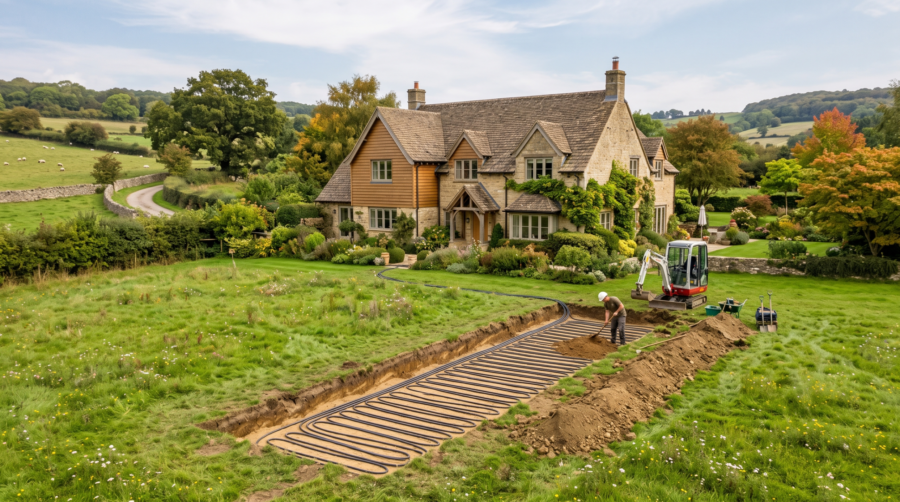
Trees, drains, septic tanks and buried services all get in the way of trenches, and the ground above the loop should not be built on later. A patio or decking over the area is fine; an extension is not.
Indoors, plan for the heat pump and a cylinder. A utility room, garage or large cupboard usually works. My guide to preparing your home for a heat pump covers what to check before the surveyor arrives.
What a ground source heat pump costs in the UK
Ground source costs more to install than air source, and almost all of the difference is the groundworks. The heat pump itself is usually 40 to 60% of the price.
| System | Typical installed cost | After the £7,500 grant |
|---|---|---|
| Horizontal loop, smaller home | £15,000 to £22,000 | £7,500 to £14,500 |
| Horizontal loop, larger home | £20,000 to £25,000 | £12,500 to £17,500 |
| Single borehole | £20,000 to £30,000 | £12,500 to £22,500 |
| Several boreholes | £28,000 to £35,000 | £20,500 to £27,500 |
Typical 2026 UK ranges including supply, installation and commissioning (less.co.uk, October 2026). Radiator or underfloor heating upgrades are usually extra.
What pushes the price up or down:
| What can add to the price | Typical figure |
|---|---|
| Heat pump unit on its own | £4,000 to £8,000 |
| Hot water cylinder, if needed | £800 to £1,500 |
| Trenching, if dug separately | Roughly £25 to £65 per metre |
| Borehole drilling | Upwards of £50 per metre, depending on geology |
| Underfloor heating | From about £120 per m² on a new build, more in a retrofit |
| Larger radiators | Depends on how many rooms need them; your heat loss survey decides |
Installation of heat pumps is also zero-rated for VAT in Great Britain until 31 March 2027, so a quote should not add VAT on top. For a cost breakdown of the air source alternative, see my air source heat pump cost guide.
Running costs and efficiency
Efficiency is measured as SCOP, the seasonal coefficient of performance: the heat delivered over a year divided by the electricity used. A well-designed ground source system usually reaches 3.5 to 4.5, so every unit of electricity gives 3.5 to 4.5 units of heat. Because the ground stays steady, a ground source heat pump holds its efficiency through a cold snap better than air source does.
| Heating system | Efficiency | Energy bought | Yearly cost |
|---|---|---|---|
| Gas boiler | 90% | 13,333 kWh gas | £1,063 |
| Air source heat pump | SCOP 3.0 | 4,000 kWh electricity | £1,053 |
| Ground source heat pump | SCOP 3.5 | 3,429 kWh electricity | £902 |
| Ground source heat pump | SCOP 4.0 | 3,000 kWh electricity | £790 |
Worked example: a home needing 12,000 kWh of heat a year, at the Ofgem price cap for October to December 2026 (electricity 26.32p, gas 7.97p per kWh). Standing charges are left out. A heat pump tariff can bring the electricity cost down further.
The figures depend heavily on the design. Three things make the biggest difference:
- Flow temperature: the cooler the water going to your radiators or underfloor heating, the higher the SCOP. That is why emitter sizing and insulation matter so much. See my guides to central heating radiators and underfloor heating.
- Loop sizing: a loop that is too small slowly chills the ground over the years and efficiency falls. A good designer sizes it from your annual heat and hot water demand, not just the size of the heat pump.
- Your tariff: a heat pump or time-of-use tariff can cut the bill further. See the best electricity tariffs for heat pumps.
For a full ten-year comparison including servicing and repairs, see heat pump or gas boiler: ten years of running costs.
Grants and funding for ground source heat pumps
- England and Wales: the Boiler Upgrade Scheme gives £7,500 towards a ground source heat pump, including systems on shared ground loops. Your MCS-certified installer claims it and takes it off your quote.
- Off-gas homes: if the property is heated by oil or LPG and has no mains gas, an extra £1,500 is available until March 2027, taking the grant to £9,000.
- Scotland: Home Energy Scotland offers a grant of up to £7,500, an optional interest-free loan of up to £7,500, and an extra £1,500 for rural homes.
- Northern Ireland: there is no Boiler Upgrade Scheme, but income-based help is available through the Northern Ireland Sustainable Energy Programme.
The grant cannot be used to replace an existing low-carbon system, and hybrid systems are not eligible. Grant amounts and rules are on GOV.UK. For everything you might be able to claim, see the Boiler Upgrade Scheme explained and which heating grants you can claim.
Shared ground loops for terraces, flats and estates
You do not need a big garden of your own to use ground source heat. With a shared ground loop, a set of boreholes serves several homes along a street or across a development, and each home has its own small heat pump indoors with its own controls and electricity bill.
Each property can still claim the £7,500 grant, and a shared loop can serve up to 300 kW of heat pumps under the scheme. Shared loops are most common on new developments and social housing, but it is worth asking about if your neighbours are considering heat pumps too.
Planning, permits and paperwork
- Planning permission: in England, a ground source heat pump on a home is usually permitted development, so no application is needed (Planning Portal). With no outdoor unit, the noise rules that apply to air source do not apply here. If you live in a listed building or conservation area, check with your council first.
- Environment Agency: in England, a new closed-loop system installed since 2 October 2023 must meet the low environmental risk exemption conditions or a regulatory position statement or have a permit (Environment Agency guidance). A competent installer handles this, but ask them to confirm it in writing.
- MCS certification: the installer and the equipment must be MCS certified for you to get the grant. Check the certificate number before you sign.
- Wales, Scotland and Northern Ireland: planning and environmental rules differ, so ask your installer and council what applies to you.
What installation involves, step by step
- Survey and heat lossA room-by-room heat loss calculation and a look at your radiators, hot water use and where the loop can go.
- Ground investigationSoil, rock and water table checks decide trenches or boreholes and how much pipe is needed.
- Design and quoteLoop size, heat pump size, cylinder and any radiator changes, with the grant shown on the quote.
- GroundworksTrenches dug and pipe laid, or boreholes drilled, then the loop pressure tested before backfilling.
- Indoor installationHeat pump, cylinder, pipework and controls fitted, usually the quickest part of the job.
- Commissioning and handoverThe system filled, flushed, set up and explained to you, with MCS paperwork for the grant.
Indoor work is usually done in a few days. The groundwork depends on the loop: trenches can take a few days with a digger, and drilling depends on how many boreholes are needed. Expect the garden to look like a building site for a while; a good installer agrees on how it will be reinstated before work starts.
The installer matters even more with ground source than with air source, because mistakes are buried and hard to fix. My guide to choosing the right heat pump installer sets out what to check.
Ground source or air source?
| Ground source | Air source | |
|---|---|---|
| Installed cost | Higher, mainly the groundworks | Lower |
| Efficiency | Usually SCOP 3.5 to 4.5, steadier in cold weather | Usually around 3 to 4, dips in cold snaps |
| Outdoor unit | None; the unit sits indoors | A fan unit outside, which must meet noise rules |
| Space | Land for trenches, or access for a rig | A wall or patch of ground for the outdoor unit |
| Disruption | Significant groundworks | Usually a few days |
| Lifespan | Ground loop designed to last 50 years or more | Outdoor unit exposed to the weather |
| Grant (England and Wales) | £7,500 | £7,500 |
Neither is better for every home. Ground source is the better long-term system where the land and budget allow; air source does most retrofits for less. If you are building, see air source or ground source for a new build, and for the basics of the alternative, air source heat pumps explained.
Is a ground source heat pump right for your home?
Often a good fit
- Off-gas homes replacing oil or LPG, especially with land
- New builds and self-builds, where the groundworks are happening anyway
- Major renovations with the garden already being landscaped
- Larger, well-insulated homes with a high heat demand
- Owners planning to stay long enough to recoup the extra cost
Think twice if
- There is no route for a digger or drilling rig into the garden
- The budget only stretches to the heat pump with no insulation work
- You are likely to move within a few years
- The house is small and well insulated: air source may do the job for less
- No local installer has real experience of ground loops
Before you ask for quotes, check:
- Do you have enough open land for trenches, or a budget for boreholes?
- Can a digger or drilling rig reach the spot?
- Is the house reasonably well insulated? Every heat pump runs best at low flow temperatures, so the cheapest fixes in my home insulation guide come first.
- Will you stay long enough for lower running costs to pay back the higher installation cost?
- Have you got quotes from MCS-certified installers who will survey the ground, not just the house?
Common questions
Ground source heat pump questions
How much does a ground source heat pump cost in the UK?
Typically £15,000 to £25,000 with a horizontal ground loop and £20,000 to £35,000 with boreholes, before the £7,500 Boiler Upgrade Scheme grant in England and Wales. Radiator or underfloor heating upgrades are usually extra.
How much land does a ground source heat pump need?
For horizontal trenches, roughly two and a half times the footprint of the house, in open ground a digger can reach. If you do not have that, boreholes need very little surface space, just access for a drilling rig.
Can a ground source heat pump work with radiators?
Yes, but the radiators must be big enough to heat each room at a lower flow temperature than a boiler uses. Some rooms may need larger radiators. Underfloor heating suits a heat pump especially well.
Do you need planning permission for a ground source heat pump?
In England it is usually permitted development, so no planning application is needed. Check with your council for a listed building or a conservation area. New closed-loop systems also have to meet Environment Agency conditions, which your installer should confirm.
How long does a ground source heat pump last?
The ground loop is designed to last 50 years or more. The heat pump itself sits indoors, away from the weather, and typically lasts 20 years or more with an annual service.
Is a ground source heat pump better than air source?
It is usually a little more efficient and has no outdoor unit, but it costs more to install. Where land or a new build makes the groundworks easier, ground source often pays off. On a typical retrofit with a small garden, air source is usually the better value.
Can terraced houses or flats have ground source heating?
Yes, through a shared ground loop: boreholes serve several homes, each with its own heat pump indoors. Each property can still claim the £7,500 grant.

This guide is general information for UK homeowners researching heating options. It is not a substitute for a site survey and heat loss calculation by an MCS-certified installer.
Final thoughts
Ground source heat pumps are not the right fit for every home, but where the land and budget allow, they give some of the most efficient, quiet and long-lasting heating available. Get a proper heat loss survey and ground investigation before you commit: groundwork is not something you want to do twice. If you would like me to look at your home, ask for a quote below.