
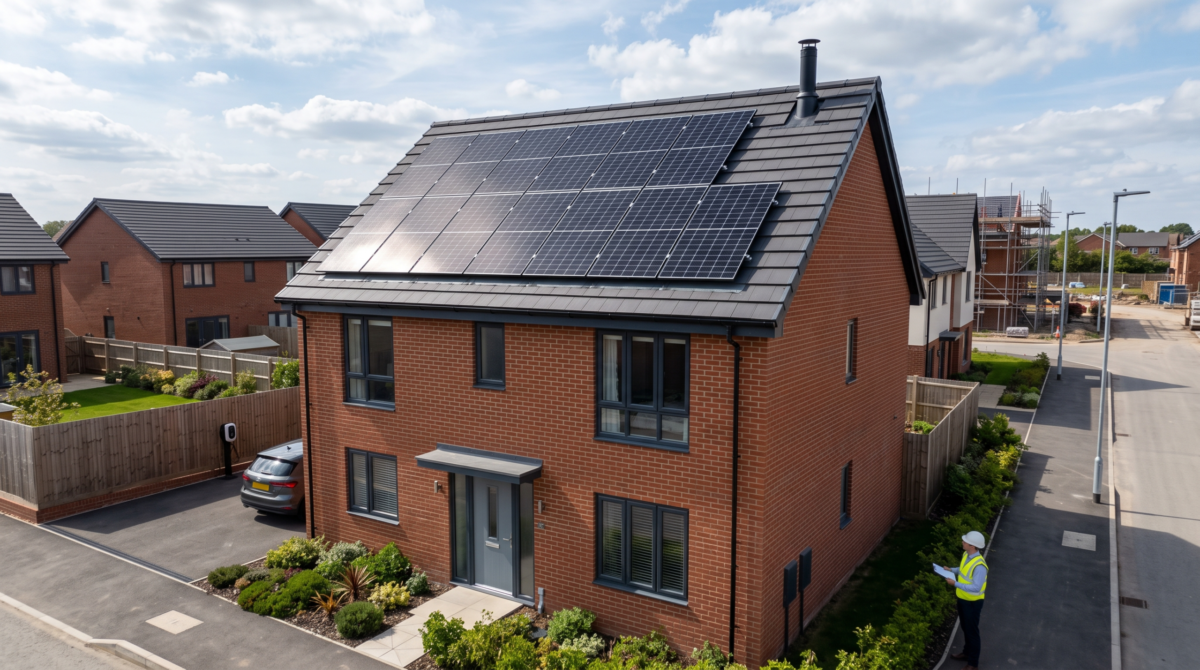
“New builds need solar panels now” is true, as covered in our Future Homes Standard explainer, but it undersells how specific the actual requirement is and glosses over a set of exemptions that some developers will lean on more than others. Here’s what the rule actually says and what to do with the solar you end up with once your heat pump is also in the picture.
At a glance
- The rule: solar PV covering roughly 40% of the dwelling’s ground floor area.
- In practice: around 3.4 kWp for a typical 3-bed semi, scaling up to roughly 7.6 kWp for a 5-bed executive home.
- Exemptions exist: genuine roof constraints, certain tall apartment blocks, and listed/conservation area restrictions, but a developer must document a technical justification.
- Once it’s installed: a solar diverter into your hot water cylinder typically pays for itself faster than a battery, though the two solve different problems.
How much solar you’re actually getting
The requirement isn’t a flat panel count; it scales with the size of the house: solar PV covers approximately 40% of the dwelling’s ground floor area. Worked through, that comes out to roughly 3.4 kWp (around eight panels) for a typical 3-bed semi with a 42.5 m² footprint, closer to 5.2 kWp for a 4-bed detached, and around 7.6 kWp for a larger 5-bed executive home. If you’re comparing plots or house types on a development, it’s worth asking the sales team what capacity is actually specified for your specific plot rather than assuming every home on the site gets the same system.
The exemptions developers can use
Four categories are recognised:
- Genuine roof constraints where orientation, overshading, or insufficient roof size make meaningful solar generation impractical.
- Certain tall apartment blocks where the roof area per individual dwelling is too small to matter.
- Conservation area or listed building restrictions.
- Properties within the curtilage of a listed building.
What’s worth knowing as a buyer is that these have to be documented with an actual technical justification, not just asserted. “We didn’t want to install it” isn’t a valid reason under the rules. If a development you’re considering doesn’t have solar and you’re curious why, it’s a completely reasonable question to ask the developer which specific exemption applies and why.
Solar PV and your heat pump: diverter or battery?
Once the panels are up, the practical question is what to do with the electricity you generate but don’t use immediately. A solar diverter is the simpler, cheaper answer for a home with a hot water cylinder (which most heat pump systems have): it detects surplus solar generation and redirects it into heating your hot water instead of exporting it to the grid for a few pence per kWh. At roughly £400 to £700, it typically pays for itself within 2 to 4 years, since a 200-litre cylinder can store a genuinely useful amount of heat, comparable to a fair chunk of a small battery’s capacity, at a fraction of the cost.
A battery solves a different problem: it lets you use stored solar power for your general electricity demand in the evening, not just hot water, but at £5,500 to £7,000 for a typical 10kWh system, the payback stretches to 8 to 15 years. For most new-build homes with a heat pump and hot water cylinder already in place, a diverter is the more clearly worthwhile first step; a battery is a separate, longer-term decision worth weighing on its own merits rather than assuming it’s the automatic next purchase after solar panels go up.
There is also the question of cheap off-peak electricity rates that will allow a heat pump to run a hot water cycle very cheaply. The downside is the fact that while it is heating the hot water, the central heating is stopped, and so the heating hot water by heat pump vs. by solar diverter has no real winner, added to the fact that the hot water can be heated by solar in the daytime when it is usually most needed.
FAQs
Can I ask my developer for a bigger solar system than the minimum?
It’s worth asking, though it will likely come at extra cost, since the mandated size is a minimum, not a cap.
Why doesn’t my new-build flat have solar panels?
Tall apartment blocks are one of the recognised exemption categories, since the available roof area per individual flat is often too small to be meaningful.
Should I install a battery straight away?
Not necessarily. A diverter into your hot water cylinder usually pays back faster and solves the most common use case, a battery is worth considering separately once you understand your actual usage pattern.
Does solar reduce my heat pump running costs directly?
Only indirectly, unless you’re diverting surplus generation into your hot water cylinder or running the heat pump itself during peak solar hours. Simply having panels doesn’t automatically cut heating costs.
Final thoughts
The 40% ground-floor-area rule means solar sizing genuinely varies by house type, so it’s worth checking what’s actually specified for your plot rather than assuming a standard package. And once it’s installed, a diverter into your existing hot water cylinder is very likely the better first move over a battery, cheaper, faster payback, and it uses infrastructure your heat pump system already has.