
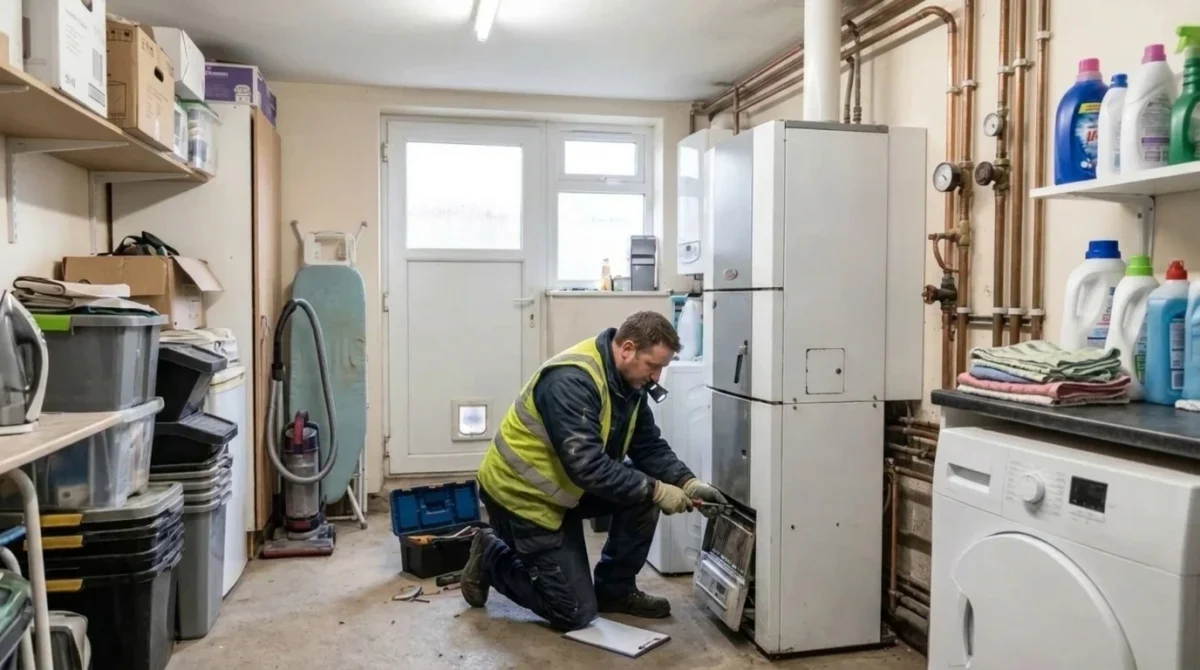
I have serviced hundreds of domestic biomass boilers since 2015, and most of the breakdowns I am called to have the same few causes: a missed service, ash left to build up, settings that were never right, or a boiler that cannot breathe. A pellet boiler is reliable when it is looked after and expensive and frustrating when it is not.
This guide explains what a proper service covers, line by line from my own service sheet, the usual reasons pellet boilers break down, and what you can safely do between services. If you own a domestic pellet boiler in England or Wales and need a service or repair, you can book with me at the end.
Biomass boiler servicing in short
- A pellet boiler needs a full service at least once a year. Most breakdowns I am called to trace back to a missed service or ash left to build up.
- A proper service covers four areas: the boiler body and burner, the electrics, the water side, and a full test run with the boiler firing.
- The usual causes of trouble are ash build-up, wrong settings, a starved air supply, a dirty flue or draught stabiliser, and poor or damp pellets.
- Between services you can empty the ash, keep pellets dry and the air vent clear, and note any fault codes.
- I service and repair domestic pellet boilers across England and Wales, from £250 depending on the boiler type and size.
Why a pellet boiler needs servicing
A pellet boiler burns a solid fuel, so it makes ash, soot and fine dust that a gas boiler never does. Some boilers clean themselves automatically, but none clean everything, and the moving parts that feed fuel, clean the heat exchanger and remove ash all wear.
Fewer winter breakdowns
Ash, worn seals and blocked hoses build up slowly, then stop the boiler on the coldest week of the year.
Less fuel burnt
Ash on the heat exchanger acts as insulation. The heat goes up the flue instead of into the water, so you burn more pellets for the same warmth.
Flue and carbon monoxide
A blocked flue, poor seals or a starved air supply can let fumes into the house. A service checks all three, and the carbon monoxide alarm.
Many manufacturers also make an annual service a condition of the warranty, so check yours before the year runs out.
What my annual biomass boiler service covers
This is the checklist I work through on every domestic pellet boiler, taken from my own service sheet. Each item is checked and reported on, so you can see what was done and what needs watching.
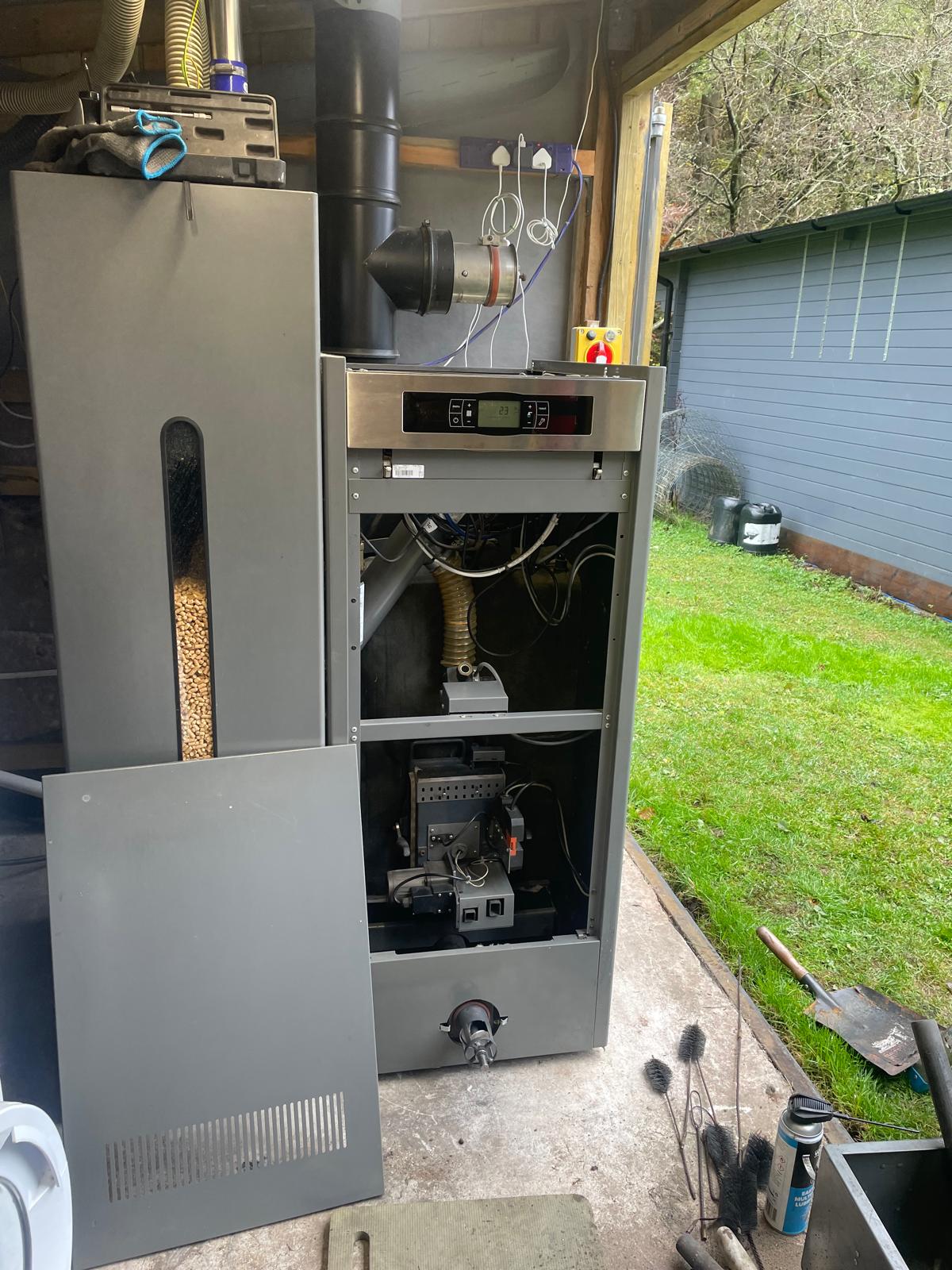
Boiler body and burner
- Clean the heat exchanger and its automatic cleaning parts
- Clean the flue fan rotor, and renew the plate seal if needed
- Clean out the lower ash tray and the boiler floor
- Clean the flue and draught stabiliser where needed
- Remove the burner, clean the combustion area and check its parts
- Check the moving grate parts
- Check and clean all door and panel seals
- Grease motor linkages and moving parts with copper grease
- Clean the tubes and depression hoses, and check every sensor
Electrics and controls
- Run the boiler’s automatic component test
- Listen to every motor for noise and smooth running
- Record the fault history and check the control panel
- Check and clean the electrical connections
Water side
- Check the boiler pump
- Check the system pressure and look for leaks
- Test the pressure relief valve and set the system pressure
- Clean the heat exchanger’s automatic air vent
Test run with the boiler firing
- Start the boiler and check the air depression (draught through the boiler)
- Check the start-up sequence and time the ignition
- Run the boiler up to its set temperature
- Check flue emissions with a flue gas analyser where needed
- Check the heating pipes are hot and the mixing valve works
- Test the carbon monoxide and smoke alarms
A written report
- Every item checked and reported on my service sheet
- Anything worn or close to failing flagged before it stops the boiler
- The work area vacuumed and the boiler panels wiped down
Parts, cleaning or flushing fluids and extra components are charged on top of the service, and I agree them with you first.
Compare this with a quick “empty the ash and check it lights” visit. A full service takes several hours because the boiler is stripped, cleaned and then checked under firing, with the draught, ignition and emissions checked.
Why biomass boilers break down: the usual causes
From the call-outs I see, these are the problems that make pellet boilers unreliable, and most of them start small:
| Cause | What you notice | How a service prevents it |
|---|---|---|
| Missed services | Gradual loss of output, then a lockout on a cold day | Annual strip-down and clean, with worn parts found early |
| Ash build-up | Ash bin full sooner, higher flue temperature, more pellets used, ignition failures | Heat exchanger, ash tray, combustion area and flue cleaned |
| Incorrect settings | Smoky start-ups, clinker on the grate, short cycling, boiler too hot or too cool | Settings checked against the boiler, fuel and house, and the test run timed |
| Starved air intake | Poor burn, soot, lockouts, worse with doors and windows shut | Air supply checked against the boiler’s needs; see below |
| Flue and draught stabiliser | Smell of smoke, unstable draught, faults in windy weather | Flue and stabiliser cleaned, the flap checked to swing freely |
| Leaking seals | Air depression faults, soot round doors | Door and panel seals checked and renewed |
| Blocked hoses and sensors | Depression or temperature faults with no obvious cause | Tubes and depression hoses cleaned, sensors checked |
| Poor or damp pellets | More ash and clinker, auger jams, swollen or dusty pellets | Fuel checked; ENplus A1 pellets stored dry |
Settings matter more than most owners realise. Fuel feed, air and cleaning intervals are set for a particular boiler, flue and fuel. A boiler set up for one pellet weight, or never adjusted after commissioning, can clinker, soot up or cycle badly. Those settings are checked on every service.
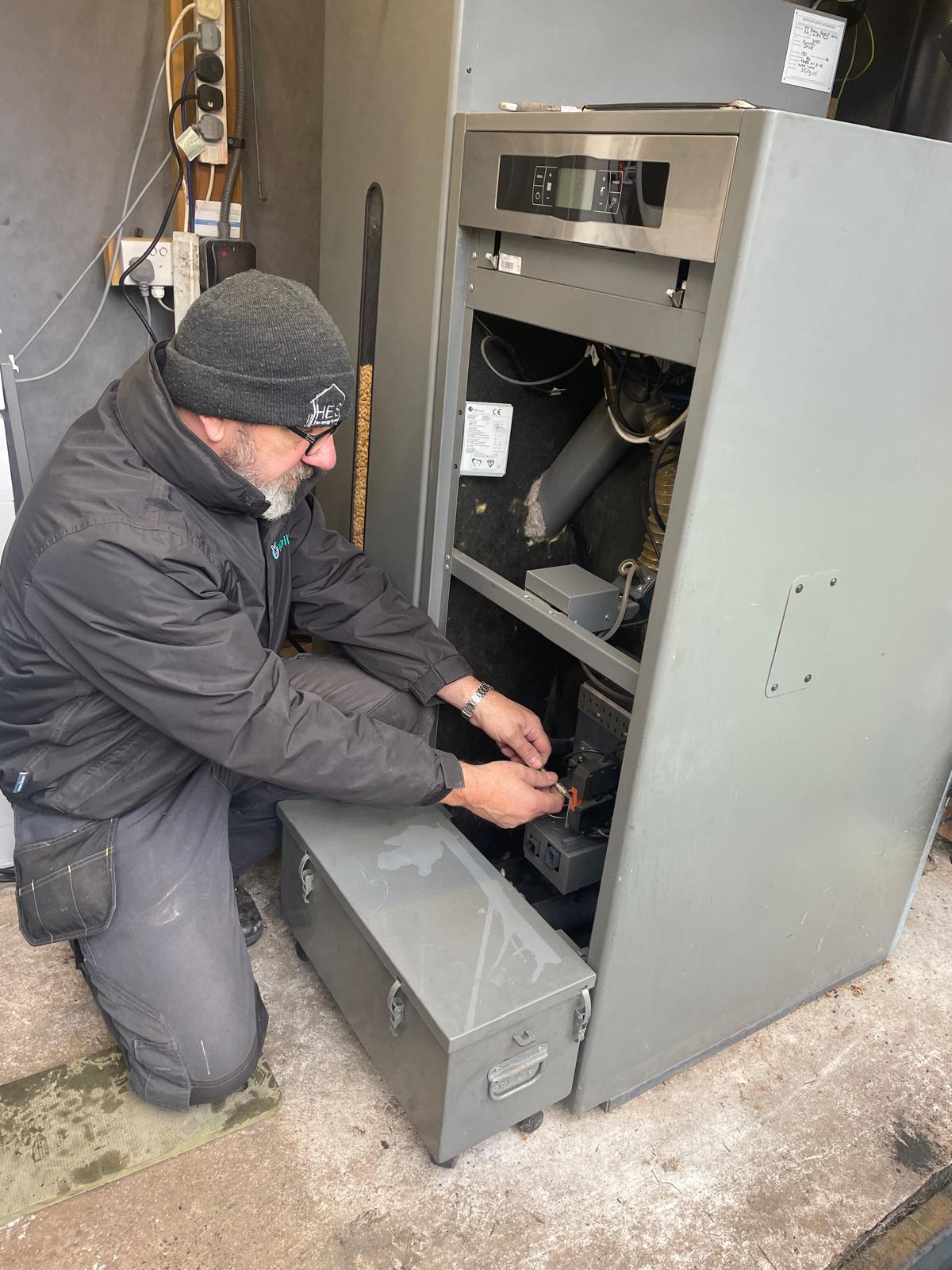
Air supply and the draught stabiliser: the problem most often missed
A pellet boiler needs a permanent supply of fresh air to burn properly. If the boiler room has been sealed up with new doors or windows, or the vent has been blocked with boxes or insulation, the boiler is starved of air. It burns poorly, soots up and locks out, and often gets worse when the house is shut up in winter.
A flue draught stabiliser increases the air needed. The stabiliser is a weighted flap on the flue that lets room air in to keep the draught steady. That air has to come from somewhere, so Building Regulations guidance asks for a bigger vent when one is fitted:
| Boiler output | With a draught stabiliser | Without one |
|---|---|---|
| 10 kW | about 58 cm² | about 28 cm² |
| 15 kW | about 100 cm² | about 55 cm² |
| 20 kW | about 143 cm² | about 83 cm² |
Permanent vent area for a closed solid fuel appliance in a typical home (air permeability above 5 m³/h.m²), from Building Regulations Part J guidance: 300 mm² per kW for the first 5 kW then 850 mm² per kW with a stabiliser, or 550 mm² per kW above 5 kW without. Newer, more airtight homes need more. Always check the boiler’s own manual.
The stabiliser itself also needs care. If it is dirty, stuck or boxed in, the draught swings with the weather, which shows up as faults on windy days. On a service I clean it and check it swings freely.
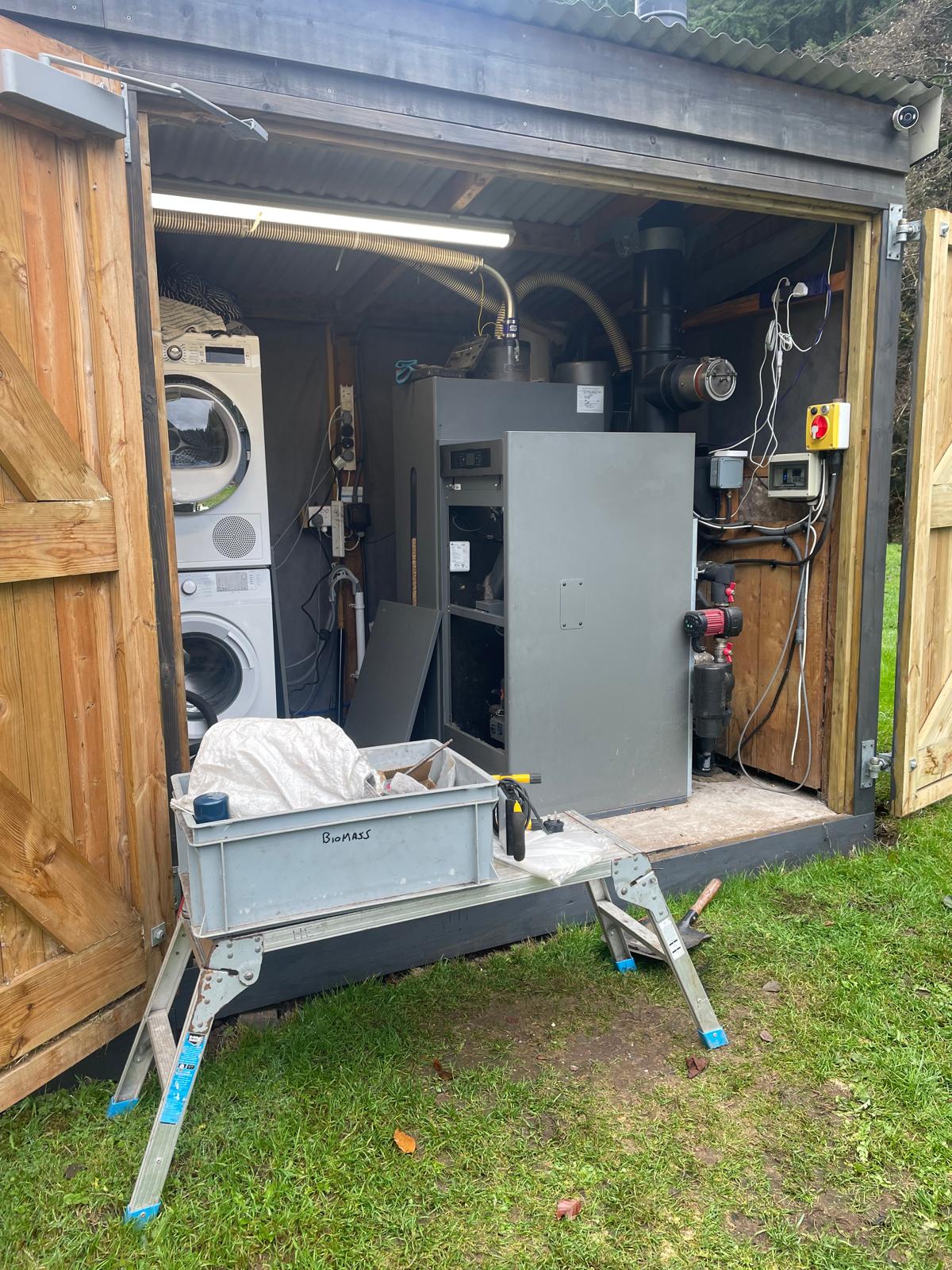
What you can do between services
Owner checks
- Empty the ash bin as often as the manual says, into a metal container, and only when cold
- Buy ENplus A1 pellets and keep them dry; damp, swollen or dusty pellets cause jams and clinker. A moisture meter gives a quick check
- Keep the boiler room air vent clear of boxes, insulation and plants
- Check the system pressure gauge
- Test the carbon monoxide alarm monthly
- Write down any fault code and when it appeared
Stop and call
- Opening the burner or combustion chamber
- Anything inside the electrical panel
- Changing combustion or fuel feed settings
- A smell of smoke or fumes in the house: switch off, ventilate and call
- The same fault returning after a reset
Useful kit for pellet boiler owners
- An ash vacuum: with a metal hose and fine filter, for emptying cold ash without dust in the house. A normal vacuum is not safe for ash.
- A carbon monoxide alarm: one in the boiler room, as Building Regulations require for solid fuel appliances.
- A pellet moisture meter: a quick check on a new delivery or a bag from the store; good ENplus A1 pellets are 10% moisture or less, and wetter pellets mean more ash, clinker and feed jams.
Biomass boilers I service
I am manufacturer trained through courses on biomass boilers, including Domusa, Extraflame, ETA and Froling, and I also service Biotech and EkoHeat boilers. Other makes are considered too; send me the details, and I will tell you whether I can help.
Domusa Bioclass
Compact domestic pellet boilers, often fitted where space is tight.
Nordica Extraflame
Italian pellet boilers and pellet stoves with boilers built in.
ETA
Austrian pellet boilers with automatic cleaning and ash compaction.
Froling
Austrian pellet boilers, from compact models to larger homes.
Biotech
Austrian pellet boilers, including the Top Light range.
EkoHeat
Domestic pellet boilers, serviced and repaired.
Thinking about replacing an old boiler? See my best biomass pellet boilers comparison, and the biomass boiler guide for running costs and the Boiler Upgrade Scheme grant.
Book a biomass boiler service or repair
Book a service or repair
I service and repair domestic pellet boilers across England and Wales, and quote for new installations. Servicing starts from £250, depending on the boiler type and size. I do not run a 24-hour call-out service, so please get in touch in good time before winter.
To get a quick, accurate answer, email me through the contact page with:
- The boiler make and model (and the serial number if you have it)
- What is wrong: the fault code, what the boiler is doing, and when it started
- Your postcode
- When it was last serviced
- A photo of the display or the data plate, if you can
Common questions
Biomass boiler servicing: common questions
How often should a biomass boiler be serviced?
At least once a year, ideally before the heating season. A boiler that runs hard, or burns lower-quality pellets, may need a mid-season clean as well. Many manufacturer warranties require an annual service.
How much does a biomass boiler service cost?
My servicing starts from £250 for a domestic pellet boiler, depending on the type and size. Parts and extra components are charged on top, agreed with you first.
How long does a pellet boiler service take?
Usually several hours, because the boiler must be cool, then stripped, cleaned and test-fired. Larger boilers, or one that has missed services, take longer.
Does a biomass service engineer need to be HETAS registered?
HETAS registration is mainly about signing off installations under the Building Regulations. For servicing, what matters is training on your make of boiler, and anything your warranty requires. I am manufacturer trained on the boilers I service.
Why does my pellet boiler keep failing to ignite?
The common causes are ash or clinker in the burner, a worn ignition element, damp pellets, a blocked feed, or an air supply problem. Note the fault code and how often it happens, then book a service rather than resetting it repeatedly.
Can I service a pellet boiler myself?
You can empty the ash and do the owner checks in your manual. The strip-down, combustion checks and settings need an engineer trained on the boiler, and doing them yourself may affect your warranty.