
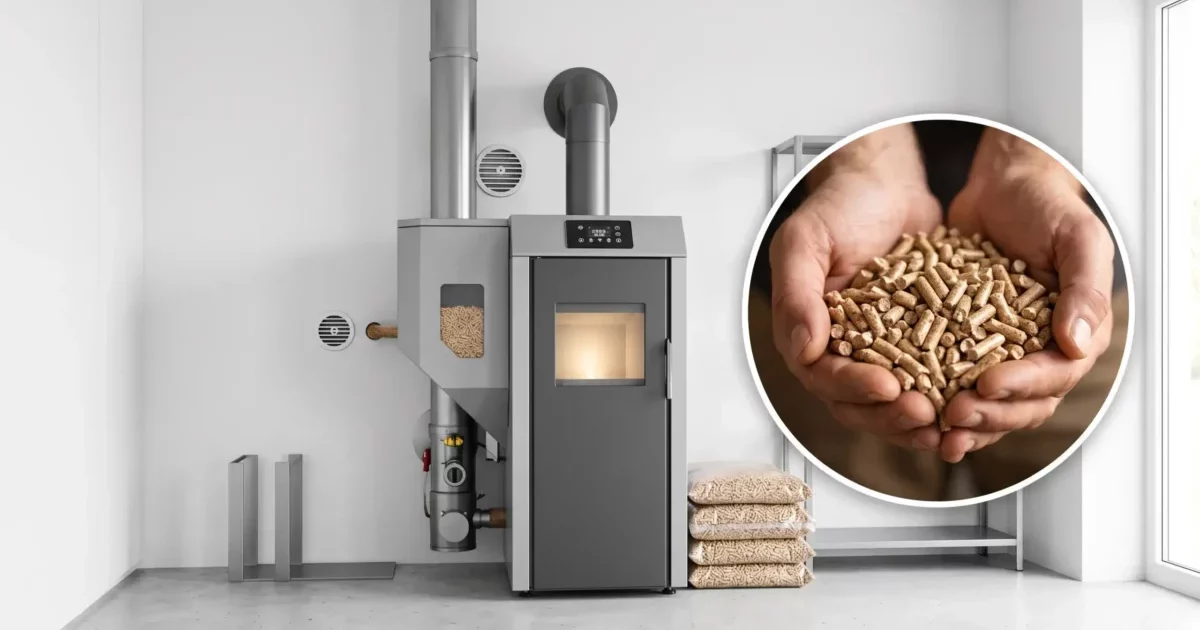
Biomass boilers have become something of a niche technology in UK domestic heating. As heat pumps have moved into the mainstream and grant support has shifted heavily in their favour, pellet boilers now occupy a narrower (but still genuine) role for off-grid rural properties, larger older homes with high heat demand, and households with access to a reliable local pellet supply.
This guide looks at where a pellet boiler still makes sense, how the leading brands compare, and what the current grant position looks like, rather than presenting biomass as a like-for-like alternative to a heat pump for every home.
On this page
Is biomass still worth considering?
Honestly, for most homes, no. If you’re on the gas grid or have a manageable retrofit path to a heat pump, a heat pump is very likely the better long-term choice: it’s cheaper to run per unit of heat in most cases, has no fuel deliveries, has no ash to deal with, and has more grant support available.
Where biomass can still earn its place:
- Off-gas-grid rural properties, particularly where a heat pump installation is difficult to design around (limited outdoor space, listed building restrictions, or very high heat loss that a heat pump would need extensive fabric upgrades to work well with)
- Properties with existing wood fuel infrastructure: farms, smallholdings, or homes near a reliable local pellet supplier
- Large, older properties with high, consistent heat demand, where biomass boilers scale well at higher outputs
- Households already used to solid fuel heating who want to stay with a similar fuel type but move to something cleaner and more automated than an old log-fed system
If none of those applies to your situation, it’s worth reading our heat pump comparison guide first.
How pellet boilers work
A pellet boiler stores wood pellets in a hopper (either integrated or as a separate silo/bulk store), then feeds them automatically via an auger into a combustion chamber. Combustion air and pellet feed rate are electronically controlled to maintain efficient burning, and flue gases pass through a heat exchanger before exiting. Ash is collected in a removable tray, which needs periodic emptying; frequency depends on ash tray size, pellet quality, and how much the boiler runs.
Modern automatic pellet boilers are a world away from manually fed log burners: ignition, feed, and combustion control are all automated, and many models now include self-cleaning heat exchangers and burners, WiFi monitoring, and smartphone control. You can read more on how pellet boilers work here.
Compare leading biomass pellet boiler brands in the UK
| Brand & model range | Origin | Output range | Notable features | Indicative efficiency |
|---|---|---|---|---|
| Grant Spira | UK | 5–72kW | Twin stainless steel turbulator baffle system; UK’s most widely installed residential pellet boiler | Up to 93% |
| ETA (via Innasol) | Austria (UK-distributed) | Wide domestic-to-commercial range | Long-established sole UK distribution model; strong installer network and training focus | High 80s–90%+ |
| Windhager FireWIN Klassik | Austria | 3.8–12kW | Compact, room-heater-style design combined with boiler function; suited to smaller homes | Around 94% |
| Froling | Austria | Domestic to large commercial | Well-regarded for reliability at higher outputs; broad model range | High 80s–90%+ |
| Hargassner | Austria | 6–330kW | Very wide range from single-home to multi-dwelling/commercial scale | High 80s–90%+ |
| Domusa Teknik Bioclass iC | Spain | 12–66kW | “Flame Logic” intelligent combustion control; standard WiFi (iConnect) for remote monitoring and scheduling; fully automatic self-cleaning of burner and flue heat exchanger. | Above 92% |
It is worth noting that the Domusa Bioclass iC DX variant integrates a stainless steel DHW cylinder and buffer tank into the boiler unit itself, which is a genuinely useful space-saver for smaller plant rooms or outbuildings where a separate cylinder isn’t practical.
What to check before choosing a pellet boiler
- Automatic vs manual feed: nearly all modern residential models are automatic-feed via hopper/auger; manual feeding is largely a thing of the past for anything beyond small stoves
- Hopper size and refill frequency: a small integrated hopper may need refilling weekly; a bulk store with automatic vacuum or auger feed from a separate silo needs far less attention but requires more installation space and cost
- Ash removal system: automatic ash compaction extends the interval between manual emptying; worth checking for your expected usage pattern
- Self-cleaning heat exchanger/burner: reduces maintenance callouts and keeps efficiency stable over time
- Remote monitoring/app control: increasingly standard (as with Domusa’s iConnect), useful for holiday homes or infrequently checked rural properties
- Flue and planning requirements: biomass flues have specific requirements, and some properties (particularly in smoke control areas or listed buildings) will need additional checks
- Pellet supply logistics: confirm a reliable local supplier before committing; pellet price and availability can vary regionally
Running costs vs heat pumps and oil boilers
Wood pellet prices have historically been more stable than oil, though they are subject to their own supply and demand pressures, and pellet cost per kWh is generally higher than a well-performing heat pump’s running cost (heat pumps benefit from the “free” renewable heat multiplier effect of their SCOP).
For an off-grid property currently on oil, replacing an ageing oil boiler with a modern pellet boiler is very often a straightforward like-for-like cost improvement, but it’s genuinely worth getting comparative quotes for both a pellet boiler and a heat pump before deciding, since the right answer depends heavily on the specific property.
BUS grant eligibility for biomass boilers (2026)
The Boiler Upgrade Scheme (BUS) biomass grant sits at £5,000, but the eligibility criteria are considerably narrower than for heat pumps:
- The property must be off the gas grid
- The property must be in a rural location
- The boiler must have a valid emissions certificate confirming minimal polluting emissions
- Self-build properties are excluded from the biomass grant entirely
- As with all BUS categories, the installation must be carried out by an MCS-certified installer, and both the installer and the specific boiler model must be on MCS’s certified lists at the time of installation
As of the most recent BUS guidance update (in force from 28 April 2026), the previous mandatory EPC precondition has been removed for the scheme generally, which makes qualifying somewhat more straightforward than it was in earlier years, though the rural, off-gas-grid, and emissions certificate requirements specific to biomass remain firmly in place.
For the full picture of how biomass grant support compares with heat pump grant tiers, see our BUS vs ECO4 vs Warm Homes Plan comparison.
FAQs
Is a biomass boiler cheaper to run than a gas boiler?
It depends on local pellet prices and gas prices at the time, but biomass is typically compared against oil or LPG rather than mains gas, since it’s mainly relevant to off-grid properties. Running costs are usually competitive with oil.
Can I get a grant for a biomass boiler?
Yes, via the Boiler Upgrade Scheme, but only if the property is off the gas grid, in a rural location, and the boiler has a valid emissions certificate. Self-build properties don’t qualify.
How often do I need to empty the ash tray?
This depends on the model, ash tray size, and how much the boiler runs, but many modern automatic pellet boilers extend this interval significantly compared to older systems, with some offering automatic ash compaction.
Do pellet boilers need much maintenance?
Modern automatic-feed pellet boilers with self-cleaning heat exchangers and burners require considerably less hands-on maintenance than older biomass systems, though an annual professional service remains standard practice.
Is biomass a good option if I’m on the gas grid?
Generally, no: a heat pump will usually be the more straightforward and better-supported option for on-grid properties, both in terms of running costs and available grant support.
Final Thoughts
Biomass pellet boilers have a real, if narrower, place in UK heating, mainly for off-grid rural properties where a heat pump is genuinely difficult to design around or where an existing wood fuel supply chain already makes sense for the household. Brands like Grant, ETA, Windhager, Froling and Hargassner remain well-established in the UK market, while Domusa’s Bioclass iC range brings a genuinely modern, well-monitored option with useful space-saving integrated variants.
The honest starting point for anyone weighing this up isn’t “Which pellet boiler is best?” but “Is a pellet boiler the right technology for this property at all?”, and for the majority of on-grid homes, a heat pump will usually be the more straightforward, better-supported choice. Where biomass does fit, though, it’s matured into a genuinely low-maintenance, automated technology rather than the manually-fed log burners many people still picture when they hear the word “biomass”.