
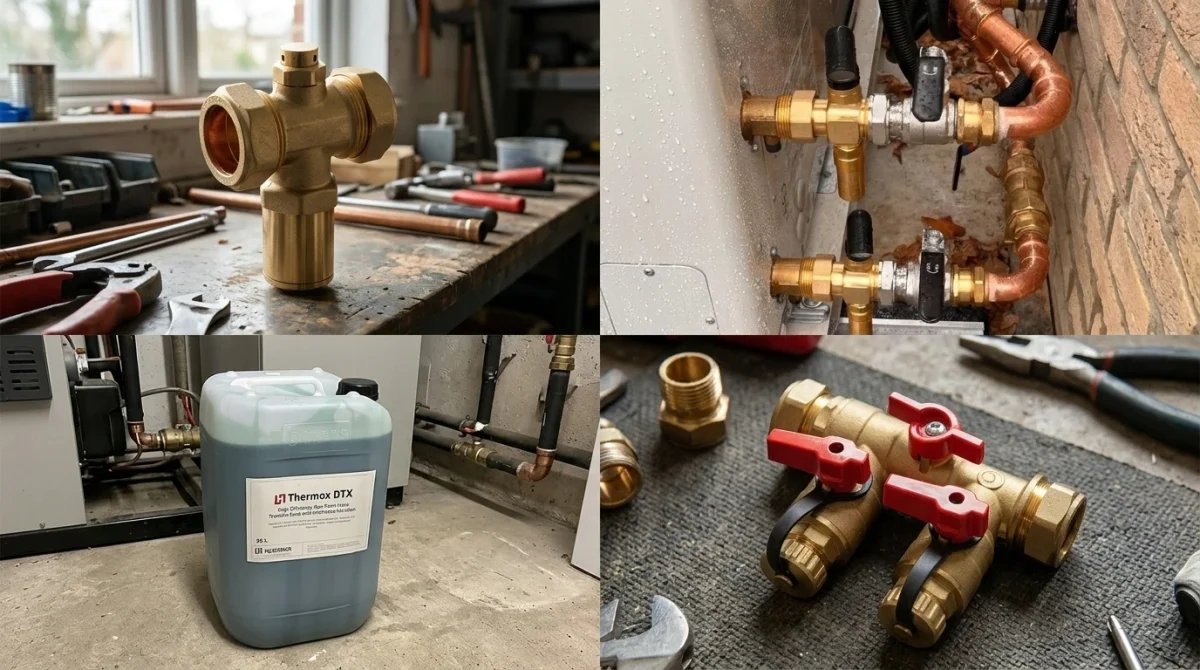
An air source heat pump sends water through pipes and a heat exchanger that sit outside in the cold. If that water freezes, it expands and can split the heat exchanger inside the outdoor unit, a repair that can cost about as much as a new unit. Every installation needs a plan for that, and installers argue and debate about which plan is best.
The two main options are anti-freeze valves and glycol. This guide covers how each works, how valves should be sited, what goes wrong with each, the bacteria question, whether glycol needs hydraulic separation, and what each costs, so you can decide with your installer rather than take a default.
Anti-freeze valves or glycol, in short
- Both only matter when the heat pump cannot protect itself: a power cut, a tripped breaker or a unit switched off in freezing weather.
- Anti-freeze valves dump water from the outdoor pipework at about 3°C. Cheap and efficient, but the system must be refilled after they open.
- Glycol stops the water freezing at all. Robust for empty homes and long outdoor runs, but it carries less heat and needs testing and topping up with the right mix.
- Glycol only fights bacteria at the right strength: around 25% or more. Diluted below 20% it can encourage bio-fouling.
- Glycol does not need hydraulic separation, but separating it with a plate heat exchanger can make sense on large or old systems, at a small efficiency cost.
Why a heat pump needs frost protection, and when it matters
In normal running, freezing is not a problem: the water is moving and warm, and the unit’s own frost function runs the circulating pump, and on some models the backup heater, if the water temperature drops.
The risk comes when that cannot happen. A power cut on a freezing night, a tripped breaker, or a unit switched off at the isolator leaves still water in the outdoor pipework, and it can freeze within hours. Valves and glycol are the backup for those moments. Neither replaces good outdoor insulation, which slows cooling in every case.
Anti-freeze valves and glycol at a glance
| Anti-freeze valves | Glycol | |
|---|---|---|
| How it works | Two thermostatic valves on the outdoor flow and return open at about 3°C and let water drain out before it freezes | An antifreeze fluid, usually monopropylene glycol, lowers the freezing point of the whole circuit |
| Power cut in a frost | Protects the unit by emptying the outdoor pipework; heating stays off until the system is refilled | Nothing drains; the system restarts when power returns |
| Efficiency | Plain water with inhibitor: no penalty | Carries less heat per litre, so needs more flow and a little more pump energy |
| Maintenance | Check for drips; replace valves if they stop reseating | Test strength at every service; top up only with the right mix |
| Bacteria | Relies on inhibitor and, if used, biocide | Bacteriostatic at around 25% or more |
| Best suited to | Occupied homes, short outdoor pipe runs, a unit maker that approves them | Second homes, long or buried outdoor runs, areas prone to long power cuts |
Check the manufacturer’s instructions first. Makers differ: some approve valves, some prefer glycol, and some set conditions such as a frost setting being switched on. Your warranty may depend on following them; see heat pump warranties compared.
How anti-freeze valves work, and how to site them
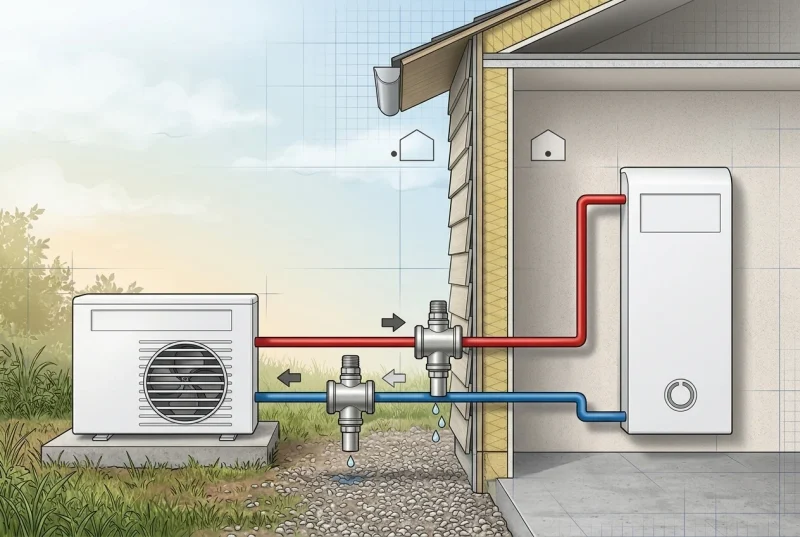
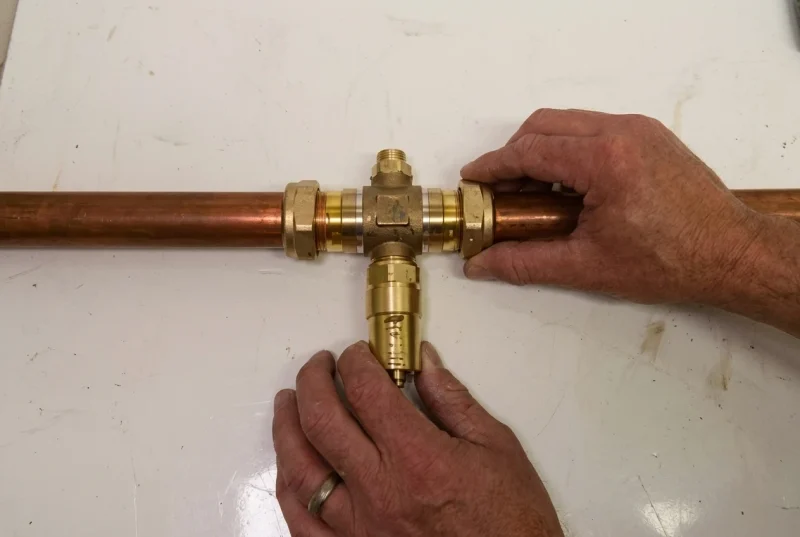
An anti-freeze valve contains a thermostatic element. When the water reaches about 3°C it opens and lets water drain out of the outdoor pipework, and it closes again at about 4°C. An air vent on top lets air in so the pipe empties instead of holding a vacuum. The system stays protected because the water that could freeze is no longer there.
Insulation depends on the valve. Some anti-freeze valves must be left bare so they feel the cold. Others are designed to be lagged, with a snorkel or remote sensor poking out through the insulation to sense the outside air. Both are used in the UK; the rule is to follow the instructions for the valve you have, because lagging over a sensor that needs to be exposed stops it opening in time.
Fitting valves well
- Fit two: one on the flow and one on the return, outside and as close to the unit as possible
- Mount them vertically with the outlet pointing down
- Leave at least 15 cm between the outlet and the ground, so ice cannot block it
- Space them at least 10 cm apart, or 20 cm for versions with an air sensor
- Lay the outdoor pipework so it falls towards the valves, with no dips that can hold water
- Give the discharge somewhere safe to go: gravel or a drain, not a path
- Insulate the outdoor pipework with UV-resistant lagging, following the valve maker’s rules for the valve itself
Common mistakes
- Lag over a valve’s sensor or air vent unless the maker allows it: a valve that cannot sense the cold will not open in time
- Fit a single valve, which can leave water trapped on the other pipe
- Mount them sideways or upside down
- Fit them inside the house, where they never see the cold
- Use them with glycol: they would dump expensive fluid
- Leave the unit switched off at the isolator in winter: the valves will open once the water cools
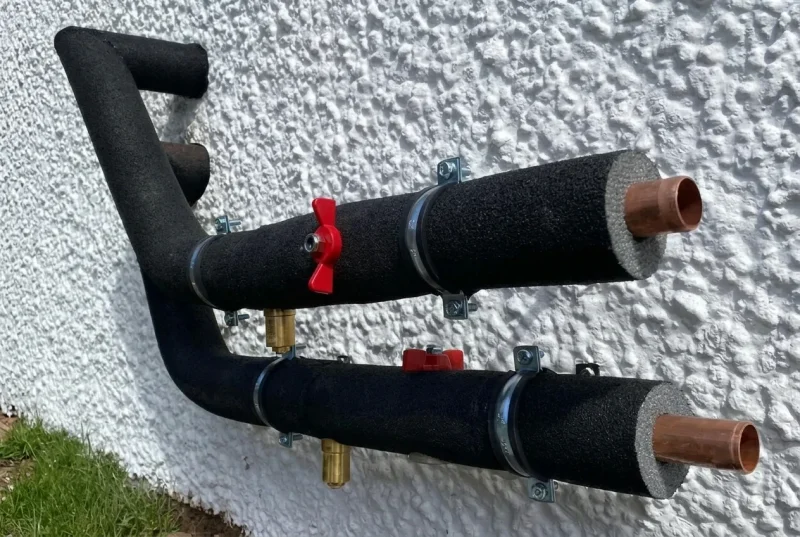
Some versions add an air temperature sensor, so the valve only opens when the outside air is cold as well, which cuts unnecessary dumps. Whatever the version, the valves must be the coldest point in the circuit, or water will freeze somewhere else first.
What can go wrong with anti-freeze valves
Most problems come from where and how the valves were fitted, or from the system around them:
| Problem | Usual cause | Prevention |
|---|---|---|
| System empties in a long power cut | The valves doing their job | Know how to refill and bleed it, or ask about an automatic fill valve or backup power |
| Valve opens with the power on | Unit switched off at the isolator, or on holiday mode with the frost function disabled | Leave the unit powered with its frost protection on all winter |
| Dripping in mild weather | Debris or scale on the seat stops it closing | A clean, flushed system with a filter; replace a valve that will not reseat |
| Water freezes in the unit anyway | Valve sensor lagged over, single valve, dips in the pipe, or valves too far from the unit | Follow the siting rules above and the unit maker’s instructions |
| Outlet blocked by ice | Fitted too low, or discharging onto a surface that freezes | At least 15 cm clearance and a free-draining spot |
| Slow pressure loss | A valve weeping, hidden by an automatic fill valve | Check the gauge and look at the valves after cold spells |
The catch most owners do not expect
After the valves open, the heat pump cannot run until the system is refilled and bled. In an occupied home that is an inconvenience; in an empty one, it can mean no heating until someone visits.
Glycol: strength, the bacteria question and the efficiency cost
Heat pump glycol is usually monopropylene glycol mixed with water, with corrosion inhibitors and stabilisers. It lowers the freezing point of the whole circuit, so nothing drains and the system simply restarts when the power returns. The strength sets the protection:
| Glycol strength | Freezes at about | Heat carried vs water | Bacteria |
|---|---|---|---|
| Water only | 0°C | 100% | Relies on inhibitor and biocide |
| 10% | -3 to -4°C | about 97% | Risk of bio-fouling |
| 20% | -7 to -9°C | about 94% | Risk of bio-fouling |
| 25% | about -10°C | about 92% | Bacteriostatic |
| 30 to 35% | -14 to -17°C | about 88 to 90% | Bacteriostatic |
Freezing points from fluid makers’ and Energy Saving Trust tables for monopropylene glycol; heat carried is specific heat compared with water. Follow the fluid maker’s own range for its product.
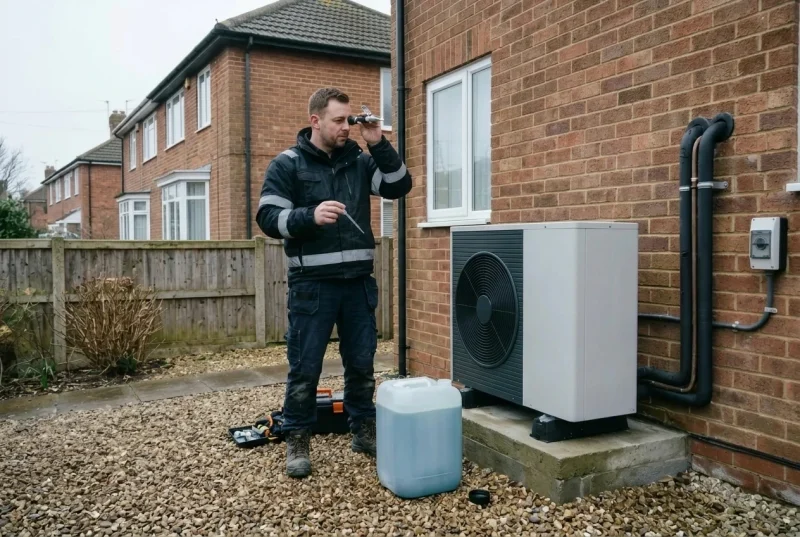
The bacteria benefit is real, but only at the right strength. At around 25% or more, glycol is bacteriostatic: bacteria and fungi cannot grow in it. Below about 20% the opposite can happen, and diluted glycol becomes a recipe for bio-fouling. That is why strength matters as much for bacteria as for frost, and why mains top-ups are a problem.
The efficiency cost is smaller than some claims online. At 25%, the fluid carries about 8% less heat per litre than water. The installer makes up for it with a slightly higher flow rate, so the main penalty is a little more pump energy and slightly less output on the coldest days. It is a design allowance, not a 20% rise in bills.
What can go wrong with glycol
| Problem | Usual cause | Prevention |
|---|---|---|
| Strength drifts down | Top-ups with mains water, often through a filling loop or automatic fill valve | Top up only with premixed fluid at the right strength; keep the filling loop disconnected |
| Fluid breaks down | Age, heat and air ingress use up the inhibitors and turn the fluid acidic | Test at every service; replace when the test says so |
| Sludge or bio-fouling | Dilution below 20%, or fluid added to a dirty system | Clean and flush before filling; keep it at 25% or more |
| Lower output on cold days | Glycol carries less heat at the same flow | The design should allow for it: pump sized for the fluid, flow rate set at commissioning |
| Leaks are costly | Every litre lost must be replaced with fluid, and it is sticky to clean up | A sound system before filling; consider separation on old installations |
| Wrong product | Car antifreeze, ethylene glycol, or mixing brands | Use the heat pump fluid the installer specified, and record its name |
Glycol does not protect your drinking water from anything. It sits in the sealed heating circuit; hot water safety comes from the cylinder’s regular heat-up to 60°C.
Does glycol need hydraulic separation?
No, not as a rule. Most domestic glycol systems run the fluid through the whole circuit. Separation is a design choice: a plate heat exchanger keeps the glycol in the outdoor loop and leaves the house side on ordinary treated water.
Glycol through the whole system
- No extra parts, and no temperature penalty
- Every litre in the radiators, pipes and cylinder coil needs treating, so large systems cost more to fill
- Any leak anywhere loses fluid
- The system must be clean and sound before filling
Separated by a plate heat exchanger
- Glycol only in the short loop to the outdoor unit; the house side stays on water with inhibitor
- Far less fluid to buy and test
- Needs a heat exchanger, a second pump and a second expansion vessel
- The exchanger adds a degree or two to the flow temperature the heat pump must make, which costs some efficiency
Separation earns its place on a large or old system, where filling everything with glycol is expensive and any leak in an old radiator loses fluid; where an existing system’s condition is doubtful; or where an automatic fill valve has to stay on the house side. On a new, compact system it usually costs more in efficiency and parts than it saves.
It is not the same as a buffer tank, though both separate circuits. See do you need a buffer tank?
Cost comparison: valves against glycol
| Cost item | Anti-freeze valves | Glycol |
|---|---|---|
| Parts | About £100 each for a 1-inch valve, so about £200 a pair | About £200 for 20 litres of concentrate; a typical 100 to 200 litre system at 25% needs 25 to 50 litres |
| Fitting | Under an hour on a new installation | Flushing, then pump-filling and mixing: a few hours |
| Each year | A visual check at the service | A strength test at the service, and premix for any top-ups |
| Over ten years | Possibly one replacement pair, plus a refill and bleed after any big freeze | Possibly a full drain and refill, plus the small pumping and output penalty |
| Hidden costs | A call-out to refill after a long power cut | Fluid lost in any leak; separation parts if used |
Typical UK trade-counter prices in November 2026, including VAT. Your installer’s prices and system volume will differ, so ask for both options priced on the quote.
On a typical new installation, valves are usually the cheaper option up front and over time, provided the house is occupied and power cuts are rare. Glycol costs more to fill and maintain, and buys protection that does not depend on anyone being there.
Which should you choose?
Occupied home, short run
The unit sits close to the wall, someone is home through the winter, power cuts are rare and the unit maker approves valves.
Empty for long spells
Second homes, holiday lets, or anywhere a power cut could go unnoticed for days. A drained system with nobody there to refill it is no use.
Long or buried pipes
Long outdoor runs, or pipes buried between a detached garage and the house, cannot drain fully through two valves.
Big or old system
Lots of water, old radiators or doubtful pipework: either valves, or glycol kept to the outdoor loop behind a heat exchanger.
Questions to put to your installer:
- Which method does the unit’s manufacturer approve, and does my warranty depend on it?
- If valves: where will they go, how will the outdoor pipe fall to them, and where will the water discharge?
- If valves: what happens after a long power cut, and is an automatic fill valve or backup power worth adding?
- If glycol: which product, at what strength, and how many litres? Will it be tested at each service?
- If glycol: is the circulating pump rated for it, and has the flow rate been set for it?
- Is separation proposed, and if so what flow temperature penalty has the design allowed for?
For what a good design should show more widely, see is your heat pump design right?, and for winter settings that keep the unit protected, see heat pump winter efficiency tips.
Useful kit
- A glycol refractometer: checks glycol strength from a few drops, so you are not relying on a once-a-year visit.
- Outdoor pipe insulation: UV-resistant lagging for outdoor heat pump pipework; check your valve maker’s rules before lagging the valves.
Common questions
Anti-freeze valves and glycol: common questions
Do I need frost protection if my heat pump has its own frost mode?
The built-in frost mode runs the pump, and on some units the heater, when the water gets cold, but it needs power. Valves or glycol cover the times it cannot work: power cuts, tripped breakers, or a unit switched off.
Can I use car antifreeze in a heat pump?
No. Use a heat pump fluid, usually monopropylene glycol with inhibitors, of the type the installer and manufacturer specify. Car antifreeze is usually ethylene glycol with additives not meant for heating systems.
How often should glycol be tested?
At every annual service, with a refractometer or the fluid maker’s test kit. Replace it when the test shows the strength or inhibitors have fallen, not on a fixed date.
Can I have both valves and glycol?
There is little point: the valves would open at 3°C and dump the glycol. Choose one method and design around it.
What should I do after the valves have opened?
Once temperatures are above freezing and the power is back, the system needs refilling and bleeding before the heat pump will run. If you are unsure how, call your installer; my checks before a call-out cover safe pressure top-ups.
Does glycol stop legionella in the hot water?
No. Glycol is in the heating circuit, sealed off from the water you use. Hot water safety comes from the cylinder’s regular heat-up to 60°C.
Next step
Getting quotes? Ask each installer which frost protection they propose and why, with both options priced. You can ask for a quote through my heat pump quote page.