
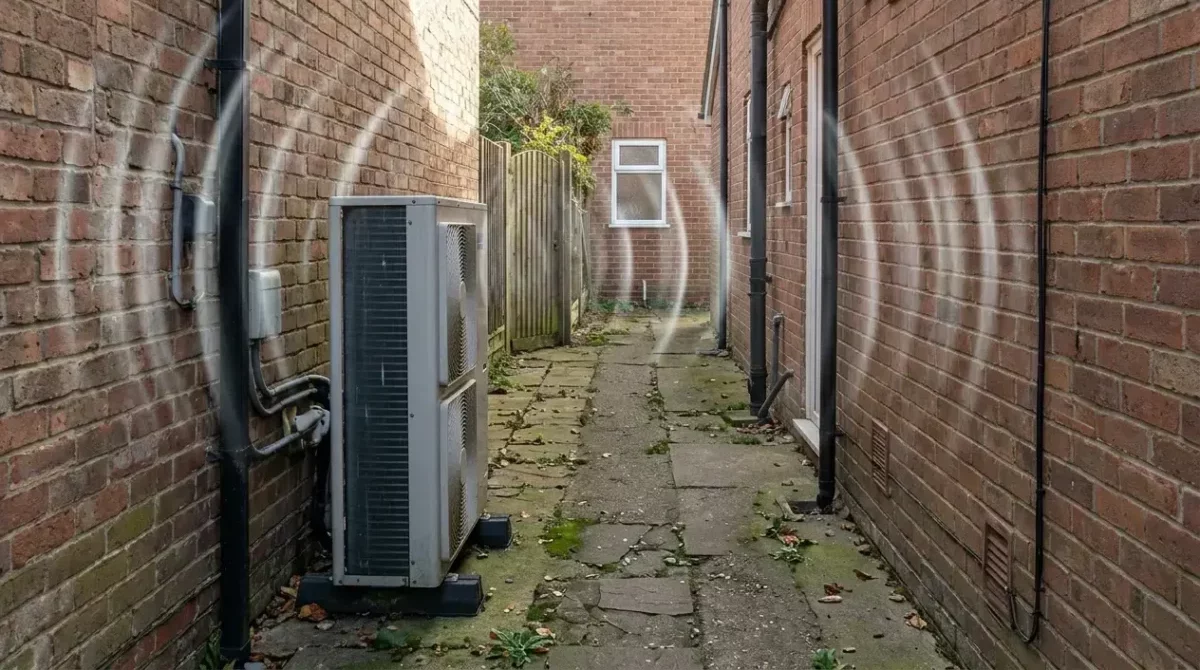
If you are asking how noisy a heat pump is, the honest answer is that it depends on the unit, where you put it and who is standing nearby. A quoted figure on a brochure tells you very little about the noise at the window next door. That figure can be worked out for your plot before anything is bought.
This guide covers how to read a manufacturer’s noise figures, how to estimate the level at a neighbour’s window, and what the MCS 020 assessment should show you. It also covers where to site the unit and what to ask an installer. It is written mainly for people on terraced, semi-detached and tight plots and for self-builders and developers placing units close to boundaries.
Heat pump noise in short
- Compare models on sound power (Lw), not sound pressure, which depends on where it was measured.
- Position matters as much as the model: the same unit can be 36 dB(A) or 50 dB(A) at a neighbour’s window depending on where it goes.
- Each doubling of distance takes off about 6 dB; a wall behind the unit adds about 3 dB, and a corner about 6 dB.
- The planning limit in England is 42 dB(A) at 1 m from the neighbour’s nearest habitable room window, calculated using MCS 020.
- Ask for the MCS 020 calculation sheet with your quote, and aim comfortably below the limit.
What a heat pump sounds like in real life, and why the number on the data sheet might mislead
An air source heat pump has two main noise sources: a fan that pulls air across the coil, and a compressor. The fan produces a steady airflow noise, a bit like a distant extractor. The compressor adds a lower hum, and that hum is what people most often find irritating, because a steady low tone is harder to ignore than a broad, even sound at the same volume.
The noise also changes through the day and through the year. On a mild day, the unit runs slowly and quietly. On a cold morning, when the house needs more heat, the compressor and fan run faster, and the unit is louder. Once the outdoor coil ices up in cold, damp weather, the unit also runs a defrost cycle, and you hear the fan stop and the refrigerant circuit change over. A single decibel number on a brochure cannot describe all of that.
For a sense of scale, this is how typical heat pump levels compare with everyday sounds:
| Sound level | What it is roughly like | For a heat pump |
|---|---|---|
| 30 dB(A) | A quiet bedroom at night | |
| 35 to 40 dB(A) | A quiet library, or a fridge humming | Typical at a neighbour’s window from a well-sited unit |
| 42 dB(A) | The permitted development limit in England, at the neighbour’s window | |
| 45 to 50 dB(A) | Light rain, or a quiet office | A poorly sited unit, close to a window or in a corner |
| 60 dB(A) | Normal conversation at 1 m | Close to the unit itself, at full output |
Everyday comparisons are approximate. A steady low hum is often more noticeable than its decibel figure suggests.
Most brochure figures are measured at one test condition, usually in a laboratory. They are a fair way to compare units against each other, but not a prediction of your neighbour’s evening. To get that, you need to turn the manufacturer’s figure into a level at a specific position.
Sound power versus sound pressure: reading the figures a manufacturer gives you
Manufacturers publish two different kinds of figures, and mixing them up is the most common mistake.
Sound power level (Lw) is the total noise the unit gives off, measured in dB(A). It does not depend on where you stand, so it is the right number for comparing one model with another.
Sound pressure level (Lp) is what a listener hears at a particular distance, also in dB(A). It falls as you move away and changes with the surroundings. Some data sheets quote it at 1 m; others at 5 m or 10 m. Two units quoted at different distances cannot be compared directly.
| Sound power level (Lw) | Sound pressure level (Lp) | |
|---|---|---|
| What it measures | The total noise the unit gives off | What a listener hears at a set distance |
| Depends on where you stand? | No | Yes: it falls with distance and changes with surroundings |
| Use it to | Compare one model with another | Check the level at a particular point, such as a window |
| Watch for | Which operating condition it was measured at | The distance quoted: 1 m, 5 m and 10 m figures are not comparable |
When comparing models, find the sound power figure and check which operating condition it was measured at. Then look for:
- The sound power at full output, not only at part load.
- Any separate figure for a reduced-noise or night mode.
- Whether the figure is quoted in dB(A) and whether the data sheet mentions tonal noise.
Some practical points about the scale itself. A change of about 3 dB is only just noticeable. A change of around 10 dB is generally heard as roughly twice or half as loud. Ten decibels is therefore a big difference, and a unit that is 5 dB quieter on paper is worth having, but the position you choose can easily swing the result by more than that.
Why distance, walls and hard surfaces change what your neighbour might hear
Three things turn a sound power figure into a sound pressure figure at a window: the distance, how much the noise is reflected back, and anything solid in between.
Distance. Noise from a small source in open space drops by about 6 dB each time you double the distance. Moving a unit from 2 m to 4 m from a window lowers the level by roughly 6 dB, which is clearly audible, and 4 m to 8 m gives a further 6 dB.
Reflection. A unit standing on open ground spreads its noise in all directions above the ground. Put it against a wall, and the wall reflects the noise outwards, raising the level by about 3 dB. Put it in a corner between two walls, and you add another 3 dB. In acoustic calculations, this is a directivity factor, usually written as Q: 2 for open ground, 4 against one wall and 8 in a corner.
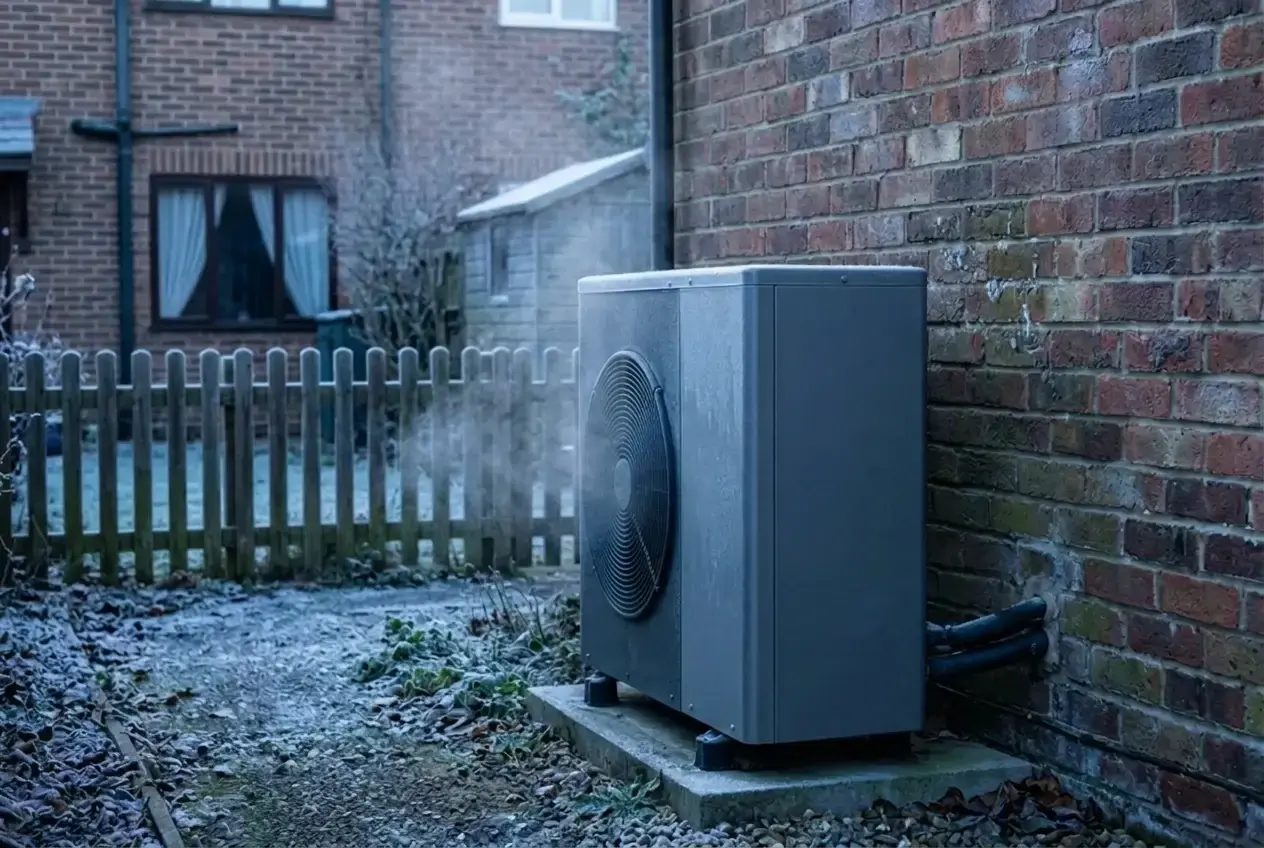
Hard surfaces and enclosed spaces. Brick, render, paving and fences reflect sound. A narrow side passage between two house walls can carry noise along its length towards windows at the far end. Soft ground, planting and absorbent cladding take a little energy out of the sound, but not much.
Here is an illustration. It uses a made-up sound power of 58 dB(A), not a real model, and it considers only distance and reflection. The level is calculated at the neighbour’s window using the standard formula Lp = Lw + 10 log₁₀ (Q ÷ 4πr²).
| Distance to window | Open ground (Q=2) | Against a wall (Q=4) | In a corner (Q=8) |
|---|---|---|---|
| 2 m | 44.0 dB(A) | 47.0 dB(A) | 50.0 dB(A) |
| 3 m | 40.5 dB(A) | 43.5 dB(A) | 46.5 dB(A) |
| 4 m | 38.0 dB(A) | 41.0 dB(A) | 44.0 dB(A) |
| 5 m | 36.0 dB(A) | 39.0 dB(A) | 42.1 dB(A) |
Illustration only: a made-up sound power of 58 dB(A), distance and reflection only, no barrier. Figures above 42 dB(A) would fail the permitted development noise limit in England.
The same unit gives 36 dB(A) at 5 m on open ground and 50 dB(A) at 2 m in a corner. That 14 dB spread comes from siting alone.
The planning noise rule and the MCS 020 calculation: what the installer should show you
In England, installing an air source heat pump under permitted development, without a full planning application, is conditional on meeting the noise standard in the MCS planning standards. The limit is 42 dB(A) at the assessment position, which is one metre from the centre of the nearest neighbour’s habitable room window or door. The method for calculating it is MCS 020. If the calculation shows the unit exceeds the limit in its proposed position, the installation does not qualify as permitted development and needs a planning application, or the unit has to move or be changed.
Scotland, Wales and Northern Ireland have their own planning rules. The permitted development conditions in England were also relaxed in May 2025, when the rule that a unit had to be at least 1 m from the boundary was removed; the noise limit still applies. Before relying on any of this, check the current requirements with your local planning authority or ask your installer to confirm them in writing.
An MCS 020 assessment is a calculation, not a measurement taken at the property. It starts from the manufacturer’s sound power level and applies the directivity factor, the distance to the assessment position, and a correction for any barrier between the unit and the window. The result is the predicted level at the neighbour’s window.
A proper assessment sheet should show:
- The make and model of the unit and the sound power figure used.
- The exact proposed position of the unit.
- The assessment position (which neighbouring window) and the distance to it.
- The directivity factor applied and why.
- Any barrier or screening credited in the calculation.
- The calculated level and whether it passes.
Treat 42 dB(A) as a ceiling for planning compliance, not a promise of silence. In a very quiet street at night, a unit running at 40 dB(A) outside a bedroom window can still be noticed. Aiming comfortably below the limit gives you room for the real-world variations the calculation cannot capture.
Where to put the unit: positions that cause complaints and positions that rarely do
These are the positions that most often lead to complaints, and the ones that rarely do:
Positions that tend to cause problems
- Close to a neighbour’s bedroom or living room window. The assessment is made at the nearest habitable room window, and a short distance is the biggest single contributor to the result.
- In a corner formed by two walls. The extra reflection adds about 6 dB compared with open ground.
- In a narrow side passage. The hard walls on both sides reflect and channel the sound, and the unit sits close to windows on both properties.
- With the fan facing a neighbour’s window or a boundary wall. Noise is not equal in all directions, and the fan side is generally louder. Facing it at a nearby wall also bounces the sound back.
- Fixed to a lightweight wall or to a party wall. Vibration travels through the structure and can be heard inside as a low hum, which a calculation for airborne noise will not reveal.
- Beneath your own bedroom window. The assessment only covers neighbours, but the unit will still be heard by you.
Positions that rarely cause problems
- On open ground, away from walls, with the fan facing a garden or open space.
- Against a blank wall of your own house, with no windows nearby on either property, and with the greatest practical distance to the boundary.
- Behind a solid structure, such as an outbuilding or garage, which blocks the direct line to the neighbour’s window.
- On a side or rear elevation facing away from the neighbour’s habitable rooms, even when this means a longer pipe run to the cylinder.

A longer pipe run adds installation cost and a little heat loss, so the quietest position is not always the cheapest. Weigh the extra metres of pipework against the risk of a dispute and the cost of moving the unit afterwards.
Fixes that work before and after installation: mounts, screening, defrost and fan settings
Some measures are simple and cheap, and they work better when planned in from the start.
| Fix | Best done | Cost | What it helps with |
|---|---|---|---|
| Anti-vibration mounts and flexible pipe connections | At installation | Low | Low hum carried through walls and pipes |
| A solid, level base or proper stand | At installation | Low | Rocking, rattling and amplified hum |
| A solid, gap-free screen | Before or after | Low to moderate | Airborne noise at the neighbour’s window, if it blocks the line of sight |
| Respecting airflow clearances | At installation | None | Stops the unit working harder and louder |
| Night or quiet mode | After, at commissioning | None | Night-time noise; may reduce maximum output |
| Defrost settings and good drainage | At commissioning | None | How often and how noisily it defrosts |
| Tightening loose panels, brackets and pipe clips | After | Low | Rattles and buzzing |
Anti-vibration mounts. Rubber or similar isolating feet under a ground-mounted unit, or an isolating bracket for a wall-mounted one, reduce the vibration passing into the structure. They are inexpensive and are among the first things to ask for. Flexible connections on the pipework reduce vibration passing along the pipes too.
A solid, level base. A concrete pad or a proper stand for a ground-mounted unit stops it rocking and rattling. Lightweight timber platforms can amplify the hum.
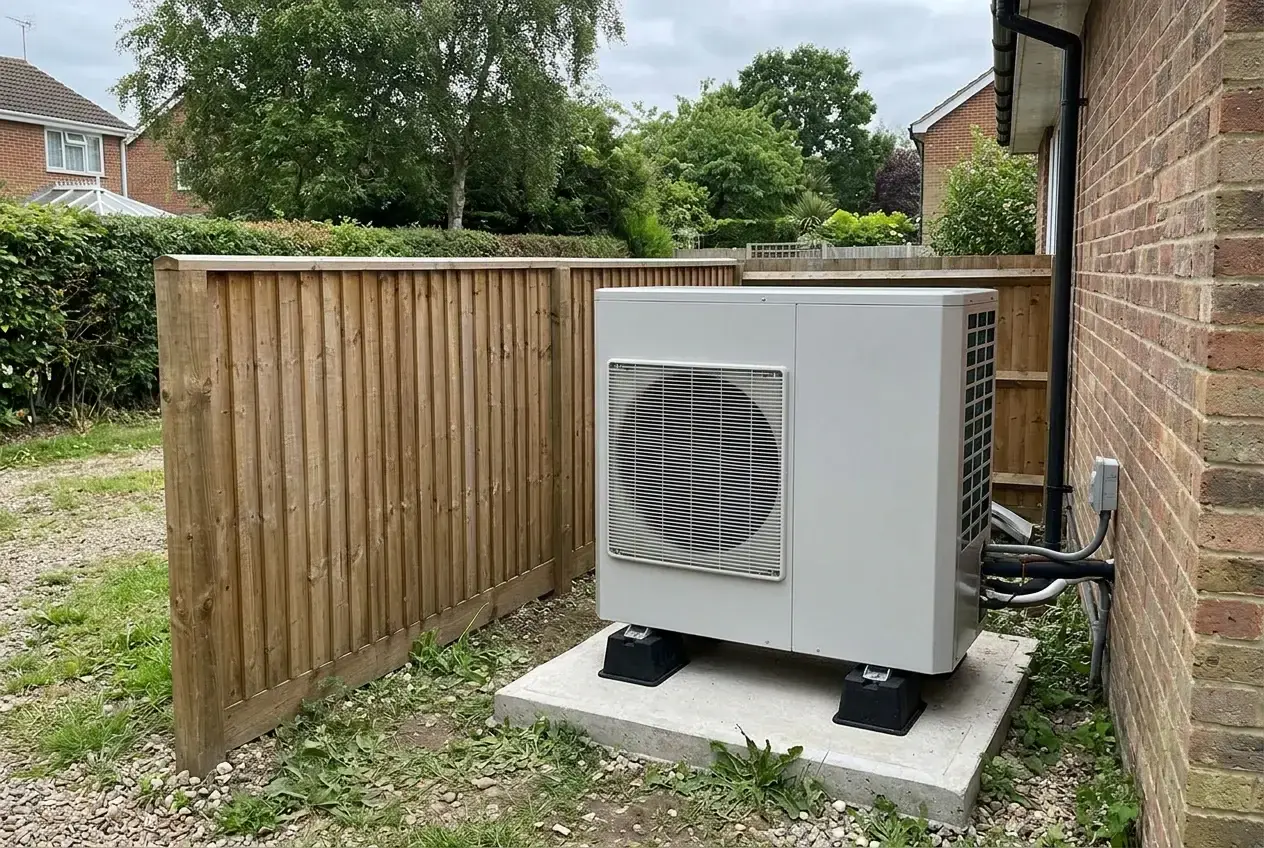
Screening. A solid barrier between the unit and the neighbour’s window reduces the level, provided it blocks the direct line from the unit to the window. Mass matters: a close-boarded fence with no gaps works better than open slats, and gaps let the sound straight through. Planting on its own has little effect. Lining the side of a screen facing the unit with sound-absorbing material helps stop reflections.
Airflow clearance. Any screen or enclosure must respect the manufacturer’s clearances. If the unit draws back in its own cold exhaust air, its efficiency falls and it works harder, which makes more noise. Do not box a unit in without checking the installation manual or asking the manufacturer.
Fan and compressor settings. Many units have a night mode or a reduced-noise setting that limits compressor speed and fan speed. This lowers the noise but can also reduce the maximum heat output, so it needs to be set with the heat loss of the house in mind. For more on how settings affect running in cold weather, see our guide to running a heat pump efficiently in winter.
Defrost. The defrost cycle cannot be avoided in cold, damp weather, but the controls may allow some adjustment. Ask your installer how defrost is handled on the unit and whether the manufacturer offers settings to reduce its noise. Position also matters: a unit that drains freely and has good airflow tends to ice up less.
After installation, if the unit proves noisier than predicted, the first checks are for loose panels, a rattling bracket or pipework touching a wall. These are easier and cheaper to fix than moving the unit.
Questions to put to an installer about noise before you accept a quote
These questions should be answered in writing, as part of the quote:
- Which model are you proposing, and what is its sound power level at full output? Ask for the data sheet, not a summary.
- Has an MCS 020 noise assessment been done for the exact position you propose? Ask to see the calculation sheet, not only the word “pass”.
- Which neighbouring window was used as the assessment position, and how far away is it?
- What directivity factor was used? If the unit is against a wall or in a corner, the factor should reflect that.
- Does the calculation credit any screening, and who is responsible for building it? If the pass depends on a barrier, it must be in the quote and in the installation.
- What is the predicted level compared with 42 dB(A)? A narrow pass leaves little margin.
- Is there a night mode, and what does it do to the maximum output?
- What mounting and vibration isolation are included?
- What happens if the unit exceeds the limit or draws a complaint after installation? Ask who pays for any remedial work.
- Have you considered an alternative position, and what would it cost?
An installer who answers these readily and shows the working is usually one who has done the job properly. For more on judging installers beyond the headline price, see our guide to choosing the right heat pump installer.
Heat pump noise questions
How many decibels is a heat pump?
Most domestic air source heat pumps have a sound power level somewhere in the 50s to low 60s dB(A). What you hear depends on distance and position: a few metres away on open ground, that typically drops to the high 30s or low 40s dB(A).
Can a heat pump be fitted near a neighbour’s window?
It can, if the MCS 020 calculation shows 42 dB(A) or less at 1 m from that window. If it does not, the installation needs planning permission, or the unit must move, be screened or be changed for a quieter model.
Do heat pumps run at night?
Yes, often, because they run steadily rather than in bursts. Many units have a night or quiet mode that limits fan and compressor speed during set hours.
Is a heat pump louder than a gas boiler?
Outside, yes: a boiler’s noise is mostly indoors, while a heat pump has a fan and compressor outside. Indoors, a heat pump system is usually quieter than a boiler.
What can a neighbour do if a heat pump is too loud?
They can raise it with you first, and if that fails, complain to the council, which can investigate noise as a statutory nuisance. Getting the position and the MCS 020 calculation right at the start is the best protection.
If you are ready to compare real proposals, request a heat pump quote through our quote page, and ask for the noise assessment for your proposed unit position to be included in writing.