
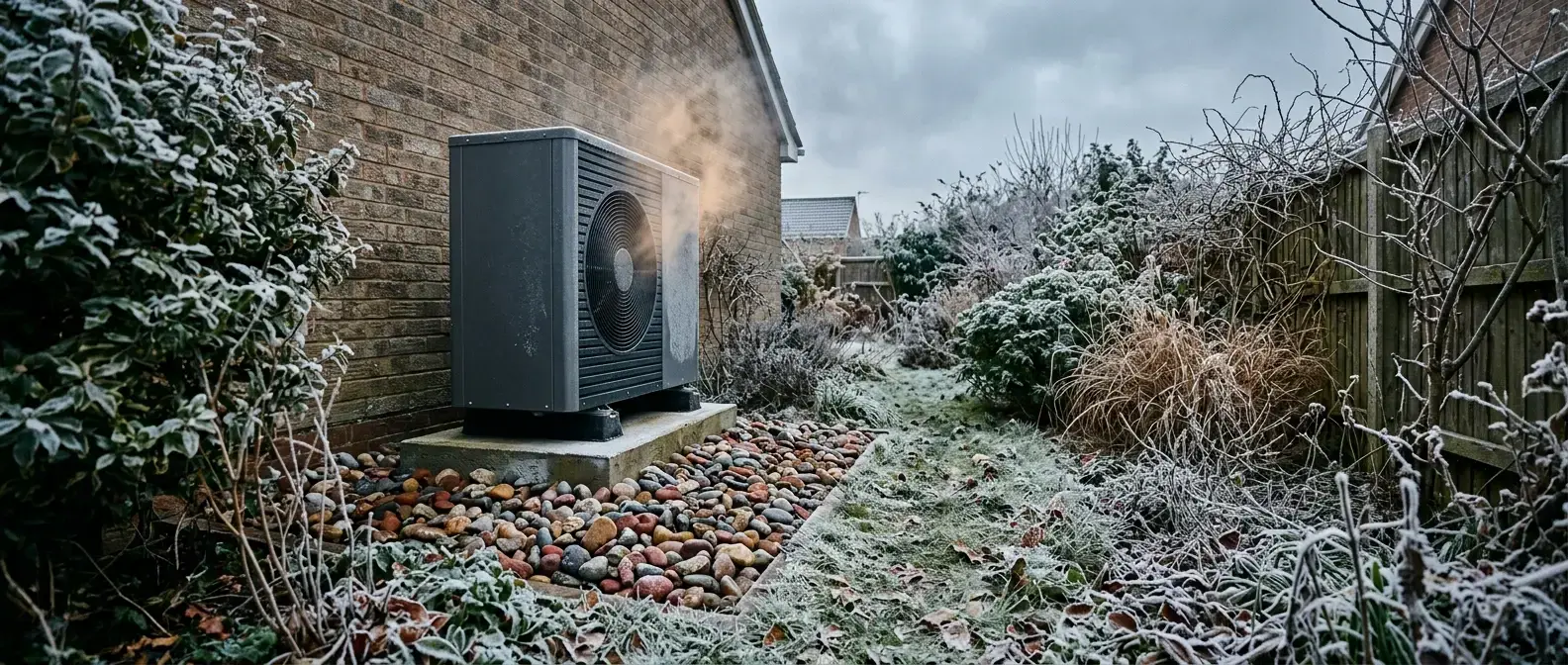
A heat pump that was sized and set up properly in the autumn can still feel sluggish the moment the first proper cold snap hits. That is not a fault. It’s physics, and once you understand what is happening, you can set the system up to cope with it rather than fight it.
This guide is for homeowners who already have a heat pump running and want to get more out of it through a UK winter, not for anyone still deciding whether to install one.
Winter settings in short
- Leave it running. A steady, low flow temperature beats switching off and on. A small overnight setback of 1 to 2°C is the most you need.
- Check weather compensation before the frost. Make sure it is switched on and the cold end of the curve keeps the house warm on the coldest days.
- Fix cold rooms at the room. A cold room is usually a radiator, balancing or insulation issue; raising the flow temperature for the whole house costs you all winter.
- Defrost is normal. A few short cycles a day in cold, damp weather is expected. Frequent cycles or ice left on the unit are not.
- Backup heat is for the odd occasion. If the immersion or backup element comes on regularly, get the settings or sizing checked.
Why a heat pump works harder in a cold snap than people expect
A heat pump moves heat from the outside air into your home rather than burning fuel to create it. The colder the air outside, the harder the compressor has to work to extract enough heat to keep your rooms warm, and the lower the efficiency becomes. This is normal and expected; every heat pump loses some efficiency as the outdoor temperature drops, but the drop is steeper than most people assume.
At 7°C outside, a typical air source heat pump might deliver a coefficient of performance of 3.5 or higher, meaning three and a half units of heat for every unit of electricity. At minus 3°C, that figure can fall to 2.5 or lower. The unit is not broken; it is simply doing more work for the same result, in the same way your car uses more fuel climbing a hill than cruising on the flat.
| Heat source | Efficiency | Cost of 1 kWh of heat |
|---|---|---|
| Heat pump, mild day (around 7°C) | COP 3.5 | 7.5p |
| Heat pump, cool day | COP 3.0 | 8.8p |
| Heat pump, cold snap (around minus 3°C) | COP 2.5 | 10.5p |
| Heat pump, cold snap with flow temperature set too high | COP 2.0 | 13.2p |
| Gas boiler, for comparison | 90% | 8.9p |
| Immersion or electric backup element | 100% (COP 1) | 26.3p |
Based on the Ofgem price cap for October to December 2026: 26.32p per kWh for electricity and 7.97p for gas, excluding standing charges. A heat pump tariff with cheaper off-peak hours lowers the heat pump figures.
The point of this guide: keep that curve as favourable as possible. Most of the waste in a UK winter does not come from the hardware. It comes from how the system is set and how it is used day to day.
The one habit that wastes the most energy: stop switching it off and on
The single biggest efficiency mistake homeowners make with a heat pump is treating it like a gas boiler and turning it off when they leave the house or turning it right down when they go to bed at night, then cranking it back up when they want heat again. With a boiler, this works reasonably well because a boiler can produce a high flow temperature quickly. A heat pump cannot and should not be asked to.
Heat pumps are most efficient at delivering a steady, lower temperature over a longer period, not blasting heat after standing idle. Switching off overnight or during the day lets your home cool down, so the heat pump then has to work at a higher output to recover that lost heat, which is exactly the thing it is least efficient at. It also strains the compressor with more frequent start-up cycles (over-cycling), each of which draws extra power before the unit settles into a steady, efficient rhythm.
That does not mean the temperature can never change. In a well-insulated home, a small overnight setback of 1 to 2°C is usually fine, and many controllers handle it well. The waste comes from switching off completely or dropping the temperature by several degrees and then asking the heat pump to claw it back.
The better habit through winter is to leave the heat pump running continuously at a lower, steady flow temperature and let the thermostat and weather compensation do the fine adjusting. If a room runs warmer than you like, turn it down at the radiator or the zone, not at the heat pump’s main switch. Think of it less like a boiler you fire up on demand and more like a background system that holds your house at a comfortable level throughout the day.
Get your flow temperature and weather compensation curve right before the frost arrives
Flow temperature is the temperature of the water leaving the heat pump and heading to your radiators or underfloor heating. Set it too high, and you lose efficiency needlessly, because every degree higher the water needs to be heated costs you performance. Set it too low, and the house will not reach a comfortable temperature on the coldest days.
Most modern heat pumps use weather compensation, where the controller automatically raises the flow temperature as the outdoor temperature drops and lowers it again when the weather is milder. This is the single most valuable setting on the system, and it is worth checking before the cold arrives rather than during it.
A few practical points worth going through now, ideally with your installer or an engineer if you are not confident doing it yourself:
| Setting | What good looks like | Get it checked if |
|---|---|---|
| Weather compensation | Switched on, so the flow temperature rises and falls with the weather | It is still on a fixed flow temperature from commissioning |
| Cold end of the curve | The house reaches a comfortable temperature on the coldest days | Rooms only go cold in a cold snap; adjust the cold end, not the whole curve |
| Cool rooms | Solved at the room: radiator size, balancing, TRV or insulation | The fix so far has been to push the flow temperature up for the whole house |
| Underfloor heating | Curve set lower than it would be for radiators | The curve was left on a radiator default |
| Schedule | Runs continuously, with a setback of 1 to 2°C at most | It switches off overnight or while you are out |
| Backup element | Comes on occasionally, mainly for hot water top-ups | It comes on most days in normal winter weather |
Do it now, not in January: getting this curve right in October or early November, while you can make calm adjustments over a few mild days, saves you from troubleshooting it during a hard frost.
Why the defrost cycle is normal, and what tells you it has gone wrong
On cold, damp days you will sometimes notice your outdoor unit’s fan stop for a few minutes, a hiss or whoosh from the unit, or a brief plume of steam. This is the defrost cycle, and it is completely normal. Frost builds up on the outdoor unit’s coil in cold, humid conditions, and the unit briefly reverses its refrigerant flow to warm the coil and melt the frost off, because ice on the coil would otherwise stop it absorbing heat from the air.
A normal defrost cycle is short, perhaps five to ten minutes, and happens a handful of times a day during cold, damp weather. It uses a small amount of energy but is far cheaper than letting the coil ice over completely.
| What to look at | Normal defrost | Call an engineer |
|---|---|---|
| How often | A handful of times a day in cold, damp weather | Every twenty minutes or more often |
| How long | Five to ten minutes | Much longer, or it keeps restarting |
| The coil afterwards | Clear of frost | Ice left on the unit that does not clear |
| Heat in the house | A brief dip that recovers | A noticeable drop that comes with frequent defrosting |
| Base of the unit | Meltwater drains away | Water pooling and refreezing around the base |
The signs in the right-hand column point to a problem such as low refrigerant charge, a faulty sensor, a fan fault or poor siting of the unit where snow or debris is blocking airflow. None of these are things to live with through a winter; they get worse under sustained cold rather than better, and they are worth flagging to an engineer rather than assuming it is just “what heat pumps do”.
Letting your TRVs and zoning do their job
A heat pump running efficiently at a steady, low flow temperature depends on your radiators and zones being set up to use that heat sensibly. Thermostatic radiator valves let individual rooms hold their own temperature without you having to adjust the main system, so a bedroom can run cooler than a living room while the heat pump keeps delivering a steady output centrally.
Where this goes wrong is when TRVs are old, sticking, or set inconsistently, forcing the system to overheat some rooms to get enough warmth into others. If your TRVs are more than a decade old, or you are not confident they are responding properly to changes, it is worth reading TRVs: are they worth upgrading? to see whether newer valves would let your system balance itself better through the coldest months, rather than relying on you adjusting things manually room by room.
When it makes sense to lean on immersion or electric backup, and when it does not
Many heat pump systems include an electric immersion heater or backup element, usually for hot water or for short periods of exceptionally cold weather. Used sparingly, this is sensible. An immersion heater can top up a hot water cylinder quickly if demand has been unusually high, without asking the heat pump to run at a high, inefficient flow temperature just for that purpose.
What is not sensible is leaning on electric backup heat as a routine way to cope with cold weather, because direct electric heating has none of the efficiency advantage a heat pump has. If your backup element is kicking in regularly rather than occasionally, that is a sign your flow temperature, weather compensation curve or system sizing needs a proper look, not a sign that backup heat is doing its job. The other lever on winter running costs is your tariff; our guide to the best electricity tariffs for heat pump owners compares the main options.
Quick maintenance checks that keep efficiency up all winter

Simple checks can be done by DIY, but if you’re not sure, then call a heating engineer
- Keep the area around the outdoor unit clear of leaves, snow and debris so airflow is not restricted.
- Check the condensate drain is not blocked or frozen, particularly after a hard frost.
- Bleed radiators if you notice cold spots, as trapped air forces the system to work harder for the same output.
- Check filters, where fitted, are clean, since restricted flow anywhere in the system reduces efficiency.
- Keep an eye on the outdoor unit’s clearance from fences, bins or planting that may have grown up over the summer and now restricts airflow.
Winter heat pump questions
Should I turn my heat pump off at night?
No. Switching it off lets the house cool, and the heat pump then has to run hard at a high output to recover, which is when it is least efficient. A small overnight setback of 1 to 2°C is fine in most homes; switching off completely is not.
Is steam coming from my heat pump normal?
Yes, in cold, damp weather. A plume of steam and a few minutes with the fan stopped is the defrost cycle melting frost off the coil. It is only a concern if it happens very often, lasts a long time or leaves ice behind.
What flow temperature should my heat pump run at in winter?
There is no single right number, because it depends on your radiators or underfloor heating and how well the house holds heat. Let weather compensation set it, and aim for the lowest flow temperature that keeps the house comfortable on the coldest days. Underfloor heating runs lower than radiators.
Does running a heat pump all day cost more than heating in bursts?
Usually not. Running steadily at a low flow temperature keeps the efficiency high, while heating in bursts forces the heat pump to work at a higher temperature with more start-ups. The steady approach normally costs the same or less for a warmer house.
Why does my backup heater keep coming on?
An occasional top-up for hot water or a very cold spell is normal. If it comes on most days, the flow temperature, weather compensation curve or system sizing may need checking, as direct electric heat costs around three times as much per unit of heat as a heat pump on a mild day.
Get a professional eye on your settings before the coldest months hit
Most of what affects winter running costs comes down to settings rather than hardware, and settings are far easier to adjust correctly with someone who understands the curve for your specific system and property. If your heat pump still feels like it is struggling or costing more than it should this winter, book a settings check with a qualified engineer through the contact page. It is often a quick fix rather than a new system.