
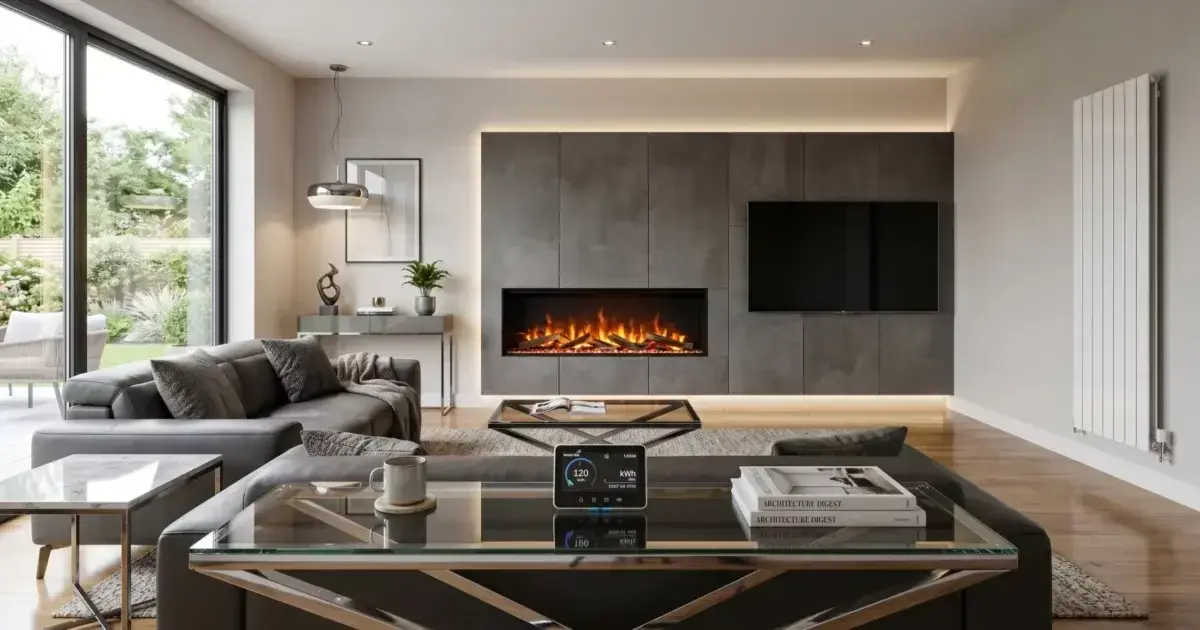
Modern electric fires have changed what a living room fire can be. They give you the look of a real fire and some warmth without a chimney, a flue, fuel to store or a gas safety check.
Choosing the right one comes down to how it fits your room, how convincing the flame looks, and how much you will use the heater, because that is where the running cost sits. This guide covers the types, the flame effects and controls, what they cost to run, and a few models worth a look.
Electric fires in short
- Easy to fit: most plug into a normal socket, with no chimney, flue or gas safety check.
- The flame effect costs pennies; the heater does not. At 2 kW, it costs about 53p an hour at the current price cap.
- Best as a focal point and top-up heat for one room, not as the main heating for the house.
- Choose the type first: freestanding stove, wall-mounted, inset or media wall, then the flame effect and controls.
- Look for a thermostat and timer, so the heater only runs when the room needs it.
Why choose an electric fire?
Electric fires are popular for living rooms because they bring a focal point and a bit of heat without the work of a traditional fireplace. Many plug straight into a normal socket, so they suit renters as well as homeowners and anyone who wants the look of a fire without a renovation.
They work best as a feature and as a top-up heat for one room. As the main heating for a whole house, they are expensive to run, which I cover in the running costs section below.
Types of electric fire
The first decision is how the fire will sit in the room. That narrows the choice more than anything else.
| Type | How it fits | Space needed | Best for |
|---|---|---|---|
| Freestanding stove | Stands on a hearth or the floor; plugs in | A clear spot near a socket | A wood burner look without a chimney |
| Wall-mounted | Hangs on the wall like a TV; plugs in | A flat wall, ideally near a socket | Modern rooms with no fireplace |
| Inset | Fits into an existing fireplace opening | A suitable opening and depth | Bringing an old fireplace back into use |
| Recessed or media wall | Built into a stud wall or chimney breast | A built-out wall; may need an electrician | A new feature wall, often under a TV |
| Fire suite | Fire with its own surround and hearth | Floor space against a wall | A traditional look in one piece |
Traditional looks are well covered. Stove-style fires mimic cast iron, fire suites come with wood- or stone-effect surrounds, and many have log or coal fuel beds. Inset fires can bring an old fireplace back to life where burning fuel is no longer practical or allowed.
Flame effects and controls
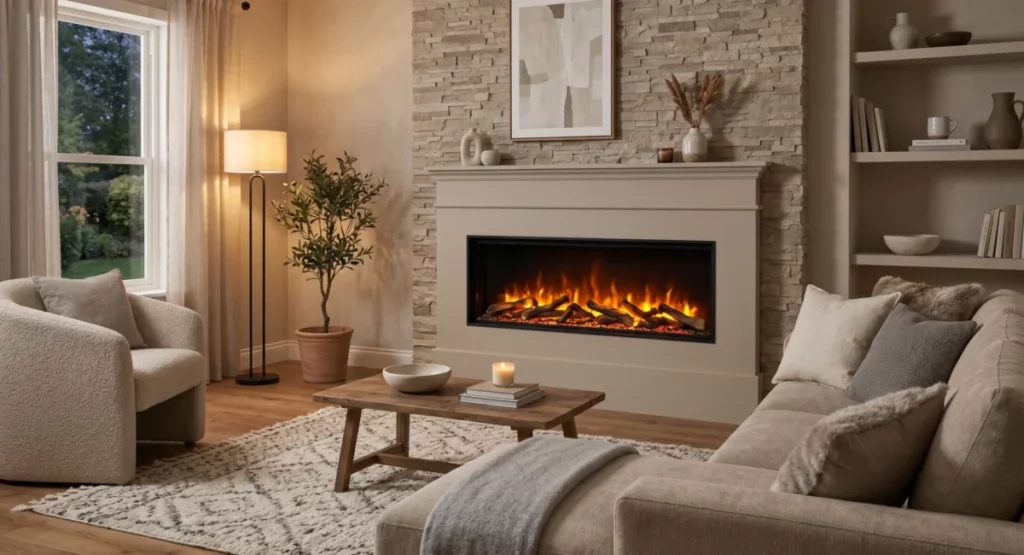
The flame effect is what you look at every evening, so choose one you really like; different effects are:
- LED flames: the most common type. They are cheap to run and long-lasting, and many offer several flame colours and brightness levels.
- Water-vapour flames: sold under names such as Optimyst, these use ultrasonic mist lit from below to look like a flame and smoke. They are the most convincing but need a water tank topped up.
- Flame without heat: almost all models let you run the flame on its own, so you can enjoy the look in summer for very little.
Controls make the biggest difference to running costs. Look for:
- A thermostat, so the heater switches off once the room reaches the temperature you set.
- A timer or run-back timer, so the fire turns itself off if you nod off in front of it.
- A remote control, standard on most models, and an app or smart home control on some higher-end ones.
What an electric fire costs to run
An electric fire turns all of its electricity into heat, but electricity costs about three times as much per unit as gas, so the heater is the expensive part. The flame effect on its own costs very little. These are the costs at today’s price cap:
| Setting | Power | Cost per hour | Three hours a night for a winter (150 nights) |
|---|---|---|---|
| Flame effect only (LED) | Usually under 0.1 kW | Under 3p | Under £12 |
| Low heat | 1 kW | About 26p | About £118 |
| Low heat on a 1.1 kW model | 1.1 kW | About 29p | About £130 |
| High heat | 2 kW | About 53p | About £237 |
At the Ofgem price cap for October to December 2026, 26.32p per kWh. A thermostat that switches the heater off once the room is warm lowers these figures. For comparison, heat from a gas boiler costs about 9p per kWh at the same cap.
If you mainly want the look and use the heater for an hour or two to take the chill off, the cost is modest. If you plan to heat the room with it every evening all winter, it is worth comparing it with your central heating first. If warmth matters more to you than the flame, our guide to electric heaters for topping up a heat pump may suit you better.
Electric fires compared with gas and wood
Weighing an electric fire against a gas fire or a wood burner? This is how they compare:
| Electric fire | Gas fire | Wood burner | |
|---|---|---|---|
| Installation | Plug in, or a simple wall fixing | Gas Safe engineer and a flue | Flue or chimney liner, hearth and building control sign-off |
| Annual upkeep | Wipe down and dust the vents | Annual gas safety check | Chimney sweep, ash and fuel to store |
| Carbon monoxide risk | None | Yes; needs a CO alarm | Yes; needs a CO alarm |
| Cost per kWh of heat | Highest (about 26p) | Lower | Varies with fuel |
| Heat on demand | Instant | Fast | Slow to start |
An electric fire wins on installation, upkeep and safety, and it has no smoke or fumes in the room. It loses on running cost per unit of heat. That makes it a good choice where you want a fire mainly for the look and occasional warmth.
Electric fires and solar panels
I often get asked whether solar panels make an electric fire cheap to run. They help a little, but less than people hope. Solar panels produce most of their electricity in summer and in the middle of the day, while you are most likely to use a fire on winter evenings, when the panels produce little or nothing.
A home battery can store some daytime solar for the evening, but a 2 kW fire for three hours uses 6 kWh, a large share of a typical battery. In practice, most of the electricity for an electric fire in winter will come from the grid, so budget on that basis.
Our picks on Amazon
These are well-reviewed models across the main types, from established brands where possible. All run their flame effect without the heater.
Dimplex Club Optiflame Electric Stove
- 2 kW fan heater with 1 kW and 2 kW settings
- LED flame effect over an artificial log bed
- Remote control; flame runs without heat
A long-standing, compact stove from one of the best-known UK brands. A good all-rounder for a living room hearth or alcove.
Check price on AmazonDimplex Willowbrook Optimyst Electric Stove
- 2 kW heater with thermostat
- Optimyst water-vapour flame and smoke effect
- Cast-iron style stove body
The water-vapour effect looks more like real flame and smoke than LEDs. It needs a water tank topping up, and soft or distilled water in hard water areas.
Check price on AmazonDimplex Bach Optiflame Wall Fire
- 2 kW heater with 1 kW and 2 kW settings
- Wall mount or recess fit
- LED flame with a log-style fuel bed
A neat option for a room with no fireplace. It can hang on the wall now and be recessed later if you build out a chimney breast.
Check price on AmazonDimplex Prism Optiflame 50″ Media Wall Fire
- 1.1 kW heater with thermostat and run-back timer
- Seven flame colours, adjustable brightness
- Wall-mounted or built in; other widths available
Wide and slim for a modern feature wall under a TV. The lower heat output suits a fire chosen mainly for the look.
Check price on AmazonWarmlite Wingham Log Effect Stove
- 2 kW heater with adjustable thermostat
- LED flame and log effect
- Overheat protection
A low-cost stove-style fire for a bedroom, snug or rental. Less convincing flame than the Dimplex models, but simple and cheap to buy.
Check price on AmazonPrices change often, so check the current price on Amazon. Looking for something else? Browse inset fires, wall-mounted fires or freestanding stoves. These are affiliate links: if you buy, I may earn a small commission at no extra cost to you.
What to check before you buy
- Room size: 1 to 2 kW is enough to top up a small or medium room. A fire will not heat a large open-plan space on its own.
- Fit: measure the wall, hearth or fireplace opening, and check the depth for an inset or recessed fire.
- Power supply: make sure there is a socket nearby; recessed and media wall fires may need a fused spur fitted by an electrician.
- Wall strength: heavier wall-mounted fires need solid fixings, especially on plasterboard.
- Controls: a thermostat and timer will save more money than any other feature.
- Flame effect: LED for low running costs and easy upkeep; water vapour for the most realistic look.
Electric fire questions
Can I use an electric fire without turning on the heater?
Yes. Almost all electric fires let you run the flame effect on its own. With LED flames, that costs very little, usually under 3p an hour.
Are electric fires expensive to run?
The heater is. At the current price cap, a 2 kW fire costs about 53p an hour on full heat and about 26p on 1 kW. Used for an hour or two in the evening alongside your main heating, that is manageable; as the main heat for a room all winter, it adds up quickly.
Can I install an electric fire myself?
Most freestanding and wall-mounted fires plug into a normal socket, and wall fixing is straightforward for anyone used to hanging a TV. Recessed and media wall fires sometimes need a fused spur, which an electrician should fit.
Do electric fires give off as much heat as a real fire?
Most domestic electric fires top out at 2 kW, less than a typical wood burner or gas fire. That is enough to take the chill off a living room, but not to heat a large open-plan space on its own.
Are electric fires safe?
There is no open flame, no fuel and no carbon monoxide, and the glass front of most models stays cool. Keep the heater vents clear, and do not cover the fire or run it from an extension lead.