
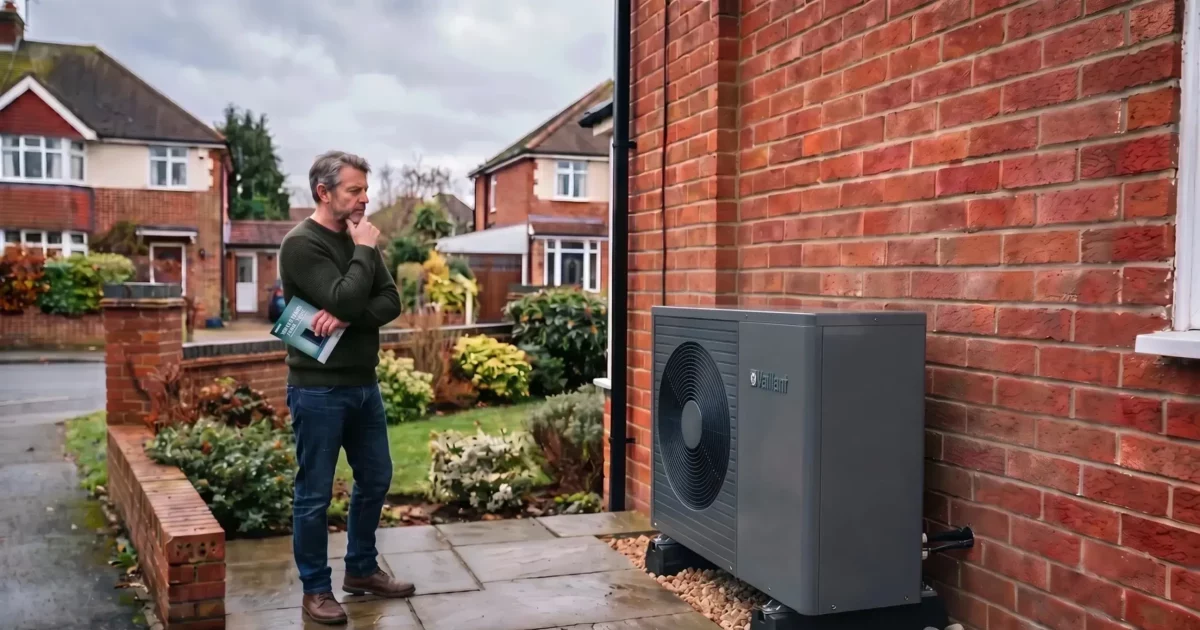
Along with my partners, we have completed many heat pump installations in the last fifteen years without complaint. Though these are at the more premium level of products, I have seen endless negative reports on social media about them, and yet the growth in UK heat pump installations is real. It’s also a lot slower than either the headlines or the government’s targets suggest. Here’s what the data gathered shows:
- Why uptake is where it is.
- What’s genuinely putting homeowners off.
- How the industry is trying to earn trust.
- Why the bigger energy security picture matters regardless of the pace.
1. The numbers, not the noise
Around 250,000 MCS-certified heat pumps had been installed in the UK by the end of 2025, with roughly 75,000 fitted in 2025 alone: a 29% increase on the year before. That sounds healthy until it’s set against the scale of the market: gas boilers still outsell heat pumps by roughly 20 to 1, at 1.5 to 1.7 million installations a year, so heat pumps remain around 4 to 5% of the heating-appliance market.
The government’s own target is 600,000 heat pump installations a year by 2028. Current volumes are running at roughly an eighth of that. The UK also has one of the lowest rates of heat pump ownership in Europe; Norway sits at 60% of households, Sweden at 43%, and Finland at 41%. That comparison is worth dwelling on, since all three have far colder winters than the UK: the “they don’t work here” argument doesn’t hold up against the data.
Compare heat pumps and boilers.
2. Why homeowners are still saying no
Which?’s 2025/26 research, Beyond Affordability, is the clearest picture available of what’s stopping people, and its central finding cuts against the usual assumption: cost isn’t the whole story. Two-thirds (67%) cite high upfront cost, but even affluent households with savings to spare are choosing not to install one, which points to a willingness-to-pay problem as much as an affordability one.
- 88% of people who got quotes found the process difficult, and a third couldn’t work out the actual cost from the quote itself.
- 37% don’t know whether a heat pump will outperform their existing gas boiler.
- 44% struggled to find clear information on maintenance and expected lifespan.
- 29% describe the whole decision as “too much of a gamble”.
- 26% said they don’t know who to trust for independent advice; the industry was described by participants as a “Wild West” with “cowboy builders”.
There’s a quieter concern sitting underneath all of this too: resale value. Many homeowners worry a heat pump is a cost they won’t recoup before they move and see it as a liability rather than an investment. Also the inconvenience factor, where a gas boiler replacement is like-for-like and easier to grasp than the more complicated aspects of a heat pump installation. Not everyone is clued up on what it might entail.
Air Source Heat Pump: Installation Guide
3. Building trust in an industry with a credibility problem
The industry’s structural answer to the “cowboy builder” perception is MCS certification, now mandatory for grant eligibility. MCS-certified installers must also sign up to a formal consumer code, either RECC or HIES, covering sales conduct, transparent quotes, capped deposits, guarantees and a proper dispute-resolution process (source): a direct response to the credibility gap Which? identified.
What the standards don’t yet fix is capacity. Nesta’s four-year review of the Boiler Upgrade Scheme points to installer numbers, not funding or demand, as the binding constraint on growth: the money and the interest are there, but the skilled workforce to install at scale is still catching up. That’s arguably a bigger obstacle to hitting the 2028 target than consumer trust on its own.
The Boiler Upgrade Scheme (BUS)
4. The bigger picture: energy security
There’s a geopolitical case for heat pumps that rarely makes it into homeowner-facing content, and it’s worth setting out plainly. UK electricity’s dependence on imported fuel has fallen from around 65% in 2014 to just under 50% in 2024, driven largely by renewables. But gas, still about 30% of generation, sets the wholesale electricity price roughly 97% of the time: the highest share of any market in Europe. That’s why UK household bills stayed so exposed during the 2021/22 gas crisis even as the grid itself was getting cleaner.
North Sea gas production is in structural decline regardless of future licensing decisions. Electrifying home heating through heat pumps compounds the security benefit of a decarbonising grid by cutting direct household reliance on imported gas specifically, rather than only reducing it at the power-station level. The caveat: rising electricity demand from heat pumps and electric vehicles means grid capacity has to keep pace, or the security gain is capped by supply constraints elsewhere.
5. Where it goes from here
The realistic read is neither the boom nor the failure story that gets told about heat pumps. Growth is genuine but decelerating in percentage terms, and the 2028 target looks very unlikely to be met on the current trajectory. The technology itself isn’t the constraint: installer capacity and consumer trust are doing most of the holding back, alongside a quoting and information process that Which?’s own respondents found genuinely hard to navigate.
Set against that, the energy security case for going electric keeps strengthening independently of how fast individual households adopt the technology. For homeowners weighing it up, the honest summary is this: the barriers are real and largely fixable, the underlying direction of travel is settled, and the pace is a question of installer supply and information, not whether the technology works.
FAQs
Do heat pumps work in cold climates? Yes. Norway, Sweden and Finland, all colder than the UK, have far higher heat pump ownership rates (60%, 43% and 41% of households, respectively) than the UK does. Performance in cold weather isn’t the barrier the myth suggests; installer capacity, cost clarity and trust are the bigger factors here.
Is a heat pump a financial gamble? Not inherently, but the research shows many homeowners feel that way because of poor information, not because the numbers are bad. Which? found that over half of people struggled to get clear running-cost information, and a third couldn’t work out the actual installation cost from their quote; that’s an information problem the industry is still working through, not evidence the investment doesn’t pay off.
How do I know if an installer is trustworthy? Look for MCS certification, which is mandatory for Boiler Upgrade Scheme grant eligibility, and confirm the installer is signed up to either the RECC or HIES consumer code. These require transparent quotes, capped deposits, guarantees and a formal dispute-resolution process.
https://mcscertified.com/find-an-installer/
Data in this post reflects UK figures available as of September 2026, drawn from Which?, Nesta, GOV.UK, MCS, the Energy Saving Trust, and the Energy and Climate Intelligence Unit (ECIU).
I’m not a homeowner yet, but I can understand how frustrating it can be when homeowners have poor-quality heating equipment, especially when the cold season arrives. Your article does a great job explaining the importance of having a reliable heat pump. A good, efficient system can help keep a home comfortable while potentially saving money on energy bills. I think this is useful information for anyone considering a heat pump for their home.
Thank you for your insights Monica, with energy costs being so high these days, I feel strongly about the rise of disinformation around new heating technologies and I hope to bring some clarity for the general public.
I appreciate how this article moves beyond the usual pro-or-anti heat pump debate and focuses on how information, clarity, and trust shape consumer decisions. From a communication perspective, the discussion of confusing quotes, unclear costs, and difficulty finding reliable advice is especially important because even a strong product can struggle when its value is not communicated clearly. Presenting the data alongside the practical concerns of homeowners makes the subject more balanced, accessible, and credible. It’s a good reminder that effective communication is not just about providing more information—it’s about making complex decisions easier to understand.
Thank you for your interest, over the years I have come across many heating technologies websites and found the information within confusing even for me, so, yes, I think it’s important to make the language as plain as it can be.
So you are saying that the reason that people don’t order more heat pumps is the lack of information out there and also maybe misinformation? I think it is also easier to stay with what you know in most cases rather than change to something new and that may not work as well.
But seeing that they are so popular in the colder countries, makes me think that this is actually the better option and even though it may be initially expensive (like solar) in the long run they are worth their weight in gold.
Thank you for your interest Michel, I am a heat pump engineer and I have no issue with the take up of heat pumps and like me, many installers bookings are full. This is an issue of expectations too high by the authorities where there is not enough skilled installers to carry out the installs. Also there is always a lack of trust with new technologies but we get used to them eventually, as the data shows people have different reasons for their reluctance but I’m sure that will change in time.
If people prefer their existing system then they should stick with them, my aim is to inform and not to convince, in the UK the higher cost of heat pump installation is countered by grant funding to encourage take up, so time will tell, the one thing to be sure of is heating gas or oil in the UK and elsewhere will no longer be an option in the future.