
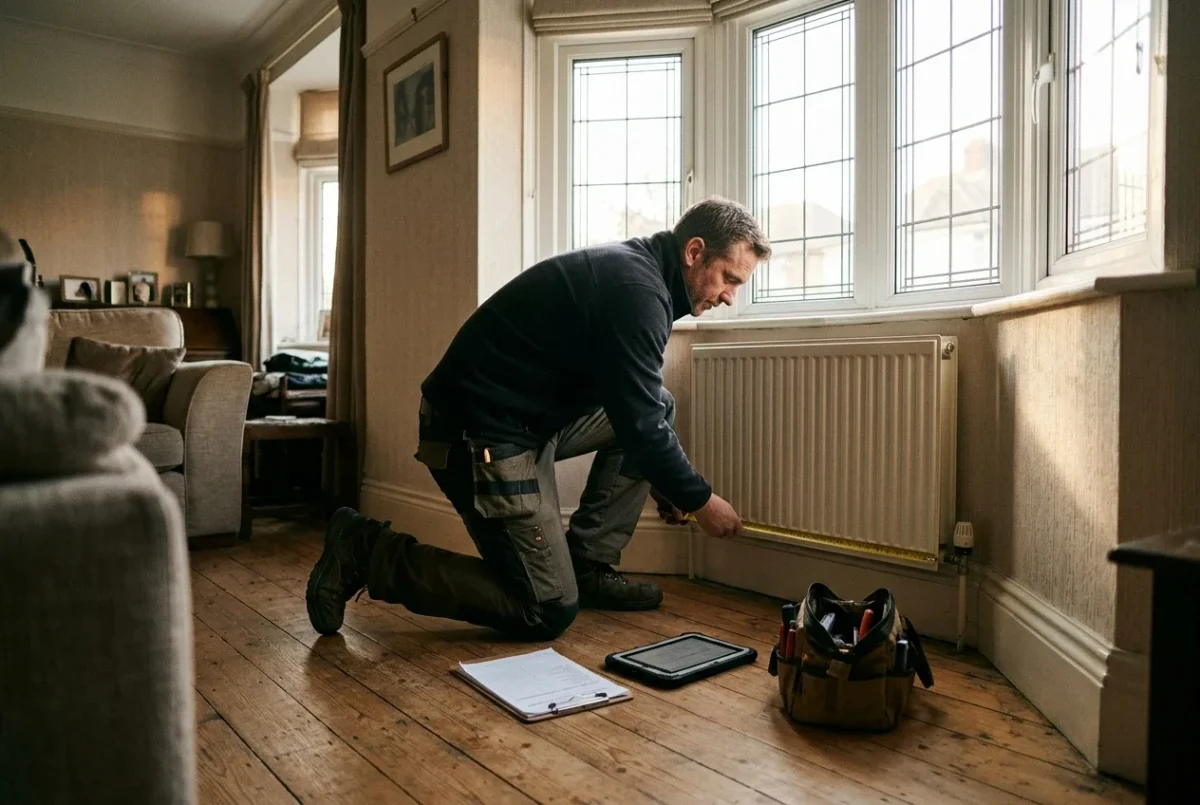
Getting three quotes is the usual advice, but it only helps if the three firms are worth quoting. A quote from an installer who has never worked on a house like yours is a well-formatted guess, and comparing three guesses tells you very little.
This guide covers the background checks before the quote: who the installer is, what they are registered for, who pays if they go under, and what their past customers say. It applies to a heat pump, a boiler replacement or a wider retrofit, and to landlords upgrading a rental. For the design side (the heat loss survey, flow temperature and radiators), see how to choose a heat pump installer.
Vetting an installer in short
- Check the firm before you ask for a price. Three quotes only help if all three firms are worth quoting.
- Each registration covers one slice of the job: Gas Safe for gas, MCS for heat pumps and the grant, competent person schemes for electrics and cylinders.
- Every claim can be checked in half an hour on public registers, Companies House and the insurance certificate.
- Plan for the firm closing: an insurance-backed guarantee, a protected deposit and a credit card payment keep you covered.
- Ask for references from houses like yours, and ask the questions a testimonial page would never answer.
Why the installer matters more in an existing house
A new-build system is designed alongside the house: the insulation is known, the emitters are sized for low flow temperatures and a cupboard waits for the cylinder. An existing house gives you none of that.
Radiators
Sized for a much higher flow temperature than a heat pump should run at.
Pipework
15mm runs in places where a heat pump needs a larger bore to move enough water.
Walls
Solid brick, filled or empty cavity, or a mix after decades of extensions.
Space and power
A full consumer unit, a marginal supply, and no obvious place for a cylinder.
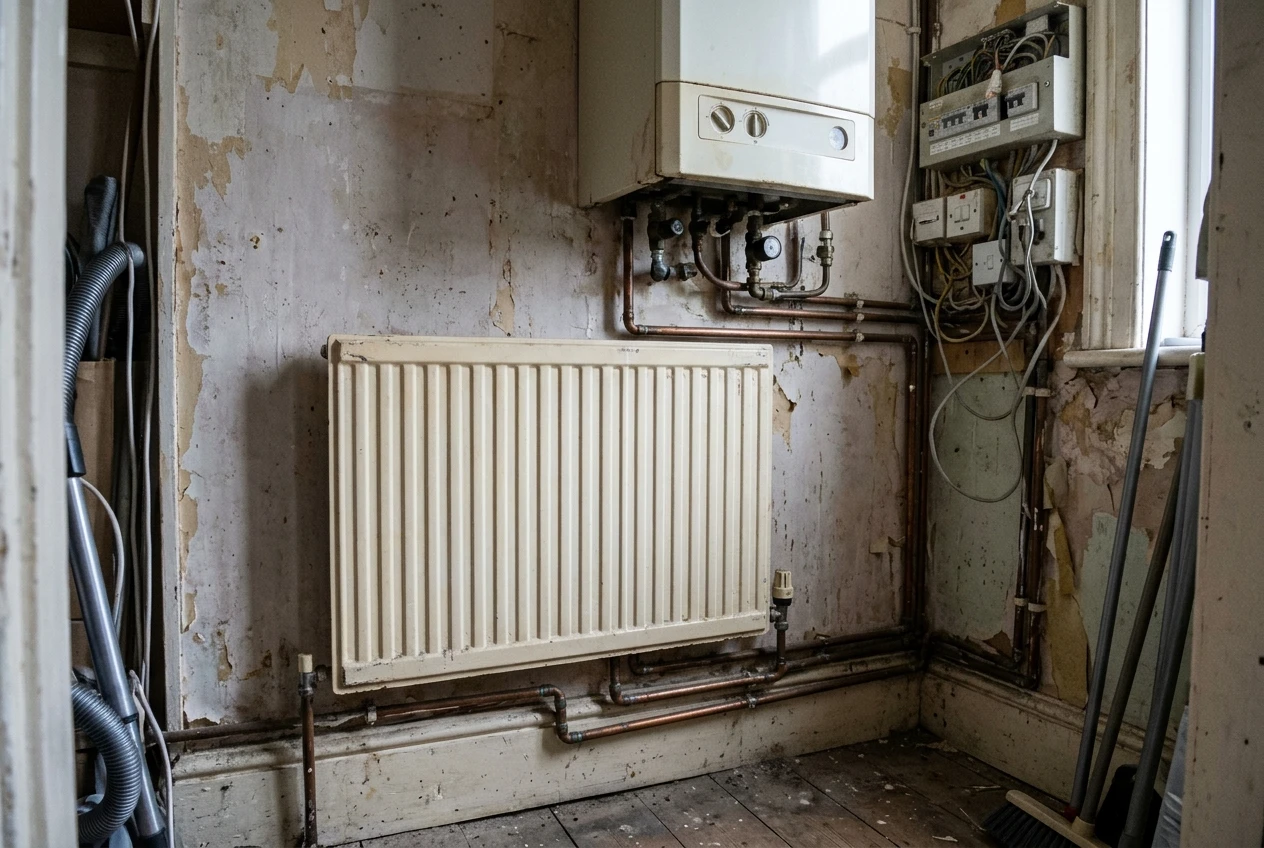
Each of those is a judgement the installer makes in your house, and two firms can propose systems that perform very differently from the same visit. That is why the choice of installer deserves more attention than the brand of heat pump, and why the checks below come before anyone prices anything.
The registrations to check, and what each one tells you
Registrations are useful because they can be checked. Each also covers a narrow slice of the job, and they are sometimes quoted as if they promise more than they do.
| Registration | Needed for | What it tells you | What it does not |
|---|---|---|---|
| Gas Safe | Any work on gas appliances or pipework, including removing or capping a gas boiler | The engineer is legally allowed to do the gas work listed on their card | Anything about heat pump competence |
| MCS | Heat pump installation, and claiming the Boiler Upgrade Scheme grant | The firm works to a documented design process, including a room-by-room heat loss calculation | How many retrofits like yours they have done, or how good their judgement is |
| TrustMark | Optional; required for some government-funded schemes | The business has been checked on trading and has a complaints route | Whether your particular system is designed well |
| Competent person schemes | Self-certifying electrical work and unvented cylinders under the Building Regulations | That part of the job can be signed off without a building control visit | Anything outside the work that scheme covers |
| F-gas certification | Split systems with refrigerant pipework joined on site | The person making those joints is qualified to handle refrigerant | Usually not needed to fit a sealed monobloc unit |
| Consumer code (RECC or HIES) | Every MCS installer must belong to one | Rules on contracts and deposits, and a dispute route | That the firm will still be trading in ten years |
Building Regulations and some schemes differ in Scotland and Northern Ireland. The principles are the same, but check which apply where you live.
Ask who does each part of the job. If the electrics or the cylinder are subcontracted, ask for the subcontractor’s name and check their registrations too.
Checking the paperwork yourself in half an hour
Do not take a logo on a van or a website at face value. Every registration has a public lookup:
- Gas SafeSearch the Gas Safe Register by company name or number. Ask to see the engineer’s ID card: the back lists the gas work they are qualified for.
- MCSUse the installer search on the MCS website and confirm the firm is certified for heat pumps, not only solar panels.
- Consumer codeCheck the RECC or HIES member list for the firm and note what it says about deposit protection.
- Competent person schemeAsk which scheme covers the electrics and the cylinder, then check that scheme’s register.
- InsuranceAsk for the public liability certificate and check the amount and expiry date. Employers’ liability is a legal requirement if they employ staff.
- Companies HouseCheck when the company was formed, who the directors are, and whether accounts are overdue or a strike-off notice has been filed.

A new company is not automatically a bad sign, since experienced people set up new firms, but you should know which it is. A genuinely registered firm hands these details over without hesitation. “We’re MCS” without a certificate number is a reason to check before going any further.
What the first visit to your house should look like
A competent installer treats the first visit as data collection for the heat loss calculation and design, and that takes time.
A proper visit
- Every room measured, with walls, windows, ceilings and floors noted
- Every radiator and the visible pipework recorded
- Boiler, cylinder, controls, consumer unit and supply checked
- Loft insulation looked at, and the outdoor unit position chosen with noise in mind
- Questions about who lives there, cold rooms and hot water use
- Photos taken so the design can be done properly afterwards
A sales visit
- A look at the boiler and a question about floor area
- A unit size given on the spot
- “Your radiators will be fine”, with nothing measured
- A price before any calculation, often with a deadline
The quote that follows will be built on assumptions, and you pay for them in comfort or running cost.
For the full list of questions to ask during the visit, and how to judge the answers, see how to choose a heat pump installer. To get the house ready beforehand, see how to prepare your home for a heat pump. Once you have a design, is your heat pump design right? shows how to check it.
Who stands behind the work if the firm closes
A heat pump can run for fifteen years or more, and small installation firms close more often than people expect. A guarantee from a company that no longer exists is worth nothing, so ask about these before you sign:
| Protection | What to ask | Why it matters |
|---|---|---|
| Insurance-backed guarantee | The insurer’s name, the length of cover and what it excludes | An insurer pays for remedial work if the installer has stopped trading |
| Deposit protection | How much, what it pays for, and how it is protected | A large deposit to a small firm is money at risk |
| Paying by credit card | Whether you can pay at least part of the price by card | For goods and services priced between £100 and £30,000, Section 75 makes the card provider jointly liable if the firm fails to deliver |
| Manufacturer warranty | What it requires: approved installer, commissioning, servicing | Some conditions tie you to one firm; see heat pump warranties compared |
| The grant | Whether they are registered to claim the Boiler Upgrade Scheme for you | The installer applies and takes it off your invoice; you cannot claim it later yourself |
Keep every document: the guarantee certificate, insurance details, commissioning record and compliance certificates. If a firm closes, these papers are what let you claim, and what let another engineer pick up the system.
References and past jobs
Ask for two or three recent jobs in houses like yours, and the contact details of those customers.
Questions for past customers
- Did the final cost match the quote, and if not, why?
- Were all the rooms warm in the first winter?
- Was it noisy, and were neighbours’ complaints dealt with?
- Were there snags after handover, and how fast were they fixed?
- Did running costs match what the installer predicted?
What to look at
- References from houses like yours: a 1930s semi, a solid-wall terrace, a bungalow, not a new build
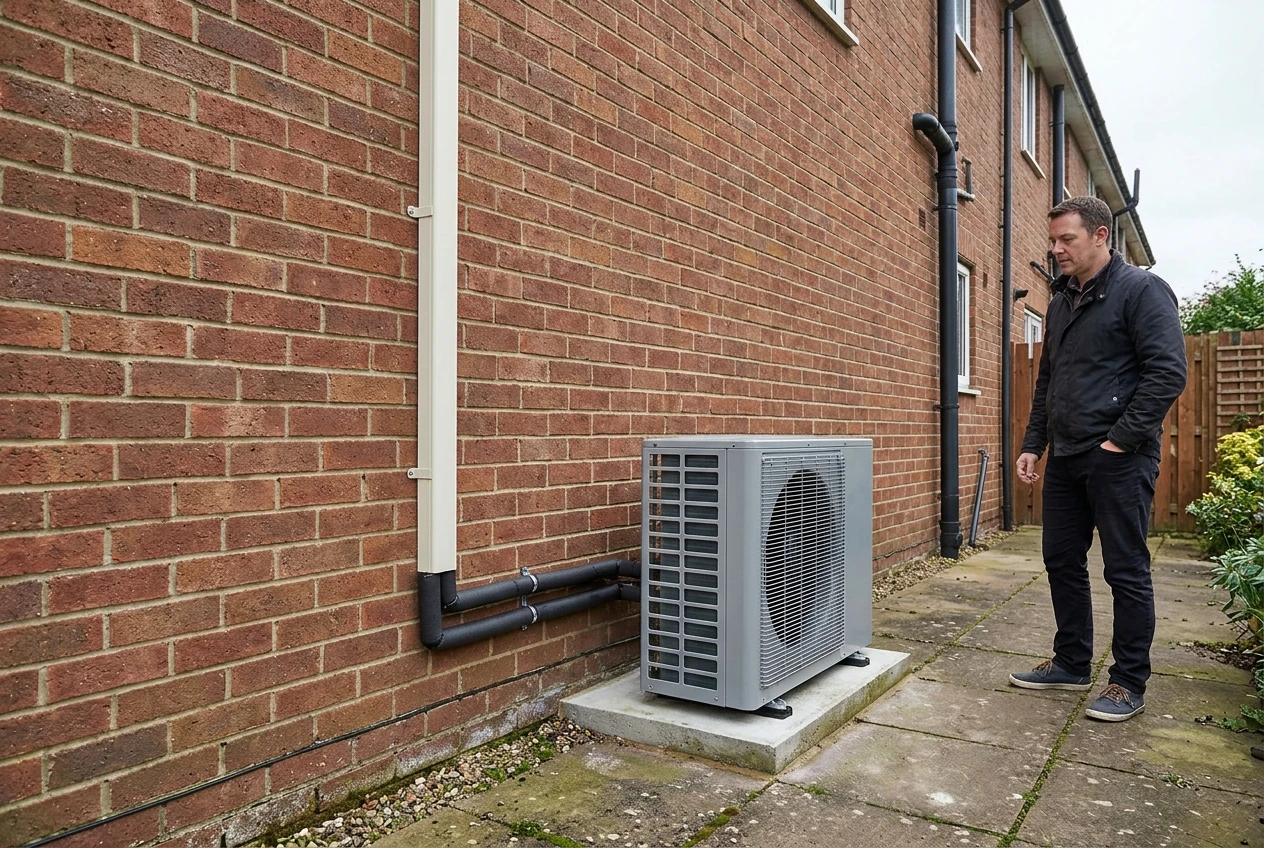
- A finished job, even from the street: pipe runs, the outdoor unit position, the general finish
- Independent review sites, reading the complaints and how the firm replied, not just the star rating
Red flags that end the conversation, and how to compare your shortlist
Any one of these is enough to drop a firm:
Selling
- Cold calls or doorstep selling
- Pressure to sign the same day
- A discount that expires if you wait
Design
- A quote without a proper visit
- “No radiators need changing” before any calculation
- Guaranteed savings with no figures behind them
Paperwork
- No registration numbers or insurance certificate
- No name for the guarantee insurer
- A large unprotected deposit
- Vague answers on who does the electrics
Once you are down to two or three firms, compare them on the same terms:
| Check | Firm A | Firm B | Firm C |
|---|---|---|---|
| Registrations checked out | |||
| Visit length, and was the house measured? | |||
| Design flow temperature proposed | |||
| Who does electrics, cylinder and commissioning | |||
| Guarantee: length, and who insures it | |||
| Deposit: amount and protection | |||
| What the references said |
The firm that looks cheapest often has the thinnest answers in the other rows.
Then score the quotes themselves with my printable heat pump quote checklist.
Common questions
Vetting a heating installer: common questions
Is a Gas Safe engineer qualified to fit a heat pump?
Not by that registration alone. Gas Safe covers gas work only. For a heat pump, look for MCS certification, which you also need for the Boiler Upgrade Scheme grant.
How do I check an installer is MCS certified?
Search the installer on the MCS website and check the firm is listed for heat pumps specifically. Ask for the certificate number and make sure it matches the company name on the quote.
What is an insurance-backed guarantee?
A workmanship guarantee backed by an insurer, so remedial work is still paid for if the installer stops trading. Ask for the insurer’s name and the policy terms before you sign.
How much deposit should I pay a heating installer?
There is no fixed rule, but keep it modest, know what it pays for, and check how it is protected. Paying at least part by credit card can add Section 75 protection.
Should I use a national firm or a local installer?
Either can be good. Run the same checks on both; national firms are compared in my UK heat pump installers compared.
Do landlords need to check anything extra?
The same checks apply, plus access arrangements with tenants and the certificates you will need to keep: the gas safety record if gas remains, and the electrical and commissioning certificates.
Next step
Want a quote from an MCS-certified installer to run these checks on? Ask through my heat pump quote page.