
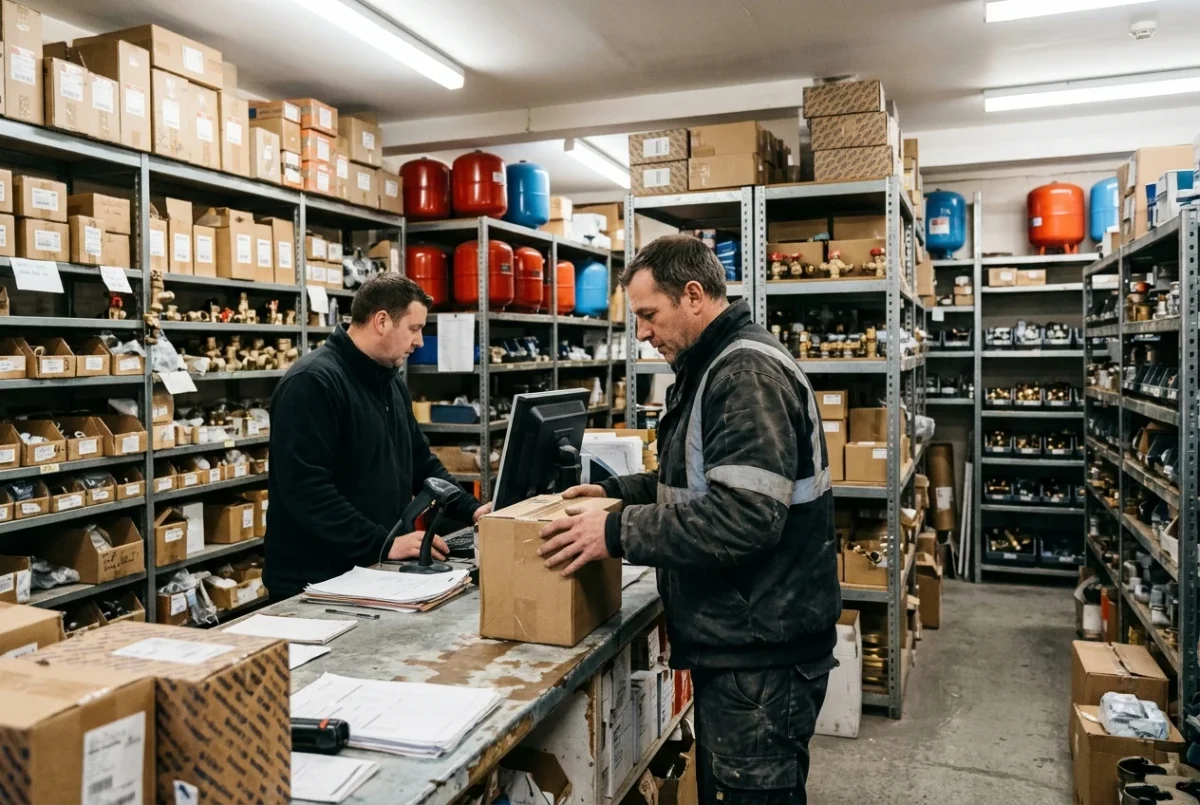
A reliability score tells you how a unit performed for a sample of owners in its first few years. It says nothing about what happens when the control board fails in year eight and the repair depends on a part that has to come from another continent. For a heat pump you expect to run for fifteen years or more, UK parts supply deserves as much attention as the efficiency figure.
This guide gives you a method, not a league table. Parts supply changes with distributor contracts and ownership, so a ranking written today would soon be out of date. Instead you will learn which parts to ask about, how they reach an engineer, what a straight answer sounds like, and a test you can run on any quote. For current models side by side, see my heat pump brands comparison.
Heat pump parts in short
- Reliability scores cover the early years. Whether your unit can be repaired in year ten depends on the UK parts supply, not the reputation.
- Five parts matter most: the control board, the outdoor fan motor, the circulation pump, sensors and expansion valve, and the compressor.
- The parts route decides the wait: UK stock or a merchant shelf means days; an import order can mean weeks.
- Ask for the parts support period in writing: how many years after a model is discontinued parts will be supplied, and by which UK company.
- A trained, stocked installer fitting a middling brand is usually a safer bet than a top brand fitted by someone who has never ordered its parts.
Why the parts question matters more than the brand’s reputation
Reputations are built on units that have already been sold, in the years they have already run. Most heat pumps in UK homes are young and still under warranty, so the evidence about how any brand behaves at year ten is thin, however confident the sales material sounds.
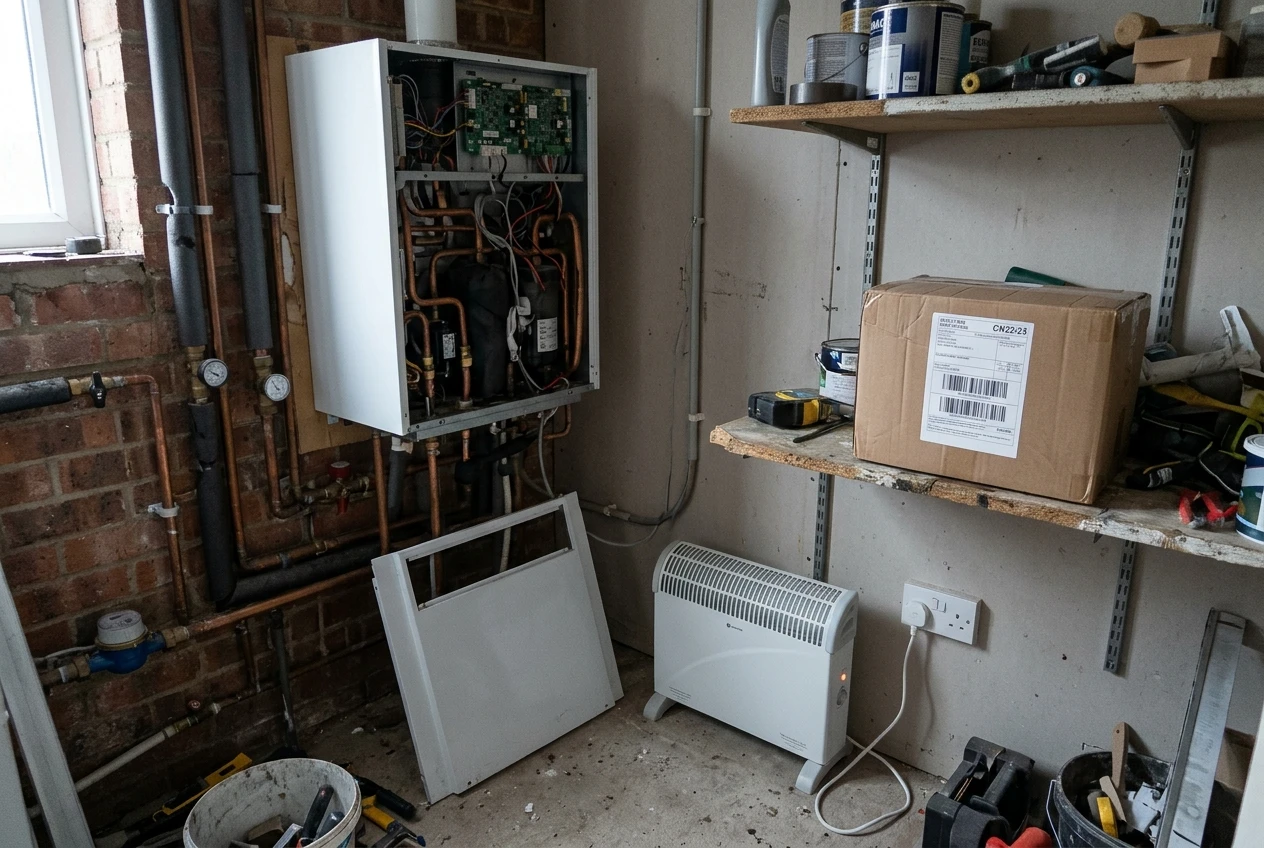
What you can check today is the supply chain behind a repair. A fault with the part in stock locally is fixed in a day or two. The same fault on a ten-week import order leaves a household on the immersion heater and plug-in heaters, at a cost nobody budgeted for.
Homeowners
Once the boiler has gone, there is no fallback heating while you wait for a part.
Landlords
In England and Wales you must keep the heating and hot water in repair, and a tenant will not wait on an import schedule.
Self-builders
Underfloor pipework, the cylinder and controls are often designed around one model, so swapping brand later is costly.
For all three, a brand with an average reputation and strong UK parts support can be a safer buy than a respected brand with a thin supply chain. Landlords will find more on keeping rentals compliant on my landlords hub.
Five parts that can fail, and what each means for supply
I cannot give you failure rates by brand, and you should be wary of anyone who does without showing their data. What I can tell you, as an installer, is which parts come up in repairs and how hard each is to replace. These five differ most between brands.
| Part | What it does | How brand specific | What to ask |
|---|---|---|---|
| Control or inverter board | Runs the compressor speed, defrost and the link to your controller | Model specific; can be withdrawn when the model is | Part number, UK stock, and whether a newer board fits |
| Outdoor fan motor | Pulls air through the outdoor coil for thousands of hours a year | Usually brand and model specific | Is it held in the UK, and the typical lead time |
| Circulation pump | Moves water between the heat pump and your heating | Sometimes a standard pump a merchant can match; sometimes built into the unit | Can a replacement be bought off the shelf? |
| Sensors and expansion valve | Read temperatures and pressures; control refrigerant flow | Often specific; cheap but a missing one can lock the unit out | Does the installer carry common sensors on the van? |
| Compressor and refrigerant circuit | The heart of the unit, and the largest repair | Model specific; needs a refrigerant-qualified engineer | Which refrigerant, and who near you is qualified to work on it |
The control board is the part to focus on most: it is model specific, often several hundred pounds or more, and the one most likely to be withdrawn once a model is discontinued.
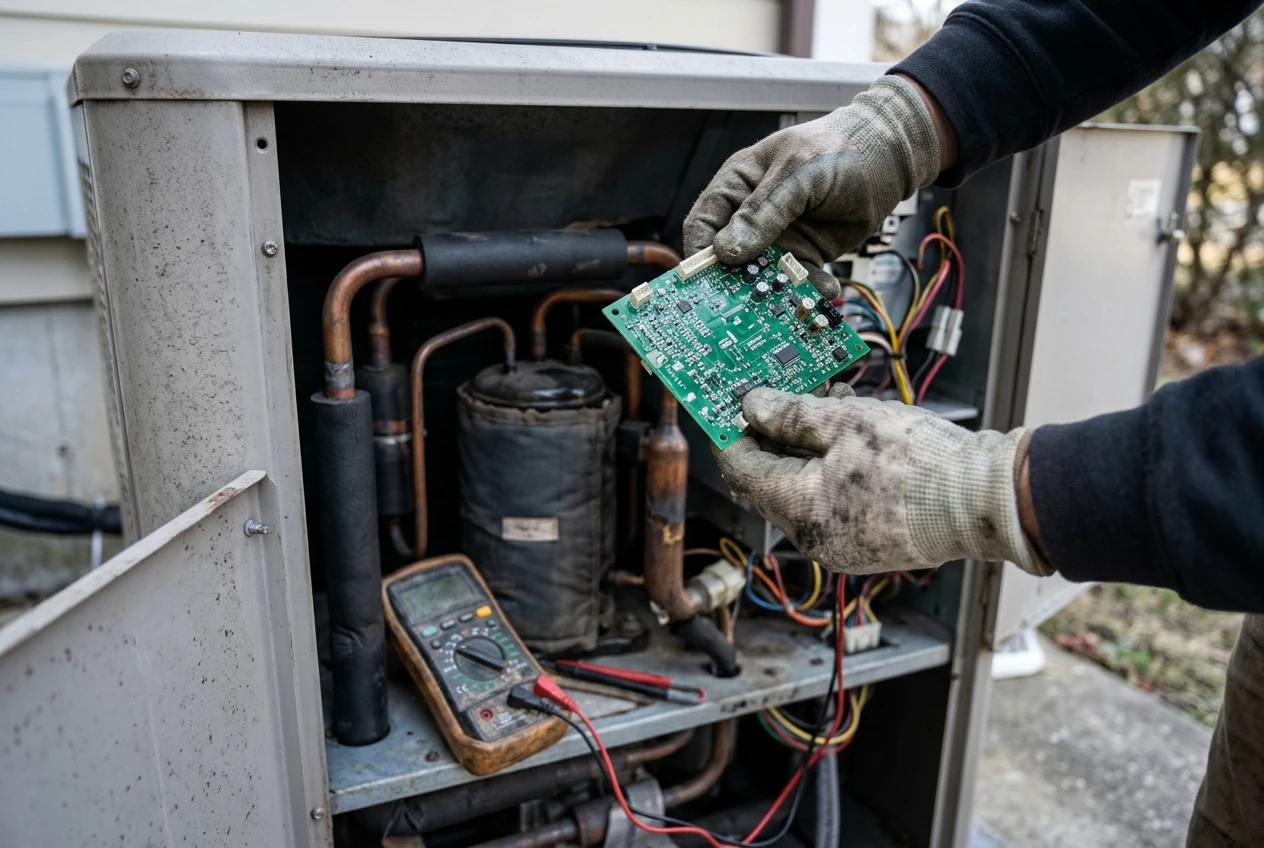
A note on refrigerant. Most new air source units are monoblocs, sealed at the factory and using R32 or R290 (propane). Fitting one needs no refrigerant work, but repairing the refrigerant circuit does, and R290 needs an engineer trained in flammable refrigerants. Ask who in the installer’s business or network holds that qualification.
For each part, the useful question is the same: if this fails, where does the replacement come from, and how long does it take to reach an engineer near me?
How parts reach a UK engineer: manufacturer, distributor, merchant or import
Parts follow one of four routes, and the route affects speed and price more than the badge does.
Manufacturer direct
A UK subsidiary with its own warehouse and parts desk. The engineer orders by part number and it ships from the UK.
Check: the stock is real and the desk answers the phone.
UK distributor
An independent importer holds the parts for an overseas brand. It can work well, but the contract can end.
Check: how long they have held the brand, and what happens if that changes.
Heating merchant
Pumps, valves, vessels and sometimes sensors on a local shelf, collected the same morning.
Check: ring your nearest merchant and ask.
Import order
Ordered from a European or Asian warehouse, with shipping and customs on top.
Check: fine for rare parts, a poor answer for a board every unit needs.
When you are quoted a brand, ask which route covers the five parts above. A brand whose common parts come from UK stock or a merchant shelf has a clear advantage over one where everything is imported.
The parts support period: what to ask, and what a straight answer sounds like
The parts support period is how long the manufacturer will supply spare parts after a model stops being sold. It is not the warranty, and the two are often confused. The warranty starts when your unit is fitted; the parts clock starts when the model is discontinued, which can be soon after you buy.
Ask the installer these questions, and ask for the answers in writing from the manufacturer or distributor:
- How many years after the model is discontinued will parts be supplied?
- Is that commitment in a document I can see, or is it informal practice?
- Which UK company holds the parts stock, and for how long has it held this brand?
- If this model is replaced, will new boards and controllers work with my unit?
- If you stop trading, can another engineer buy parts and get the service documents?
A straight answer
“Parts are supplied for ten years after the model is discontinued. That covers the outdoor unit and controller, and it is in the manufacturer’s service policy, which I will email you. Pumps are standard and sourced separately.”
It names a number of years, a UK company and a document, and admits the limits.
A poor answer
“These units hardly ever fail. We’ve never had a problem, and the manufacturer is very well established.”
It may all be true, but it does not answer the question. Ask again, in writing.
If the installer cannot find out and the manufacturer will not say, treat that as information about the brand.
Reading a brand’s UK support set-up
A parts catalogue only helps if engineers can use it. Most of the wider support set-up can be checked from the outside.
| What to check | A good sign | A warning sign |
|---|---|---|
| Engineers and training | UK training courses and a postcode list of trained installers | A handful of trained installers nationally |
| Technical helpline | Engineers reach someone who knows the product the same day | Call-backs that take days |
| Documentation | Manuals, fault codes and parts diagrams open to registered engineers | Documents only through one installer, or withdrawn with the model |
| Stock | A UK warehouse, and installers who carry common spares | Every part ordered from abroad |
| Company continuity | Many years on sale in the UK with the same distributor | Recent changes of owner or distributor |
An installer who keeps a few spares on the van for the brand they fit has usually learned where its supply chain is slow. That is worth asking about directly.
How to test any brand in an afternoon before you accept a quote
This takes a few phone calls and an hour or two of reading, and swaps trust in a sales pitch for answers you can compare.
- Find the parts routeLook on the manufacturer’s UK website for a parts or trade section, a UK address, a UK phone number and an installer list.
- Ask for three part numbersThe main control board, outdoor fan motor and circulation pump for the exact model quoted. A regular fitter finds these quickly.
- Ask for a lead time on each“If this failed on a Monday, when would it arrive, and from where?”
- Ring a merchantAsk your nearest heating merchant whether they stock parts for the brand, and if not, who does.
- Get the commitment by emailThe parts support period and the name of the UK stockholder, so you have a record.
- Check the engineer poolHow many other trained installers are within reach? If yours disappeared, could you find another?

Then compare. Put the answers side by side:
| Question | Quote A | Quote B | Quote C |
|---|---|---|---|
| UK parts stockholder named | |||
| Part numbers given for board, fan and pump | |||
| Typical lead time for a board | |||
| Local merchant stocks parts | |||
| Parts support period in writing | |||
| Other trained installers nearby |
Copy this onto paper and mark each brand yes, partly or no. Gaps show up once the brands sit side by side.
My printable heat pump quote checklist covers everything else a quote should contain, so use the two together.
When the installer matters more than the badge on the unit
A well-supported brand fitted by an installer who has never seen its paperwork will still disappoint. Parts only help if the engineer who turns up knows where to get them, has a trade account to order them, and can diagnose the fault in the first place.
Some installers hold distributor accounts and can order the same day. Some are trained by the manufacturer, with direct access to the helpline and documents. Others buy wherever is cheapest that day and have no relationship with the manufacturer at all. The unit is identical; the repair timeline is not.
Plan for the installer’s own future too. A small firm can close or change hands within ten years. Ask for a copy of the commissioning record and settings, so another engineer can pick up the system. For checking an installer properly, see choosing the right heat pump installer and my UK heat pump installers compared. For the full aftercare chain, see who will fix your heat pump in year six?
My rule of thumb
Given a choice between a better brand with an unknown installer and a middling brand with an installer who is trained, established and stocked, take the second. You will rely on it for years.
Where this fits with warranties and manufacturer choice
Parts support is one of three things to weigh, and each answers a different question:
Warranty
Who pays for faults, and the conditions you must keep to. See heat pump warranties compared.
Manufacturer
Efficiency at your flow temperature, reliability evidence and local support. See how to choose a heat pump manufacturer.
Parts
Whether the unit can still be repaired once the warranty has ended. That is this guide.
Check whether the warranty requires a particular installer or an annual service, because that can tie you to one firm whose future you cannot guarantee. Used together, the three tell you who pays in the early years, how the unit should perform, and whether it can still be repaired once both have run out.
Common questions
Heat pump parts: common questions
Which heat pump brands have the best parts availability in the UK?
There is no published UK data that ranks brands on this, and supply changes with distributor contracts and ownership. Use the afternoon test on the brands you have been quoted; it gives you current answers for your area.
Is a parts support period the same as a warranty?
No. A warranty runs from installation and says who pays for faults. A parts support period runs from when the model is discontinued and says how long parts will be made available. A model can be discontinued soon after you buy it.
Can any engineer repair my heat pump?
Most electrical and water-side faults can be handled by a competent heating engineer with the documentation. Opening the refrigerant circuit needs a refrigerant-qualified engineer, and units using R290 (propane) also need training in flammable refrigerants.
What happens if my installer stops trading?
The manufacturer warranty normally still stands, but you will need another engineer. Keep the commissioning record, settings, model and serial numbers, so a new engineer can pick it up. A brand with a wide trained network makes this much easier.
Does an annual service help with parts?
Indirectly. A service picks up a failing fan or sensor before it stops the unit, so a part can be ordered while the heating still works, and many warranties require it. See what is carried out during a heat pump service.
Next step
Ready to compare installers? Ask for a quote through my heat pump quote page, then put the parts questions above to each installer before you choose.