
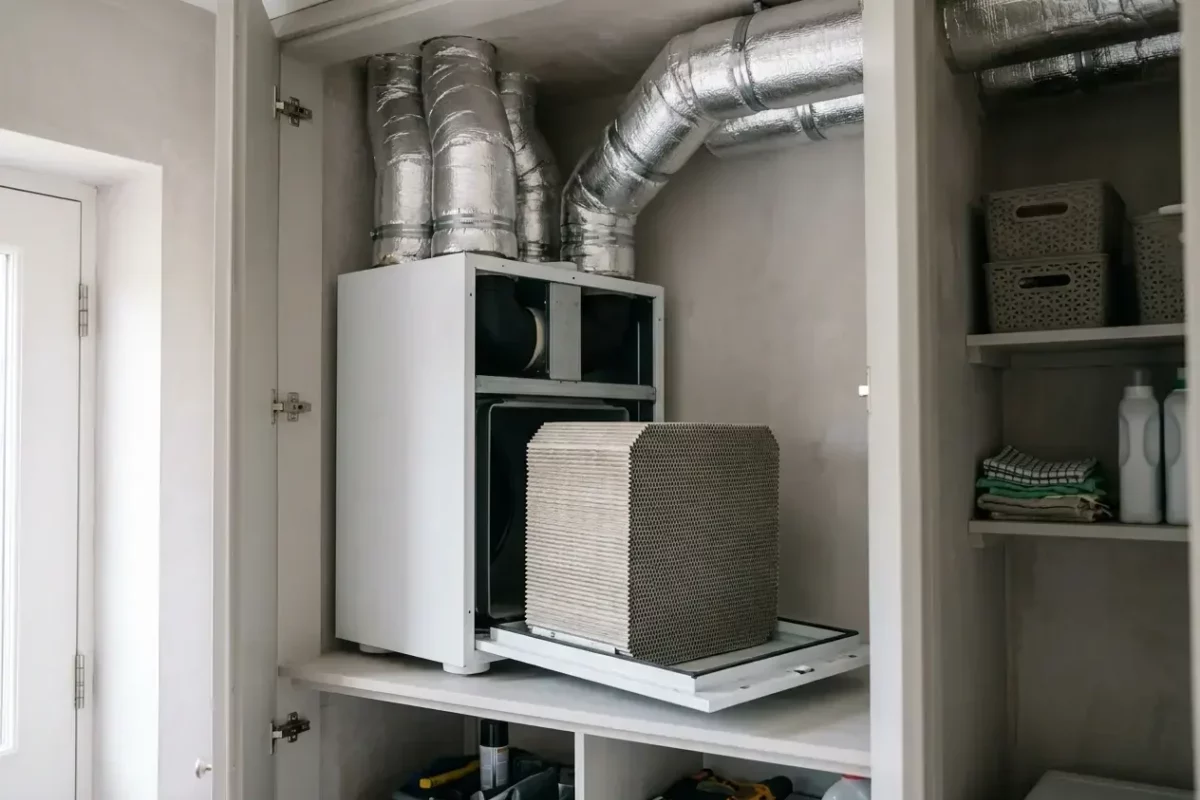
If you are planning an airtight home, you will be offered MVHR with a heat pump as a package. The two do work well together, but they do different jobs. MVHR (mechanical ventilation with heat recovery) takes heat out of the air leaving the house and puts it into the fresh air coming in. The heat pump still supplies all the space heating and, in most homes, the hot water. Getting the pairing right means treating them as one design problem, because the ventilation plan changes the heat loss your heat pump has to be sized for.
This guide is for new-build buyers, self-builders and developers planning for the Future Homes Standard, which applies from March 2027, and for homeowners whose deep retrofit will leave the house much tighter than it was. It ends with a clear view on when the pairing earns its cost.
MVHR and a heat pump in short
- They do different jobs. MVHR ventilates and recovers heat from outgoing air; the heat pump does all the heating and hot water.
- MVHR shrinks the heat load in an airtight home, so the heat pump and emitters can be smaller. Use realistic efficiency figures in the calculation.
- It is not a heating system. Every room still needs its own radiator or underfloor loop.
- Installation decides performance: unit inside the heated envelope, short insulated ducts, a summer bypass and balanced airflow.
- New build: usually worth it. Retrofit: only if the house tests airtight and the ducts fit without major work.
What MVHR does in a house, and what it leaves to your heating
An MVHR system is a box with two fans and a heat exchanger, connected to a network of ducts. One set of ducts pulls stale, humid air from the wet rooms: kitchen, bathrooms, utility and WC. The other set delivers fresh filtered air from outside to the bedrooms and living spaces.
Inside the box, the two airstreams pass on either side of thin plates, so heat transfers from the outgoing air to the incoming air without the two mixing. In winter, air that would arrive at near outdoor temperature arrives much closer to room temperature. Manufacturers quote heat recovery efficiencies in the high 80s and above under test conditions. Installed performance is lower and depends heavily on how well the ducts are designed, insulated and balanced.
What MVHR leaves to your heating system is everything else: the heat lost through walls, roof, floor and glazing, the small amount of heat lost through unavoidable leakage, the portion of ventilation heat the exchanger does not recover, and all of your hot water. The heat pump covers all of it.
| Heat demand in an airtight home | Who covers it |
|---|---|
| Heat lost through walls, roof, floor and glazing | Heat pump |
| Ventilation heat loss | Mostly recovered by MVHR; the heat pump covers the rest |
| Air leakage through the remaining gaps | Heat pump |
| Hot water | Heat pump (MVHR has no effect) |
| Fresh air and moisture removal | MVHR |
Why an airtight home needs controlled ventilation
A leaky house ventilates itself badly. Air finds its way through gaps around windows, floors and service penetrations, and the rate changes with wind and temperature. Some rooms get too much air, and others too little.
When you build or retrofit to a high standard of airtightness, those gaps are sealed on purpose. That saves heat, but moisture from cooking, showering and breathing now has nowhere to go. Humidity builds, condensation forms on cold surfaces, and mould follows. Carbon dioxide, cooking smells and chemicals released by furnishings and finishes also accumulate.
Ventilation therefore has to be designed in. Building Regulations guidance in Approved Document F recognises several ways of doing it, including continuous mechanical extract and balanced systems with heat recovery. Opening windows is not a ventilation strategy for a sealed house, because nobody opens windows in January at 3am when the air is stale, and the heat goes out with the air when they do.
If you plan a wood burner or any appliance that draws combustion air from the room, tell your designer early. It changes the ventilation design and the airtightness approach. Heat pumps have no flue and no such requirement.
How MVHR changes the heat load your heat pump has to meet
In a poorly insulated house, fabric losses dominate and ventilation is a minor part of the total. As insulation and airtightness improve, fabric losses fall and ventilation becomes a much larger share of what remains. That is where heat recovery matters: it cuts the largest remaining loss.
The effect shows up in the heat loss calculation. Each room is calculated for the coldest design day, using a standard method such as BS EN 12831, and the ventilation rate and heat recovery efficiency you enter go straight into the result. A lower design heat loss means a smaller heat pump, lower flow temperatures to the emitters, and usually a better seasonal efficiency. Low-temperature emitters such as underfloor heating or oversized radiators suit this kind of house well.
Three cautions apply here:
- Use realistic figures. Entering the manufacturer’s best-case efficiency produces an optimistic heat loss. Use the efficiency from the product’s certified test data for the duct configuration you are installing, and ask the designer to show which figure they used.
- Check the smallest heat pump available. Every heat pump has a minimum output. If the home’s heat loss is very low, the smallest unit may still be larger than the house needs on a mild day, and it can start and stop repeatedly. Ask the installer about the unit’s modulation range, not only its peak output.
- Hot water does not change. MVHR has no effect on cylinder reheating. The heat pump, cylinder size and any legionella cycle need designing as normal.
Where the house is a self-build, the choice between air source and ground source also interacts with the load. Our guide to air source versus ground source for a new build covers how site conditions and cost play into that decision.
MVHR is not a heating system, and the mistake of expecting it to warm rooms
The most common misunderstanding is that a house with MVHR does not need much heating, or that the system can distribute warmth around the house. It cannot do either reliably.
The supply air is tempered. On a freezing day it arrives at a temperature close to the room’s, but not above it. The volume of air that can sensibly be moved for ventilation carries very little heat compared with what a room needs on a cold day. Forcing more air through to warm a room means draughts, dry air and noise, plus higher fan electricity use.
Some units can be fitted with an electric duct heater to warm the incoming air. This turns a ventilation system into a resistance heater, using one unit of electricity for one unit of heat, where a heat pump gives several. Specifying one to compensate for an undersized heating system is a design error.

Every habitable room still needs its own heat emitter or heated floor loop, sized to its own calculated loss. Bathrooms, bedrooms in a cold spell and any room above a garage deserve particular attention. If a designer tells you the house will not need radiators because it has MVHR, ask to see the room-by-room heat loss figures behind that claim.
Design choices that make the pair work
MVHR performance is decided largely by installation. A good unit badly installed delivers poor results. Most complaints about noise, draughts and high running costs trace back to a handful of design decisions.
Unit location
Put the unit inside the insulated, heated envelope: a utility room, plant cupboard or airing cupboard. A unit in a cold loft loses heat through its casing and ducts, suffers condensation, and is hard to reach for filter changes. Where a loft is the only option, the unit and every duct need thick insulation and a properly sealed vapour barrier.

Allow clear space to open the unit, remove the heat exchanger and reach the condensate drain. The drain needs a fall and a trap, and it must not run through places that can freeze.
Ducting
Short, straight and smooth ducts move air quietly with little fan energy. Long runs with many bends need larger fans, which cost more to run and are noisier. Rigid or smooth-bore semi-rigid duct performs better than flexible corrugated duct. Ducts running through unheated spaces need insulation because otherwise the recovered heat leaks out on the way to the room.
Intake and exhaust terminals must be positioned so exhaust air is not drawn back into the intake. Sound attenuators on the supply and extract ducts, particularly those serving bedrooms, keep fan and airflow noise down.
Summer bypass
In warm weather, recovering heat is unwanted. A summer bypass lets air skip the heat exchanger, so cool night air can flow through without being warmed by the outgoing air. Check that the unit has an automatic bypass and that it is commissioned correctly. Bypass is not air conditioning, though. It will not cool a house that has overheated from large south-facing glazing, and that needs solving through the building design.
Commissioning
Commissioning is the part most often skimmed. The installer should measure airflow at every valve and balance the system so each room receives the design rate, then record the results on a commissioning sheet. Without balancing, some rooms are over-ventilated, others under-ventilated, and the system uses more energy than it should.
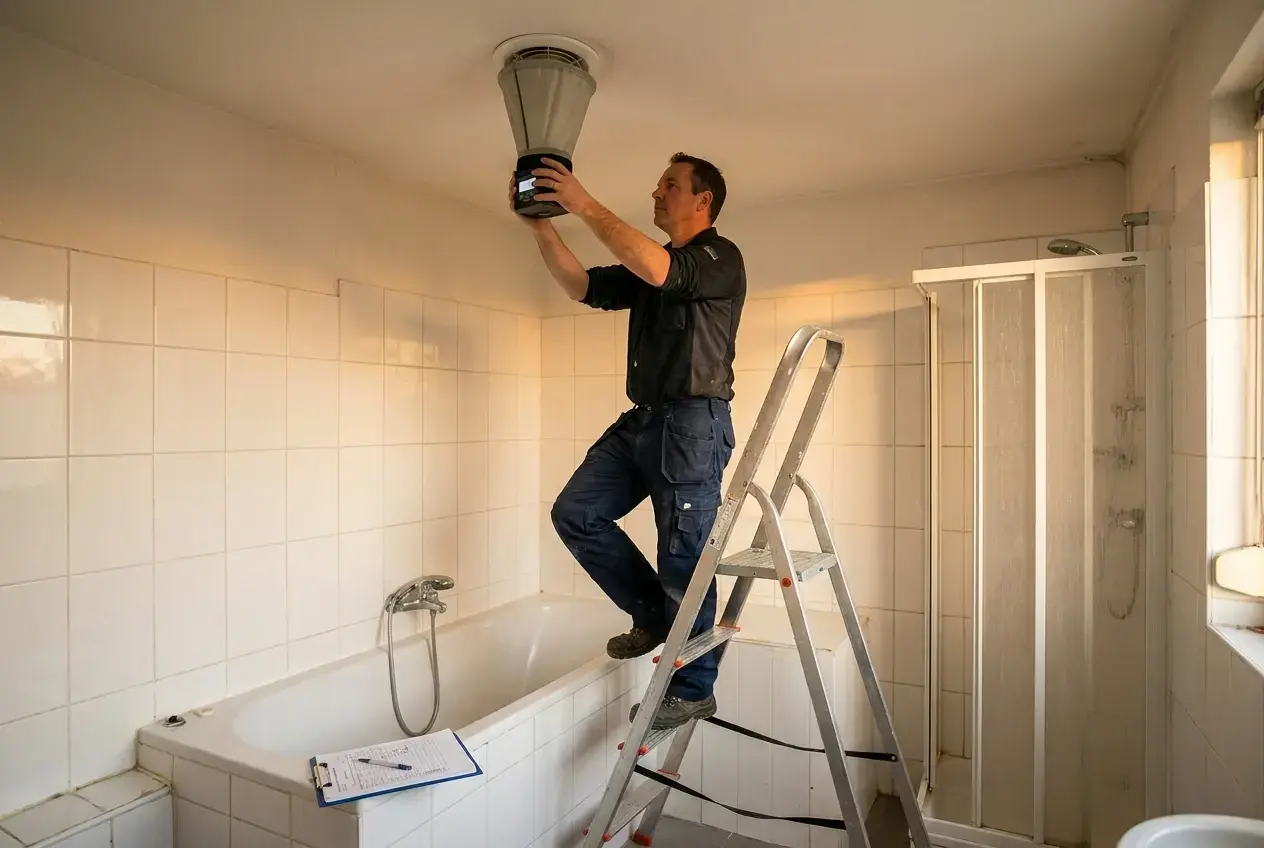
Also ask how the unit handles frost. In very cold weather, moisture in the extract air can freeze in the heat exchanger. Units manage this by reducing supply air, by briefly changing fan balance, or with an electric preheater. A preheater is acceptable if it only runs on the coldest days, but it adds to electricity use and should be accounted for in the running cost.
Running costs and upkeep: filters, servicing, noise and who looks after what
MVHR runs continuously, so the fans use electricity all year. Modern units with efficient motors use little power per hour, but over twelve months it is a real cost that offsets part of the heat saving. Duct design has a large bearing on this, which is another reason to keep runs short.
Filters. These are the main routine jobs. Dirty filters restrict airflow, raise fan power and let dust into the ducts. Manufacturers specify an interval, commonly somewhere between six and twelve months, and many units show a reminder. Replacement filters are inexpensive, but check before buying the unit that they are readily available and that you can fit them yourself. A system that is awkward to service tends not to get serviced.
Heat exchanger and ducts. The exchanger usually needs an occasional clean, following the manufacturer’s instructions. Ductwork is generally left alone unless there is a reason to inspect it, such as a building defect or contamination.
Noise. A well-designed system is barely audible in living rooms and bedrooms. If you can hear it, the cause is typically a fan speed set too high, undersized ducts, a missing attenuator, or a unit fixed rigidly to a wall without anti-vibration mounts. All of these are fixable by the installer.
Who looks after what. Ask this before you sign. The heat pump installer and the MVHR installer are often different companies, and when something goes wrong in a house with both, each can point at the other. Agree who commissions each system, who holds the commissioning records, who handles warranty claims, and who does the annual check. For the heat pump side, our guide to what happens in a heat pump service sets out what to expect each year.
Retrofit or new build: when MVHR earns its place and when it does not
New build. For a home built to a high airtightness standard, MVHR is usually a sound choice. The ducts can be planned into the structure from day one, which keeps runs short and costs sensible. The reduced ventilation heat loss also lets the heat pump and emitters be sized smaller. Developers working towards the Future Homes Standard will find the combination fits the direction of travel, and our explainer on the Future Homes Standard sets out what changes in March 2027. Self-builders should also read our guide to self-build heating before the Future Homes Standard starts.
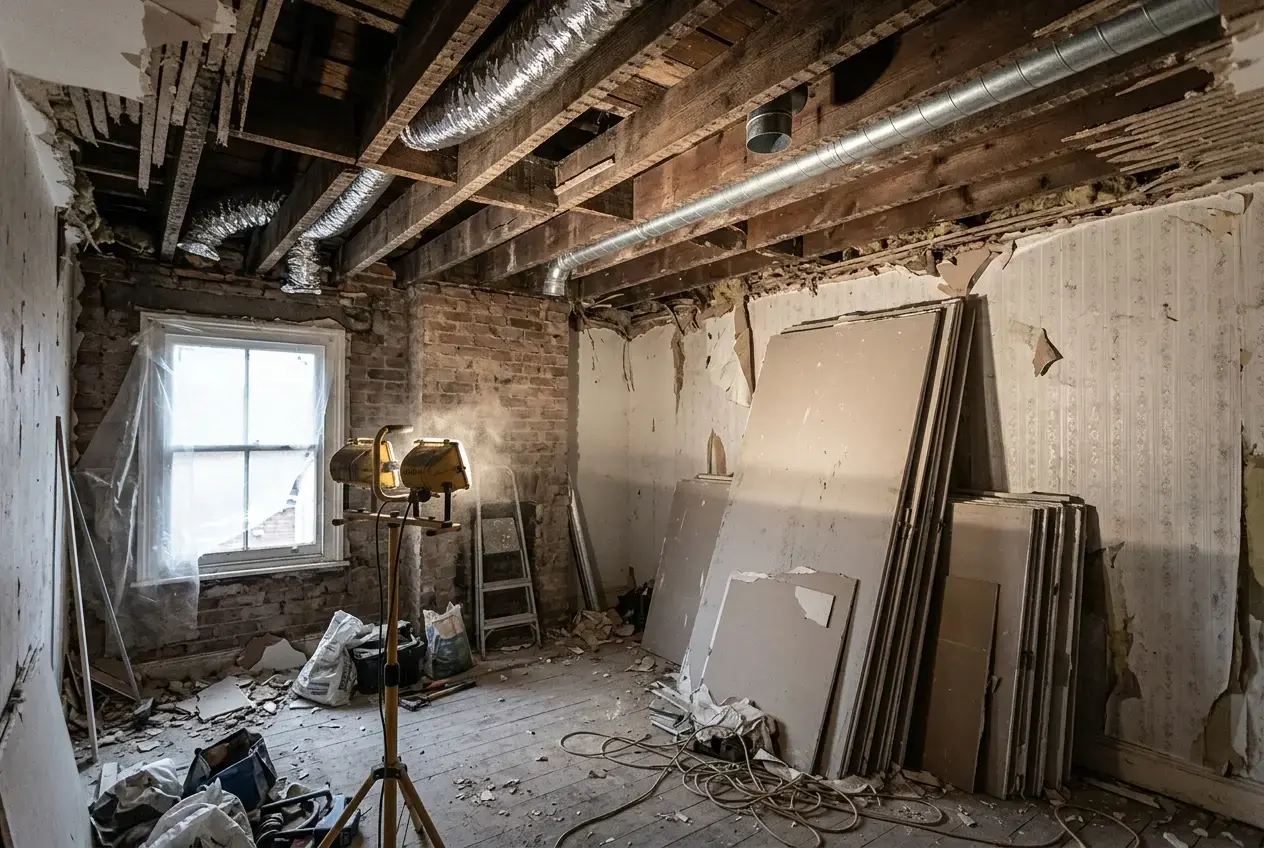
Deep retrofit. MVHR can work in a retrofit, but only when two conditions hold. First, the house must reach a good level of airtightness, confirmed by a test, because heat recovery only works on air that passes through the unit. Where air leaks in and out through gaps, the exchanger recovers heat from only a fraction of the total. Second, there must be somewhere to run the ducts. In a typical existing house with no spare voids, ducting means boxing in ceilings, losing cupboard space or lifting floors, and the cost and disruption climb quickly.
Where ducting is impractical, alternatives exist: continuous mechanical extraction, which pulls air from wet rooms and lets fresh air in through controlled wall vents, or decentralised units fitted through external walls. They recover less heat, or none, but cost less and are much easier to fit.
| Ventilation system | Heat recovery | Ducting | Typical fit |
|---|---|---|---|
| Whole-house MVHR | Yes, most of the outgoing heat | Supply and extract ducts to every room | Airtight new builds; deep retrofits with space for ducts |
| Continuous mechanical extract (MEV) | None (unless paired with an exhaust air heat pump) | Extract ducts from wet rooms only | New builds and retrofits where supply ducts will not fit |
| Decentralised extract fans (dMEV) | None | None; fans fitted in wet room walls or ceilings | Retrofits; simple and cheap |
| Single-room heat recovery units | Some, room by room | None; units fitted through external walls | Retrofits where whole-house ducting is impractical |
| Background vents and intermittent fans | None | None | Leakier houses; not suited to very airtight homes |
MVHR earns its place when
- the house is a genuinely airtight new build, or a retrofit that has tested tight
- the ducts can be planned into the structure, with short, straight runs
- the unit can sit inside the heated envelope, with room to service it
- the designer uses the recovered heat to size a smaller heat pump and emitters
It is an expensive add-on when
- the house is only moderately airtight, so most air exchange bypasses the unit
- the layout forces long, complicated duct runs
- the home is small and well insulated enough that the heating savings are modest against the installation and maintenance cost
- the budget is better spent on insulation, glazing or correcting airtightness first
For a landlord weighing ventilation against fabric work, the comparison in heat pump versus insulation for the cheapest route to EPC C shows how to weigh that kind of choice.
My verdict: in a genuinely airtight new build, MVHR with a heat pump is a sensible pairing, provided the design and commissioning are done well. In a retrofit, it is worth the money only when the house tests tight, and the ducts fit without heroics. Otherwise a simpler ventilation system and a correctly sized heat pump will deliver most of the benefit for less.
Questions to put to your designer and installer before you sign
Take these to the designer and to each installer. The quality of the answers tells you a good deal about the quality of the work.
- What ventilation rate and heat recovery efficiency did you use in the heat loss calculation, and where did the efficiency figure come from?
- Can I see the room-by-room heat loss and the emitter sizing for each room?
- What is the heat pump’s minimum output, and how does it behave on a mild day when the house needs very little heat?
- Where will the MVHR unit sit, and is it inside the heated envelope?
- How long are the longest duct runs, and what are they made of?
- How does the unit protect itself from frost, and does it use an electric preheater?
- Does the system have an automatic summer bypass?
- Will you balance the airflow and give me a signed commissioning record?
- How often do the filters need changing, how much do they cost, and can I fit them myself?
- Who is responsible for each system after handover, and who do I call if there is a fault with both?
If the answers are vague, treat that as a warning. A designer who has done the calculation can answer all ten quickly.
MVHR and heat pump questions
Do I need MVHR with a heat pump?
No. A heat pump works with any ventilation system. MVHR becomes worthwhile when the house is airtight enough that ventilation is a large share of the remaining heat loss, which is usually a well-built new home or a deep retrofit.
Can MVHR heat my house?
Not on its own. The supply air arrives close to room temperature but carries little heat. Every room still needs a radiator or underfloor loop sized to its heat loss.
How much electricity does MVHR use?
The fans run all year, so there is a steady electricity cost. Efficient units with short, well-designed duct runs keep it low; long runs, dirty filters and high fan speeds push it up.
How often do MVHR filters need changing?
Most manufacturers recommend every six to twelve months. Filters are inexpensive and on most units you can change them yourself; check this before you choose a unit.
Can I fit MVHR in an existing house?
Sometimes. The house needs to reach a good level of airtightness, confirmed by a test, and there must be somewhere to run the ducts. Where that is not practical, extract-only systems or single-room heat recovery units are simpler options.
Getting a heat pump sized around your ventilation plan
Once you have a ventilation design, whether MVHR or a simpler system, the heat pump should be sized to match it. If you want an installer to do that, you can request a heat pump quote and share your ventilation plan with them. Before you accept any proposal, read the guide on how to vet a heat pump installer, so you know what quality looks like beyond the headline price.